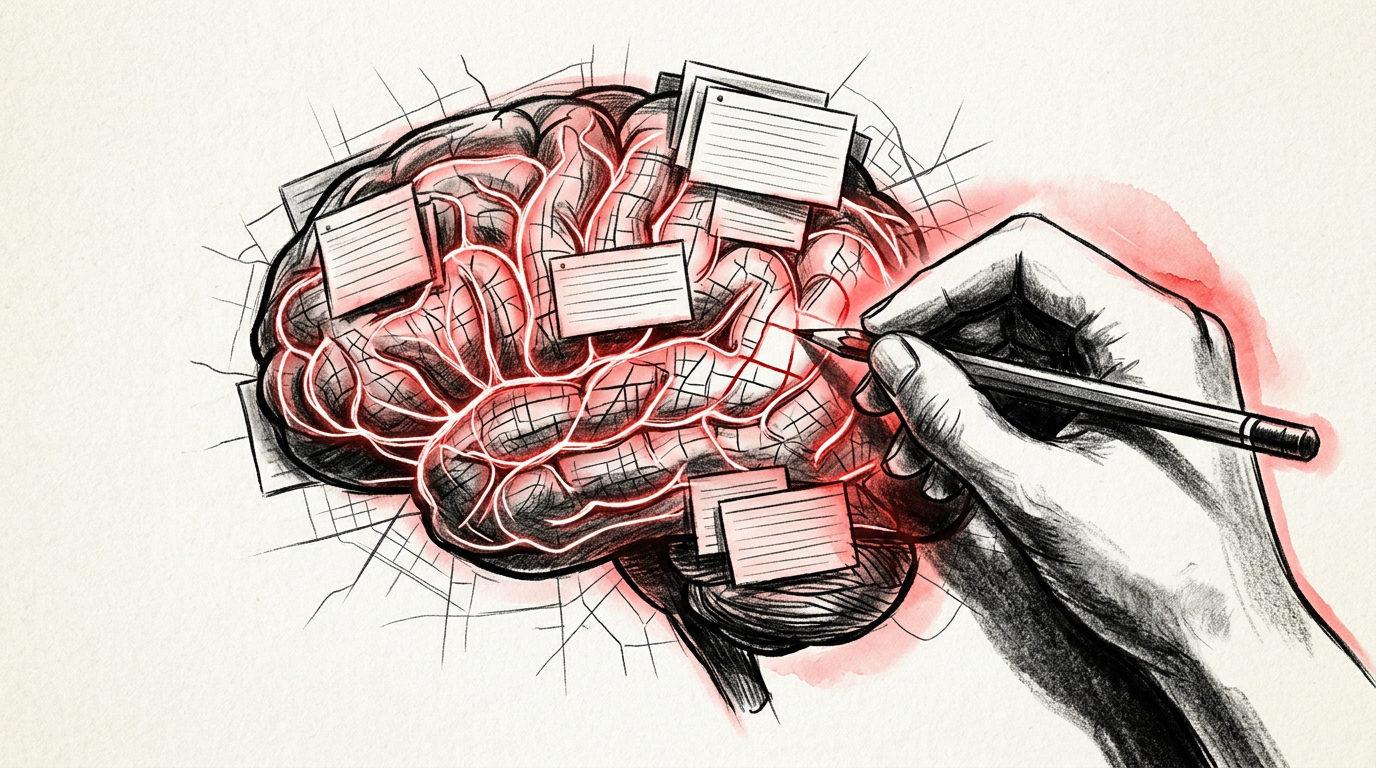
Your memories are rebuilt, not replayed
Scene: the coffee cup you almost lost
You walk into the kitchen, open a cabinet, and stop. Why are you here?
A few seconds later, the answer pops back: coffee. You grab the mug, and with it comes a small chain of details. The email you were reading. The meeting in 12 minutes. The fact that you slept badly. Nothing magical happened. Your brain stitched together a purpose from scattered clues.
That small kitchen glitch is memory doing its normal work. Not failing in some dramatic way. Working.
Memory feels like a recording because it often arrives with sights, sounds, faces, and emotion. A birthday dinner can come back with the clink of forks and the smell of garlic. Your first apartment might bring back the exact angle of afternoon light on the floor.
The trap is thinking the brain stores these moments like files in a folder. It does not. Memory is not a tiny movie sitting behind your forehead. It is an active biological process that rebuilds parts of the past using cells, connections, context, and expectation.
That is stranger than the movie idea. It is also more useful.
What it actually is
A memory is a pattern of activity and connection across brain cells.
The brain is made of neurons, which are nerve cells that send signals to one another. They meet at tiny gaps called synapses. A synapse is not just a wire. It is more like a busy handoff point where chemistry changes the chance that one neuron will make another neuron fire.
When you experience something, groups of neurons become active together. Some respond to visual details. Others track sound, body position, emotion, language, or meaning. If the experience matters enough, or repeats enough, some of the connections among those neurons change. That change is the beginning of memory.
The classic shorthand comes from psychologist Donald Hebb, who wrote about this idea in 1949. People often summarize it as: neurons that fire together wire together. The exact biology is more complicated, but the core idea holds. Repeated joint activity can make certain neural pathways easier to activate later.
Several systems help memory happen:
- Working memory is the mental scratchpad. It holds a phone number long enough to type it, or the start of a sentence while you finish reading it. Psychologists Alan Baddeley and Graham Hitch proposed an influential model of working memory in 1974.
- The hippocampus is a curved structure deep in the brain that helps bind pieces of an experience into a memory. It is especially important for new memories of events and facts.
- The cortex is the brain’s outer layer. Over time, many long-term memories become more distributed across cortical regions.
- The amygdala helps tag experiences with emotional importance, especially fear and threat. That is one reason scary moments can feel sticky.
The most famous clue came from patient H.M., whose real name was Henry Molaison. In 1953, surgeons removed parts of his medial temporal lobes, including much of the hippocampus, to treat severe epilepsy. In 1957, surgeon William Scoville and psychologist Brenda Milner reported that H.M. could no longer form many kinds of new long-term memories, even though his intelligence and short-term conversation remained surprisingly intact.
H.M. changed neuroscience. He showed that memory is not one single thing stored in one single place. The brain has different memory systems, and they can break apart.
Why it matters
Memory is not just about the past. It is how you function in the present.
You use memory to recognize your neighbor, avoid touching a hot pan, understand jokes, find your car, trust a friend, speak a language, and know what kind of person you think you are. Without memory, every moment would arrive without handles.
It also matters because memory is editable.
That does not mean every memory is fake. It means remembering is an act of reconstruction. When you recall an event, your brain does not simply press play. It rebuilds the scene from stored traces, current context, emotion, and knowledge you gained later.
Psychologist Elizabeth Loftus showed this powerfully in the 1970s. In a well-known 1974 study with John Palmer, participants watched films of car accidents and answered questions about them. The wording mattered. People estimated different speeds depending on whether the cars had “hit,” “smashed,” or “contacted” each other. Later, some were more likely to report seeing broken glass when stronger wording had been used, even when there was no broken glass.
The point is not that humans are foolish. The point is that memory is optimized for usefulness, not courtroom-level playback.
Daniel Kahneman’s idea of fast and slow thinking helps here. Your fast, intuitive mind wants a coherent story quickly. Memory often serves that need. It fills gaps, smooths rough edges, and makes the past feel more complete than it really is. That can help you make decisions quickly. It can also make you overconfident.
This is why eyewitness testimony can be fragile, why family arguments about “what really happened” can feel impossible, and why two honest people can remember the same dinner differently.
The simplest analogy that works
Memory is less like a video and more like a recipe card covered in notes.
A video tries to preserve every frame. A recipe stores instructions for rebuilding something later. It tells you the ingredients, the order, the heat, and a few warnings: more salt, less time, do not burn the onions.
When you remember your high school graduation, your brain is not retrieving a complete recording. It is pulling out ingredients:
- the gym or stadium
- a face in the crowd
- your body feeling awkward in the gown
- a song
- the meaning of the day
- a later story your family told about it
Then the brain cooks the memory again.
Most of the time, this works well enough. You do not need every frame of graduation. You need the gist, the emotional meaning, and a few useful details. Memory compresses life so you can carry it.
Computer analogies can help, but only up to a point. The brain is not a hard drive. A file on a laptop can sit unchanged if nobody opens it. A memory can change when you recall it. Scientists call this reconsolidation: after a memory is reactivated, it can become temporarily flexible before being stored again.
That flexibility is not a bug. It lets the brain update old knowledge. If a dog scared you as a child but you later meet gentle dogs, your brain can slowly revise the old fear. Therapy often depends on this kind of updating.
A better everyday object might be a city map with pencil marks. The streets are real. The marks guide you. But each trip adds new shortcuts, warnings, and landmarks. The map changes because you keep using it.
A simple five-step way to think about a memory
Memory formation is often described in stages. The stages overlap, but this version is clean enough to use.
1. Attention opens the gate
Your brain cannot store everything. Attention decides what gets a real chance.
If you are texting while someone gives you directions, the directions may never become a durable memory. The problem is not retrieval. The memory may not have been encoded well in the first place. Encoding means turning an experience into a brain pattern that can be stored.
Attention is the bouncer at the door.
2. Emotion adds a highlighter
Emotion tells the brain, “This may matter.”
The amygdala helps strengthen memories tied to danger, reward, embarrassment, surprise, and attachment. That is why you may forget a routine Tuesday but remember the moment your boss praised you, your car nearly got hit, or your child said something brutal and funny at dinner.
B.J. Fogg’s behavior model says behavior depends on motivation, ability, and prompt. Memory is not the same as behavior, but the lesson rhymes: a signal sticks better when the brain has a reason to care and a cue that points to it.
3. The hippocampus binds the pieces
A single event has many parts. The hippocampus helps link them.
Think of it as a temporary index. Not the whole book. More like the card that says which shelves to check. It binds the face, room, smell, sentence, and feeling into something you can later call “that dinner.”
Damage the hippocampus, as H.M.’s case showed, and new event memories become much harder to form.
4. Sleep helps stabilize the trace
Sleep is not just downtime. It is active maintenance.
During sleep, especially slow-wave sleep, the brain appears to replay and reorganize recent experiences. This helps stabilize memories, connect them with older knowledge, and discard some noise.
That is why cramming all night can backfire. You may expose your brain to the material, but you deny it one of the conditions that helps make learning durable.
5. Retrieval strengthens and reshapes
Pulling a memory back is not passive.
When you test yourself, explain a concept to a friend, or find your way without GPS, you are practicing retrieval. That act can strengthen the memory. It can also update it.
This is why rereading feels easier than it deserves. It gives you familiarity, not necessarily recall. A blank page, a practice quiz, or teaching the idea out loud forces the brain to rebuild the path.
Common misconceptions
“Memory works like a camera”
It feels that way because vivid memories have sensory detail. But vivid does not always mean accurate. Confidence and accuracy are related sometimes, but they are not the same thing.
A memory can be emotionally true and factually distorted. That is uncomfortable. Also very human.
“There is one memory center in the brain”
The hippocampus matters a lot, but memory is distributed. Skills, facts, emotions, habits, and events rely on partly different systems.
Riding a bike is not stored the same way as remembering the capital of Oregon or recalling your first concert. This is why H.M. could learn some motor skills without remembering the practice sessions.
“Forgetting is always failure”
Forgetting is often housekeeping.
A brain that stored every detail equally would be buried in junk. You need to forget where you parked last month so you can remember where you parked today. Useful memory requires filtering.
Hermann Ebbinghaus, a German psychologist, studied his own memory in the 1880s and published work in 1885 showing that forgetting often happens quickly at first, then slows. His “forgetting curve” is still a useful reminder: memory fades unless it is revisited or made meaningful.
“Repetition alone creates learning”
Repetition helps, but mindless repetition is weak.
Spacing, meaning, retrieval, and feedback matter. Saying a name five times while anxious at a party may not work. Connecting it to a face, using it in conversation, and recalling it later gives the brain more hooks.
“Old memories are fixed”
Some memories feel carved in stone. Biology is messier.
Every recall can slightly refresh the trace. That does not mean your childhood is constantly rewritten from scratch. It means memory has both stability and flexibility. The same quality that creates error also allows healing, learning, and perspective.
What scientists can actually track
Researchers cannot watch a complete memory as if it were a movie on a screen. They infer memory from behavior, brain activity, and cellular change.
Common tools include:
- Recall tests, where someone produces information without seeing it first.
- Recognition tests, where someone identifies something they have seen before.
- Reaction time, which can reveal familiarity even when a person cannot explain it.
- Brain imaging, such as fMRI, which tracks changes related to blood flow as brain regions work.
- Electrophysiology, which measures electrical activity in neurons or brain areas.
- Synaptic plasticity, the ability of synapses to strengthen or weaken over time.
Eric Kandel’s work with the sea slug Aplysia helped show how learning can change synapses at a cellular level. He began that line of research in the 1960s and later shared the 2000 Nobel Prize in Physiology or Medicine. The animal was simple enough to study, but the lesson was huge: memory has a physical footprint.
Not a glowing file. Not a tiny photograph. A changed probability that certain cells will activate together again.
Key takeaways
- Memory is a rebuilt pattern, not a replayed recording.
- The hippocampus helps bind new event memories, but memory is spread across multiple brain systems.
- Emotion, attention, sleep, and retrieval all affect what sticks.
- Forgetting is not always a flaw; it helps the brain filter what matters.
- Vivid memories can still be wrong, especially when later information reshapes them.
- The best way to make something memorable is to give it meaning, revisit it with spacing, and practice pulling it back without hints.
The brain does not preserve your life like a security camera. It keeps a working model of what has mattered, what might matter again, and what can be safely ignored.
That model is imperfect. It is also the reason you can learn from pain, recognize home, forgive someone, fear the right things, and become a slightly different person after a single sentence lands at the right time.
Discussion (0)
Loading comments…