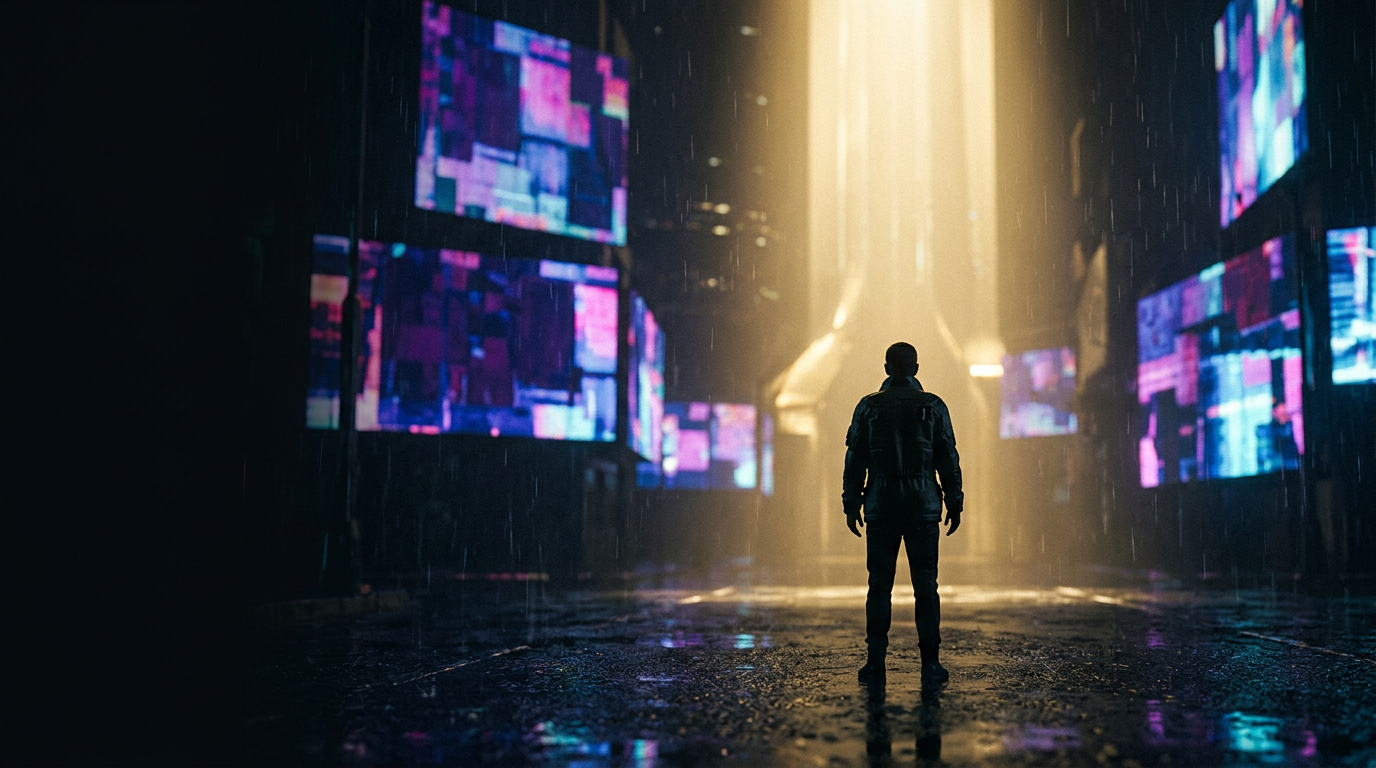
Devs makes the universe look guilty
A dead mouse appears on a screen, then moves backward into life. That is the whole sermon.
Alex Garland’s Devs, the 2020 FX on Hulu limited series, has aged better than almost any prestige sci-fi of its streaming moment because it does not confuse scale with intelligence. It has no galactic senate, no franchise homework, no cute robot sidekick, no lecture about saving humanity. Its central image is simpler and nastier: a machine that might tell you the truth, and a roomful of people ruined by the possibility.
The angle that still makes Devs feel current in 2026 is not merely quantum computing, though the show gives that phrase a gorgeous, gold-plated menace. It is the simulation hypothesis as an aesthetic problem. What would reality look like if it could be rendered? What would human behavior look like if it could be predicted? And what kind of person would build a screen big enough to mistake for God?
Garland, who made Ex Machina and Annihilation, has always been better at dread than warmth. Here, that limitation becomes part of the design. Devs is chilly, solemn, sometimes maddeningly stiff. It also understands something most screen sci-fi gets wrong: the terrifying thing about a simulated universe is not that life becomes fake. It is that life becomes legible.
Why it matters now
The last few years have been crowded with tech anxiety dressed in expensive lighting. Apple TV+ has leaned into institutional sci-fi with Severance, Silo, and Foundation. Netflix turned Liu Cixin’s cosmic paranoia into 3 Body Problem. Black Mirror keeps resurfacing whenever the culture needs a mirror with fingerprints on it. Meanwhile, the theatrical revival of ambitious science fiction — from Denis Villeneuve’s Dune films to Christopher Nolan’s IMAX-scale metaphysics in Oppenheimer and the lingering shadow of Interstellar — has reminded studios that audiences will sit still for big ideas if the craft has muscle.
Devs belongs in that conversation, but it is stranger than most of its peers. It is not a future-world epic. It is not cyberpunk, despite its corporate paranoia. It is not hard sci-fi in the documentary sense, because Garland is not trying to make a training video for quantum engineers. It is closer to a technological ghost story: Silicon Valley as cathedral, code as scripture, grief as venture capital.
That matters because the simulation hypothesis has become one of pop culture’s laziest shortcuts. Too often, it is used as a trapdoor: the world is fake, therefore anything goes. The Matrix earned its iconography by fusing cyberpunk, Hong Kong action, Gnostic myth, and late-capitalist office horror into one clean bullet-time scream. Many imitators settled for the twist. Devs does something less flashy and more corrosive. It asks what happens when the idea of a rendered reality becomes a corporate product.
The show arrived before the current AI boom fully colonized dinner-table conversation, but it now plays like a premonition of our algorithmic mood: prediction masquerading as understanding, pattern recognition sold as wisdom, surveillance softened by design language. In Devs, the future does not announce itself with chrome. It wears a fleece vest and speaks calmly.
What it gets right
!A glowing research campus sits uneasily among redwoods at dusk
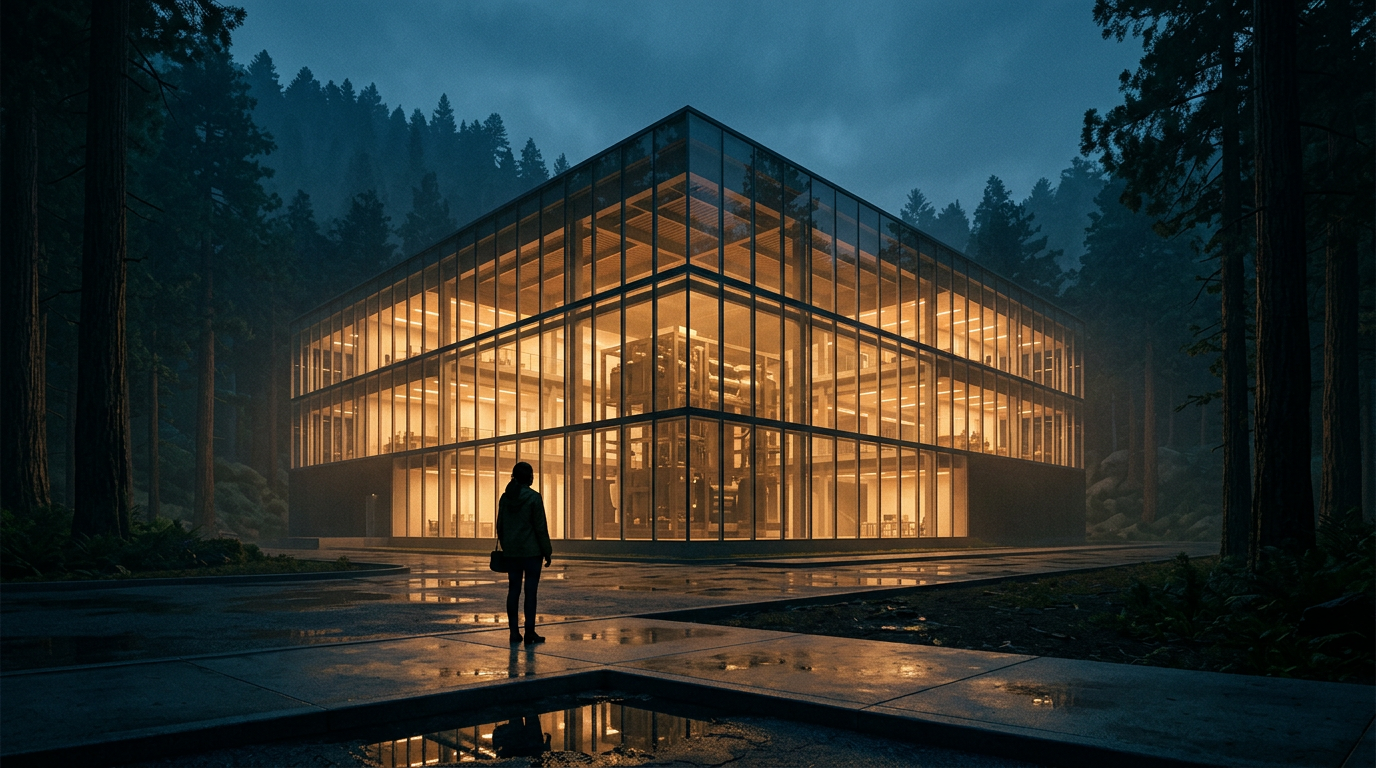
Garland and cinematographer Rob Hardy give Devs one of the most coherent visual grammars in recent television sci-fi. The Amaya campus is all soft lawns, redwoods, glass, and impossible serenity. Then there is the Devs unit itself: a suspended golden cube inside a vacuum-sealed chamber, less workplace than reliquary. The mise-en-scène says the quiet part aloud. This is a company town built around a forbidden chapel.
Nick Offerman’s Forest, the tech billionaire behind Amaya, is one of the show’s sharpest inventions. Offerman resists the obvious cartoon version of the role. Forest is not a strutting disruptor or a hoodie tyrant. He is wounded, depleted, almost priestly. His power comes from grief curdled into certainty. He does not want to change the world. He wants the world to confess that it could never have been otherwise.
Sonoya Mizuno’s Lily Chan gives the series its human vector. Lily is a software engineer pulled into the secret center of Amaya after a personal catastrophe involving her boyfriend, Sergei, played by Karl Glusman. Mizuno’s performance is intentionally guarded, sometimes to a fault, but her stillness has a purpose. Lily moves through the show like someone trying not to become another data point.
The sound design and score do enormous work. Ben Salisbury, Geoff Barrow, and The Insects create music that feels half-liturgical, half-industrial: choral voices, low drones, metallic pulses. It is not there to goose action beats. It turns computation into ritual. When Devs is at its best, the score and image collaborate so closely that the machine seems to be dreaming the show into existence.
Most importantly, Devs treats the simulation hypothesis as a moral wound rather than a Reddit argument. The show is not especially interested in whether we are literally living inside someone else’s computer. Its deeper obsession is determinism: if every cause produces an inevitable effect, then guilt, love, betrayal, and sacrifice start to look like user-interface labels slapped onto physics. That is a brutal idea for drama, because drama depends on choice. Garland leans into the contradiction. He makes a series about free will that keeps threatening to abolish character.
What it gets wrong / where it stumbles
The same severity that gives Devs its power also limits it. Garland’s dialogue can sound like people speaking from inside a philosophical brochure. Characters pause, stare, and deliver clean little slabs of argument. Sometimes that works; scientists and engineers do, in fact, say strange things in sterile rooms. Sometimes it turns human beings into mouthpieces with excellent lighting.
Lily is the show’s most frustrating case. Mizuno has presence, intelligence, and a fascinating opacity, but the writing often asks her to function less as a person than as a variable in Forest’s cosmic equation. Her grief, suspicion, anger, and courage are all present, yet the show withholds texture. We learn more about what Lily means to the machine than what she means to herself.
There is also a thriller problem. Devs begins with corporate espionage and paranoia, but its procedural machinery is less persuasive than its metaphysical dread. Jin Ha’s Jamie, Alison Pill’s Katie, Zach Grenier’s Kenton, and Stephen McKinley Henderson’s Stewart all bring welcome specificity, yet the show sometimes moves them around like pieces in a proof. The blocking can be hypnotic; the plotting can be rigid.
That rigidity is not accidental, of course. A deterministic drama should feel trapped. But intention does not cancel effect. At eight episodes, Devs occasionally stretches a feature-film idea across prestige-TV acreage. The slowness is often earned. Not always.
[SPOILERS AHEAD]
The bigger idea
!Two silhouettes watch a ghostly particle figure on a lab screen
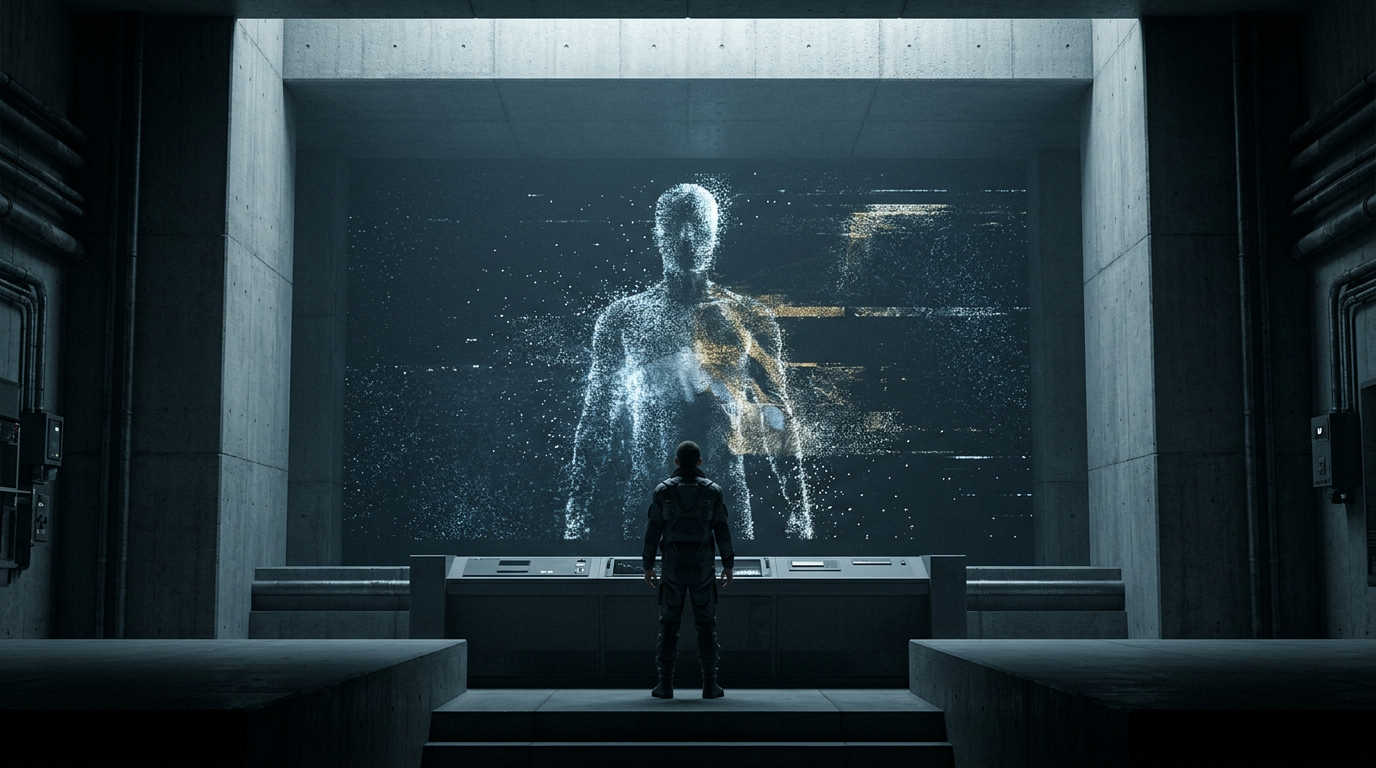
The most interesting thing about Devs is that its machine does not merely predict the future. It changes the meaning of watching.
Forest and Katie believe the Devs system can model reality backward and forward, reconstructing the past and projecting the future from the complete state of the universe. On screen, this becomes both miracle and violation. The machine shows Christ on the cross, Marilyn Monroe, private moments, dead loved ones. History becomes footage. Memory becomes surveillance. The past is no longer gone; it is simply low-resolution until the system improves.
This is where Devs finds its sharpest connection to the simulation hypothesis. Nick Bostrom’s famous argument asks whether advanced civilizations might run ancestor simulations, making simulated consciousness statistically likely. Garland’s series sidesteps the dorm-room smugness that often attaches to that idea. He cares less about proving the hypothesis than dramatizing its emotional consequence: if reality can be rendered, then privacy is an illusion, mystery is a technical limitation, and grief becomes a software problem.
The show’s most haunting move is its insistence that perfect prediction is a form of imprisonment. Forest’s longing for his dead daughter is understandable, even devastating. But his refusal of uncertainty becomes monstrous. He wants a universe where he is innocent because he had no choice. Determinism becomes absolution. The machine is not just a scientific instrument; it is a laundering device for guilt.
That is why the finale’s move into a simulated afterlife is both beautiful and troubling. Lily’s apparent act of defiance — throwing the gun, disrupting the predicted path — cracks the theological architecture. Then the series relocates Lily and Forest into a rendered continuation, a world inside the system where their lives can proceed under different conditions. It is a strangely tender ending, and also a little too neat. Garland gives his characters a digital purgatory with better lighting.
Still, the ambiguity holds. Is this mercy, imprisonment, or merely another layer of computation? The finale refuses the clean triumph of free will. Lily’s choice matters because it is experienced as choice. That may be the only freedom the show is willing to grant.
Devs among screen simulations
Compared with The Matrix, Devs is allergic to liberation fantasy. There is no red pill glamour here, no balletic gunplay, no chosen-one swagger. If the Wachowskis imagined simulation as a prison that could be seen through and fought, Garland imagines it as a theory that infects every room it enters.
Compared with Westworld, Devs is narrower and more disciplined. Westworld turned consciousness into a maze of loops, trauma, and corporate control, then expanded until its own mythology became a burden. Devs stays almost monastic. It has one campus, one machine, one wound.
Compared with Black Mirror, it is less satirical and more mournful. The episode “San Junipero” treats digital continuation as bittersweet possibility; Devs treats it as a metaphysical crime scene. Compared with Garland’s own Ex Machina, it is less elegantly built but more ambitious. Ex Machina is a chamber piece about manipulation, gender, and artificial consciousness. Devs is a cathedral piece about causality.
The closest recent cousin may be Severance, not because the premises match, but because both shows understand architecture as ideology. Lumon’s fluorescent corridors and Amaya’s golden cube are not backgrounds. They are belief systems in built form.
What to watch next if you liked this
Pair Devs with works that test reality without turning ambiguity into a party trick.
- Ex Machina — Garland’s tighter, colder film about artificial intelligence, performance, and captivity. Watch it after Devs to see how his interest in control systems began in miniature.
- Annihilation — A more sensuous and biological Garland film, where identity mutates instead of calculating itself.
- The Matrix — Still essential, especially as a contrast: simulation as action cinema, spiritual jailbreak, and cyberpunk fashion statement.
- Severance — Apple TV+’s great office-nightmare machine, with production design that weaponizes corporate blandness.
- Black Mirror: “San Junipero” — A useful double-bill because it asks whether a simulated life can be emotionally real without becoming sentimental mush.
- Westworld season one — The cleanest version of that show’s loop-and-consciousness premise, before the sprawl overtook the incision.
- Primer — Shane Carruth’s knotty microbudget time-travel film, still unmatched for making technical opacity feel like a moral atmosphere.
- Tales from the Loop — Softer, sadder, and more humane; a good comedown if Devs leaves you feeling trapped inside an equation.
For reading, start with Nick Bostrom’s 2003 paper “Are You Living in a Computer Simulation?” if you want the philosophical source code. Then read Ted Chiang’s “The Merchant and the Alchemist’s Gate” for a warmer, more humane approach to fate and choice. Chiang understands what Devs sometimes forgets: an idea only hurts if a person is allowed to bleed.
The verdict
Devs is not perfect television. It is too stiff in places, too enamored of its own solemnity, and not always generous to Lily as a character. But it remains one of the most intellectually serious sci-fi series of the streaming era because it knows that the simulation hypothesis is not really about pixels, servers, or whether the moon renders when nobody looks.
It is about responsibility.
Garland’s finest insight is that a total model of reality would not make us feel powerful. It would make us feel accused. Every image on the Devs screen looks like evidence. Every prediction looks like a sentence. The universe, rendered clearly enough, begins to resemble a courtroom.
That is why the show still lingers. Not because it solves free will. It does something more cinematic and more unnerving. It makes determinism visible, gives it production design, scores it like a funeral hymn, and lets us sit with the awful possibility that the machine is not lying.
Discussion (0)
Loading comments…