Dune made blockbuster sci-fi grow up again
The sandworm is not the point; the waiting is.
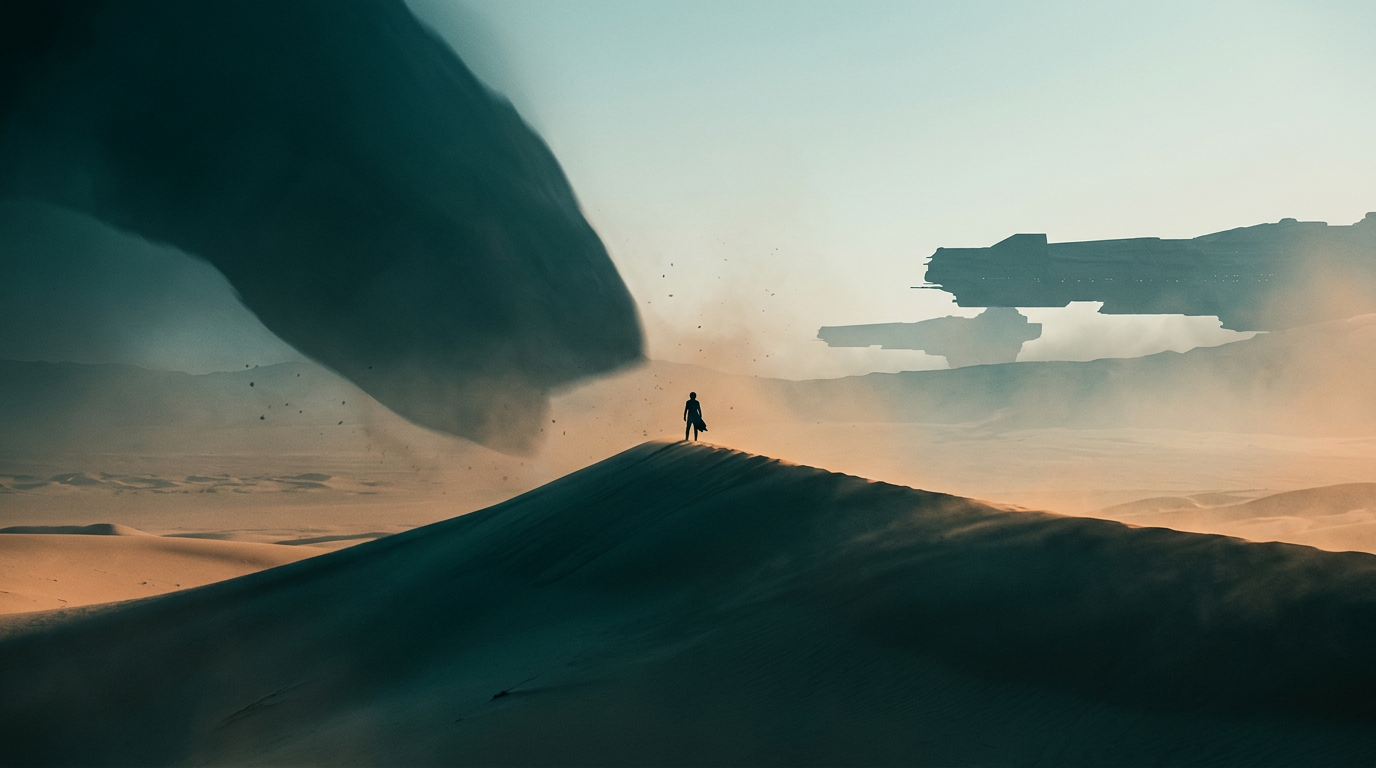
Denis Villeneuve’s Dune films understand something most contemporary science fiction forgets while sprinting between lore drops: awe needs patience. A ship hangs in the air too long. A door groans open like a geological event. A figure crosses a dune and the frame gives the desert more moral authority than the person walking through it. This is blockbuster filmmaking with a pulse slowed to planetary time.
That slowness is not decorative. It is the argument. Dune and Dune: Part Two are not great because they make Frank Herbert’s novel easier to follow, though they do. They are great because they make mass-market sci-fi feel dangerous again: political, sensual, religious, ecological, and suspicious of its own hero-making machinery.
By 2026, that matters. Streamers have spent years turning science fiction into content architecture: the expandable universe, the eight-hour pilot, the finale designed to open twelve tabs in a fan wiki. Villeneuve went the other way. He made two big theatrical objects, built for IMAX, Dolby Cinema, and silence as much as sound. He treated the multiplex as a temple and then filled that temple with poison.
The job Villeneuve gave the blockbuster
The Dune blueprint is not simply scale. Hollywood has plenty of scale and very little weight. Villeneuve’s achievement is that he made scale legible as politics.
Arrakis is not just a location. It is an economic system, a colonial wound, a weather pattern, a spiritual battleground, and a machine for producing myth. The spice is both MacGuffin and indictment: every empire needs a resource it pretends is destiny. That idea could become a lecture. Villeneuve turns it into mise-en-scène. The Harkonnen world is oily monochrome and industrial appetite. The Atreides world is carved from stone, ceremony, and doomed restraint. The Fremen world is defined less by exposition than by movement: how bodies kneel, hide, conserve, listen.
This is soft sci-fi with the discipline of hard sci-fi. The films do not care about engineering diagrams in the way The Martian does, but they care obsessively about systems. Water has rules. Sand has rules. Power has rules. Belief has rules. Even Hans Zimmer’s score, all throat-singing, metallic blasts, and ritualized pressure, feels diegetic in spirit, as if the planet itself has learned to weaponize sound.
That is why Dune has become the reference point for serious 2020s sci-fi. Not because every film should look like a brutalist cathedral dropped into the desert. Please, no. Because it proves that expensive genre cinema can be slow, strange, and ideologically thorny without apologizing for itself.
Why it matters now
!Small figure facing a vast desert shadow under hovering ships
The 2020s have been oddly good to ambitious sci-fi, even as the business around it keeps behaving like a malfunctioning algorithm. Apple TV+ has leaned into prestige futurism with Severance, Silo, and Foundation. Netflix made The Three-Body Problem into a global wager on hard sci-fi spectacle. Max inherited the HBO instinct for expensive obsession and extended the Dune brand with Dune: Prophecy. Amazon MGM keeps orbiting space opera and speculative IP. A24 and Neon have trained audiences to expect genre films with nerve endings.
Still, much of the decade’s sci-fi has been trapped between two bad habits: puzzle-box withholding and brand management. Dune avoids both. It has lore, but it does not worship lore. It has mythology, but it does not confuse mythology with trivia. It invites the audience to understand a world through behavior before vocabulary.
That is a major corrective. The films trust blocking, costume, rhythm, architecture, and faces. Timothée Chalamet’s Paul Atreides is not written as a quip machine. Rebecca Ferguson’s Lady Jessica does not need a speech every time her face can carry terror, calculation, and maternal ambition in the same breath. Javier Bardem’s Stilgar, especially in Part Two, becomes a portrait of belief as both shelter and trap. Zendaya’s Chani gives the films their necessary counterweight: a refusal to be seduced by the music of destiny.
Villeneuve also caught the theatrical revival at exactly the right moment. Dune: Part Two was not just something to stream later while folding laundry. It was a reason to leave the house. The IMAX frame mattered. The rumble mattered. The collective hush before a worm surfaced mattered. After years of platform fatigue, the films made serious sci-fi feel like an event without sanding off its complications.
[SPOILERS AHEAD]
What it gets right
The films’ smartest move is also their harshest: they understand that the chosen one story is a horror story told from the wrong angle.
Dune: Part Two does not merely complete Paul’s rise. It contaminates it. Villeneuve stages triumph like infection. The more Paul becomes the figure people need him to be, the less human he seems. His visions do not free him; they narrow him. The messianic arc, usually the laziest engine in franchise storytelling, becomes a study in how political necessity and religious desire can launder catastrophe.
That is where the adaptation improves the contemporary usefulness of Herbert’s novel. The book’s warning about charismatic leadership remains intact, but the film makes the warning emotional through Chani. Her final look is not a loose thread. It is the moral punctuation mark. The camera understands what the crowd inside the story cannot: liberation has curdled into domination.
Villeneuve’s craft serves that idea at every level. Greig Fraser’s cinematography favors massive negative space, turning human ambition into a small dark scratch against sand and sky. The combat is often cleanly blocked, not shredded into digital confetti. The practical effects and VFX do not feel like separate departments fighting for oxygen. The ornithopters have insect weight. The shields have an ugly tactical logic. The sandworms are not monsters in the usual sense; they are weather, god, infrastructure.
The films also revive an older blockbuster virtue: they let images carry ethical force. Think of 2001: A Space Odyssey, Alien, Blade Runner, The Matrix, Children of Men, Arrival, and Blade Runner 2049. The best sci-fi cinema does not merely show new worlds. It changes the temperature of the room. Dune belongs in that line because its world-building is not ornamental. It is pressure.
What it gets wrong and where it stumbles
!Futuristic aircraft shadow crossing dunes at dawn
The blueprint is not flawless. Dune pays a price for its monumental clarity.
The political ecology of Herbert’s novel is more intricate than the films can accommodate. The terraforming dream, the long ecological patience of the Fremen, and the institutional strangeness of the Spacing Guild are necessarily compressed. Some of that compression is elegant. Some of it leaves the universe feeling cleaner than it should. Herbert’s Dune is messy with competing agendas; Villeneuve’s Dune is cleaner, sharper, more tragic, and occasionally less weird.
There is also the problem of mediation. The story remains, by design, a colonized people’s struggle refracted through the crisis of an aristocratic outsider. Villeneuve is clearly aware of the danger. Chani’s skepticism helps. The Fremen are not treated as scenery. Their language, ritual, and tactical intelligence matter. Even so, the gravitational pull of Paul’s story is immense. The film critiques messiah logic while still giving messiah cinema many of its grandest pleasures. That tension is productive, but it is not solved.
Part Two also makes Stilgar broader than expected. Bardem is terrific, and the performance has real pathos, but the repeated beats of fervent belief flirt with comic relief. The choice sharpens the danger of fanaticism for a broad audience. It also risks simplifying a man who should feel as politically intelligent as he is devout.
These are not fatal flaws. They are the bruises left by adaptation at this scale. The films condense a dense, argumentative novel into muscular cinema. Something had to go. The question is whether the exchange was worth it. Mostly, yes.
The bigger idea
Dune is the decade’s sci-fi blueprint because it rejects the false choice between spectacle and thought.
A less confident version would explain its themes until they became harmless. Villeneuve instead builds a sensory trap. You feel the appeal of power before you judge it. You feel the grandeur of Paul’s ascent before you register the dread. You understand why oppressed people might embrace a prophecy and why empires would manufacture one. That ambiguity is the film’s intelligence.
The closest useful idea here is the panopticon, not as a prison diagram but as a way of thinking about internalized control. The Bene Gesserit do not dominate by standing over everyone with a weapon. They plant stories inside cultures, bloodlines, and private fears. Their power works because people learn to watch themselves through inherited prophecy. Dune turns surveillance inward and makes myth the camera.
That is more interesting than another evil AI or multiverse spreadsheet. It is also more contemporary. Our age is full of systems that present themselves as inevitabilities: markets, algorithms, security states, fandoms, dynasties, platforms. Dune asks what happens when inevitability is a story somebody wrote, and what happens when that story becomes useful to the person trapped inside it.
This is why Villeneuve’s influence should be understood carefully. The lesson is not fewer jokes, more sand. It is not that every sci-fi film needs whispery solemnity and giant helmets. The lesson is commitment. A serious sci-fi work needs a worldview. It needs form that expresses that worldview. It needs to believe that the audience can handle silence, contradiction, and dread.
And yes, it needs beauty. But beauty with teeth.
What 2020s sci-fi can steal from Dune
If studios are paying attention, the practical takeaways are obvious and still rarely followed.
- Build worlds through behavior before exposition.
- Treat sound design as storytelling, not wallpaper.
- Give political systems visual grammar.
- Let actors play thought, not just plot.
- Use scale to humble the hero, not flatter him.
- Preserve ambiguity instead of sanding it into franchise clarity.
This is why Dune pairs so well with Andor. Tony Gilroy’s Star Wars series has none of Villeneuve’s desert mysticism, but it shares the same adult respect for institutions, labor, fear, and rebellion. It understands that empire is not a villain in a cape. It is meetings, prisons, payroll, ideology, and people learning to obey before anyone asks.
It also explains why Dune makes many lesser franchise entries look weightless. The issue is not seriousness as a mood. It is seriousness as structure. Villeneuve’s films are not afraid to be entertaining. They are afraid of being empty.
What to watch next if you liked this
For a proper double-bill, pair Dune: Part Two with Andor season one, especially the Aldhani and Narkina 5 arcs. One gives you holy war and desert empire; the other gives you bureaucracy, labor, and revolt. Together they form the decade’s strongest argument for political science fiction on a large canvas.
If you want Villeneuve in a more intimate key, watch Arrival with Blade Runner 2049. Arrival is his most humane sci-fi film, a linguistic and emotional puzzle about time, grief, and contact. Blade Runner 2049 is colder, more architectural, and more haunted by manufactured identity. Both show the director testing ideas he later enlarges in Dune: slowness, scale, and the terror of inheritance.
For ecological and colonial counterpoints, watch Annihilation and then read Ursula K. Le Guin’s The Word for World Is Forest. Alex Garland’s film turns transformation into body horror and shimmer; Le Guin’s novella is sharper about occupation, extraction, and the moral vanity of conquerors.
For the messy ancestor, watch David Lynch’s Dune from 1984, then the documentary Jodorowsky’s Dune. Lynch’s film is compromised, fascinating, often ungainly, and far stranger in texture than Villeneuve’s. The documentary is a useful reminder that impossible adaptations can influence cinema even when they never get made.
For reading, go straight to Frank Herbert’s Dune Messiah after the films. It is the hangover after the coronation, and it makes explicit what Villeneuve has been careful to stage: the worst thing about a messiah is that he may know exactly what he is doing.
Villeneuve’s Dune is not the only model for the future of sci-fi. It should not be. The genre also needs scrappy cyberpunk, cheap chamber pieces, solarpunk optimism, biopunk disgust, and strange little films that would never survive a studio notes call. But for large-scale, adult, theatrical science fiction in the 2020s, Dune set the bar because it remembered the oldest rule of speculative cinema.
Show us another world. Then make us afraid of wanting it.
Discussion (0)
Loading comments…