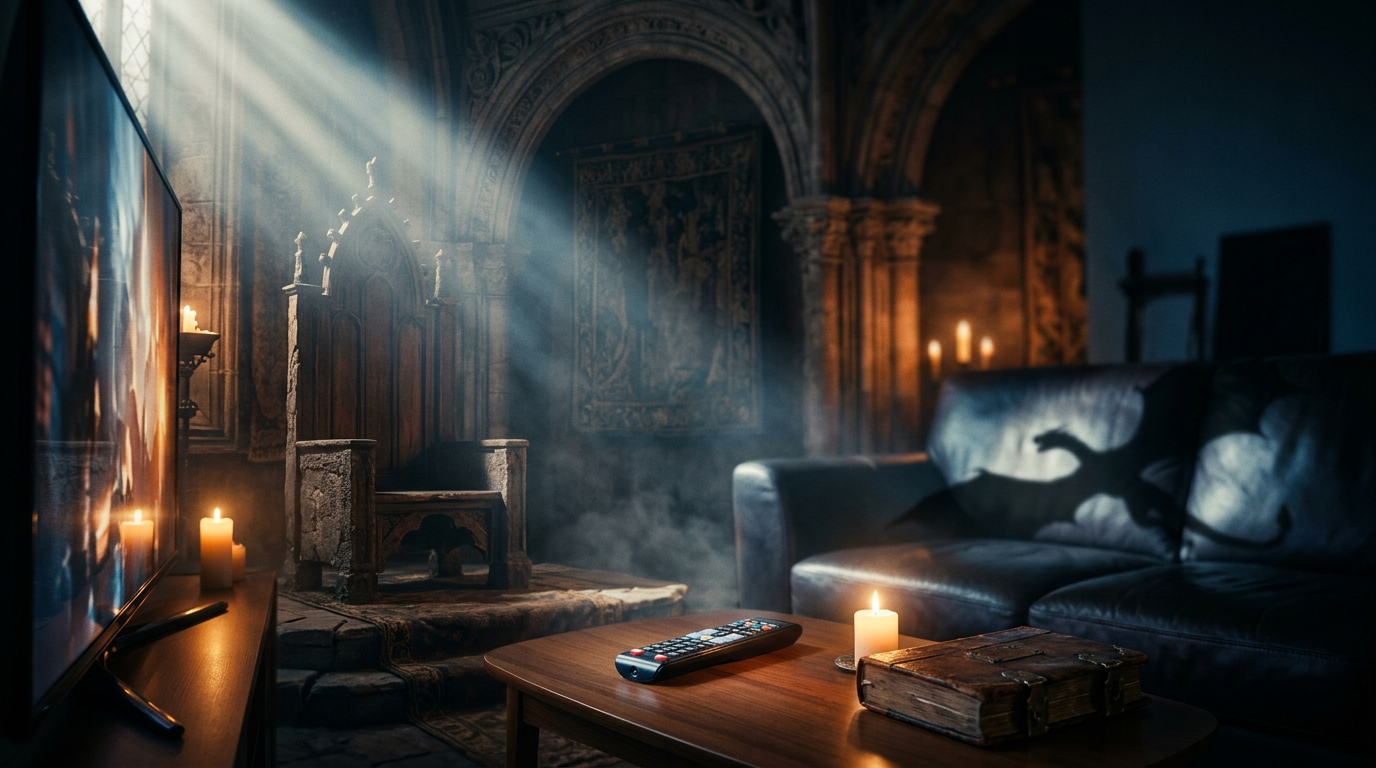
Fantasy finally found the right screen
The dragon is not the point. The court watching the dragon is.
That, more than any single burst of digital fire, explains why the most compelling new fantasy is happening on television rather than in theaters. The big screen still has scale, volume, communal awe, Dolby thunder, IMAX height. What it increasingly lacks is patience. Fantasy, at its best, is not just spectacle with better tailoring. It is social architecture: bloodlines, maps, rituals, invented economies, old gods, bad marriages, haunted objects, and power passing through rooms before anyone draws a sword.
Television is built for that. Or at least it can be, when it resists the algorithmic mush of eight-hour movies chopped into installments. The reason House of the Dragon works when it works, why The Sandman found a plausible shape on Netflix, why Delicious in Dungeon and Frieren have become indispensable parts of the fantasy conversation, and why even uneven swings like The Rings of Power remain more interesting as serial objects than as hypothetical three-hour blockbusters, is simple: fantasy needs duration. Not bloat. Duration.
Theaters have given us worthy counterexamples. David Lowery’s The Green Knight remains one of the most beautiful American fantasy films of the last decade, a chilly medieval hallucination with mud under its fingernails. Dungeons & Dragons: Honor Among Thieves was looser, funnier, and better blocked than most franchise machinery around it. Poor Things turned gothic science-fantasy into a perverse coming-of-age fable. But those feel like exceptions smuggled through a marketplace that would rather finance known brands, superhero residue, or musicals with pre-sold hooks. On TV, fantasy has become less apologetic. Stranger. More domestic. More political. More itself.
Why it matters now
By 2026, the streaming wars have sobered up. Netflix, Max, Prime Video, Disney+, Apple TV+, Paramount+, Hulu, Peacock, Mubi, and the rest are no longer spending as if subscriber growth were a fairy spell. Ad tiers, cancellations, shorter seasons, international co-productions, and library consolidation have made television feel less utopian and more like a market with a hangover.
Yet fantasy has survived the correction better than many prestige genres because it gives platforms something they desperately need: worlds people return to, argue about, cosplay, quote, map, and keep alive between seasons. A courtroom drama can be excellent and still vanish after finale week. A fantasy world lingers. It produces theories, fan art, language, backlash, and devotion. Streamers may not always understand art, but they understand retention.
The theatrical business, meanwhile, has become a harsher arena for mid-budget enchantment. If a fantasy film is not attached to a famous toy, book, game, theme-park ride, or decades-old brand, it has to fight for oxygen between superhero fatigue, horror’s efficient profit margins, and the event-film dominance of Nolan-sized spectacle. Theaters are not dead; anyone who saw Oppenheimer in 70mm or Dune: Part Two in a premium large format knows better. But the theatrical revival has favored either monumental cinema or low-cost genre bets. Fantasy often falls awkwardly between the two: expensive enough to scare financiers, weird enough to worry marketers.
Television, especially streaming television, can amortize strangeness. It can introduce a magical bureaucracy in episode two, a demonology in episode four, and a meal-based ecology across an entire season. It can make lore feel like weather rather than homework.
What TV understands about fantasy
!A fantasy map table lit by candles with modern servers behind it
Fantasy is not only a genre of images. It is a genre of rules.
The best fantasy television understands that rules become meaningful through repetition. The dynastic rituals in House of the Dragon do not matter because a character explains them once. They matter because we watch people bend, exploit, inherit, and choke on them. The mise-en-scène does half the writing: candlelit chambers, carved tables, armored bodies arranged by rank, servants moving like ghosts at the edge of aristocratic disaster. Blocking becomes ideology. Who stands? Who sits? Who is allowed to interrupt?
That kind of pressure is difficult to build in a two-hour film without resorting to exposition dump. Television can let power accrue in glances. It can make the audience fluent.
The same is true of Netflix’s The Sandman, which wisely treated Neil Gaiman’s source material less like a conventional quest and more like a shifting anthology of moods: myth, horror, whimsy, grief, cosmic office politics. A feature version would almost certainly have flattened it into a hero’s-journey chase. The series could instead preserve the property’s oddest virtue: its refusal to stay in one tonal room.
Animation has been even more nimble. Delicious in Dungeon turns the dungeon crawl into a study of appetite, ecology, and grief, using food as world-building rather than garnish. Frieren: Beyond Journey’s End does something rarer: it begins after the victory and asks what heroism looks like when memory outlives urgency. That is fantasy as slow cinema, almost. The battles matter, but the pauses matter more.
This is where television has outpaced theaters: it has rediscovered fantasy’s ordinary textures. Meals. Lessons. Bad jobs. Local customs. The way a road changes people slowly. The way immortality might make someone emotionally late to every room.
What theaters keep getting wrong
The mistake is not that theatrical fantasy has too many visual effects. Practical effects and digital effects are both tools; neither is inherently moral. The problem is that many modern fantasy films use spectacle as a substitute for social imagination.
Too often, the movie gives us the castle before it gives us the household. The monster before the superstition. The prophecy before the politics. The glowing portal before the cost of crossing it. The result is a kind of fantasy theme-parking: immaculate surfaces, weightless stakes, a digital army arriving on schedule.
Dungeons & Dragons: Honor Among Thieves worked because it remembered that fantasy benefits from comic timing and physical problem-solving. Its action had shape. Its party dynamics had rhythm. It understood that a failed spell can be more revealing than a successful one. The Green Knight worked for the opposite reason: it stripped fantasy down to dread, landscape, temptation, and moral weather. Neither film treated mythology as a content category.
But Hollywood has grown cautious around the middle. Original or semi-original fantasy has trouble surviving the pressure to be either massive IP or austere art object. If a theatrical fantasy cannot promise franchise expansion, it is treated as a risk. If it can, it is often asked to spend its first installment setting up the next five. The serpent eats the map.
This is where Mark Fisher’s idea of capitalist realism has an uncomfortable usefulness: the industry often behaves as if no imaginative world is worth building unless it can be converted into a brand ecosystem. Fantasy should be the genre most resistant to that logic. Too often, in theaters, it becomes its obedient servant.
What it gets right
!An empty theater with mist and roots spreading from the screen

Television’s strongest fantasy gets three things right.
First, it treats world-building as behavior. House of the Dragon is not compelling because viewers can recite Targaryen genealogy, though plenty can. It is compelling because lineage infects every gesture. A family dinner becomes a battlefield. A marriage proposal becomes a military maneuver. A nursery becomes a succession crisis waiting for language.
Second, TV allows fantasy to vary scale without apology. One episode can revolve around a kingdom; the next can hinge on a private disappointment. The Rings of Power, whatever its flaws, is most interesting when it lets geography carry emotional meaning: forests, mines, shorelines, forges, and roads as places where history presses against the present. Even when the writing grows too polished or reverent, the serial form gives the world room to breathe.
Third, television has become a better home for tonal hybridity. Interview with the Vampire is not usually filed as epic fantasy, but its gothic supernatural mode belongs in this conversation. It understands immortality as performance, romance, addiction, and historical rot. One Piece, in live action, succeeds when it leans into theatricality rather than apologizing for it: elastic bodies, pirate sincerity, heightened costumes, emotional directness. Percy Jackson and the Olympians works best when it remembers that myth, for children, is not dusty. It is parental drama with monsters.
That breadth matters. Fantasy on TV is not just dragons and swords. It is mythic bureaucracy, gothic desire, culinary dungeon ecology, haunted adolescence, immortal melancholy, and animated metaphysics. The genre is healthier when it stops dressing every idea in the same leather tunic.
What it gets wrong / where it stumbles
Television has not solved fantasy. It has merely given it better odds.
The obvious problem is padding. Some streaming seasons still move like a committee mistook slowness for seriousness. Characters walk through expensive sets delivering lore with the rhythm of a corporate onboarding video. The eight-episode structure can be brutal: too short for old-school episodic pleasure, too long for a clean dramatic arc. Prestige TV has trained some showrunners to confuse withholding with depth.
There is also a visual sameness problem. Too many fantasy series share the same desaturated palette, the same gray villages, the same blue-black night interiors, the same anonymous digital skylines. Expensive does not mean expressive. A strong fantasy image should tell you something about cosmology, class, history, or desire. It should not merely announce that a VFX vendor has been paid.
The other danger is lore-as-currency. Streamers love worlds that can be expanded, but expansion is not imagination. A prequel, sequel, spin-off, companion podcast, and interactive map do not automatically make a fictional universe richer. Sometimes they make it smaller by explaining away mystery. Fantasy needs negative space. The unseen kingdom. The half-remembered god. The spell no one translates.
And yes, the release model can hurt the form. Weekly episodes can restore conversation and suspense; all-at-once drops can turn an intricate season into weekend consumption sludge. Not every show needs the same cadence. But fantasy, perhaps more than any genre, benefits from waiting. Myth grows in the gap.
The bigger idea
The best new fantasy is on TV because television is closer to oral storytelling than cinema is.
That sounds counterintuitive. Film has the grandeur, the dream logic, the cathedral darkness. But fantasy comes from recurrence: the next chapter, the next campfire, the next installment, the old tale altered by a new teller. TV can mimic that ancient rhythm. It returns. It revises. It lets characters age beside the audience. It makes places familiar enough to be violated.
J.R.R. Tolkien, in his essay On Fairy-Stories, argued for the seriousness of secondary worlds: invented places that require internal consistency and invite belief without embarrassment. The best fantasy television has absorbed that lesson more thoroughly than most contemporary fantasy film. Not because TV is inherently superior, but because its form rewards consistency. A world cannot survive on one beautiful shot. It has to keep functioning after the camera cuts away.
That is why the most persuasive fantasy scenes right now are often not the largest. A ruler alone in a room after everyone has bowed. A meal made from a monster. A vampire choosing an outfit like armor. An elf realizing that decades of travel have not taught her how to say goodbye. These are not trailer beats. They are durational rewards.
The theater will always be the better temple for certain kinds of awe. Give me a giant screen for sandworms, starships, haunted houses, and impossible landscapes. But fantasy’s deepest pleasure is not size. It is inhabitation. Television, for all its industrial sins, is better built for dwelling.
What to watch next if you liked this
If you want to see why fantasy currently belongs to television, build your own pairings rather than chasing the loudest recommendation carousel.
- House of the Dragon + The Green Knight: dynastic cruelty beside mythic austerity. One is about power as inheritance; the other is about honor as a trap.
- The Sandman + Interview with the Vampire: two studies in immortal beings who use style, language, and performance to survive loneliness.
- Delicious in Dungeon + Frieren: Beyond Journey’s End: the best recent argument for animation as fantasy’s most elastic form.
- One Piece + Dungeons & Dragons: Honor Among Thieves: buoyant ensemble fantasy that remembers adventure should have timing, not just lore.
- His Dark Materials + The Golden Compass novels by Philip Pullman: a useful case study in how adaptation gains power when it has enough time to honor theological and emotional complexity.
- The Rings of Power + Tolkien’s On Fairy-Stories: not to police fidelity, but to think harder about what makes a secondary world feel alive.
- The Dark Crystal: Age of Resistance + Jim Henson’s original The Dark Crystal: practical texture, puppet bodies, and fantasy as tactile weirdness rather than digital wallpaper.
- Ursula K. Le Guin’s essay From Elfland to Poughkeepsie: still one of the sharpest pieces ever written about language, tone, and the embarrassment that ruins bad fantasy.
The lesson is not that theaters should give up on fantasy. They should get braver. Smaller sometimes. Stranger often. Less obsessed with franchise scaffolding and more interested in the uncanny force of a well-made world.
Until that happens, the richest kingdoms are on the couch. Not because television is humbler, or cheaper, or easier. Because fantasy needs time to teach us its customs before it burns them down.
Discussion (0)
Loading comments…