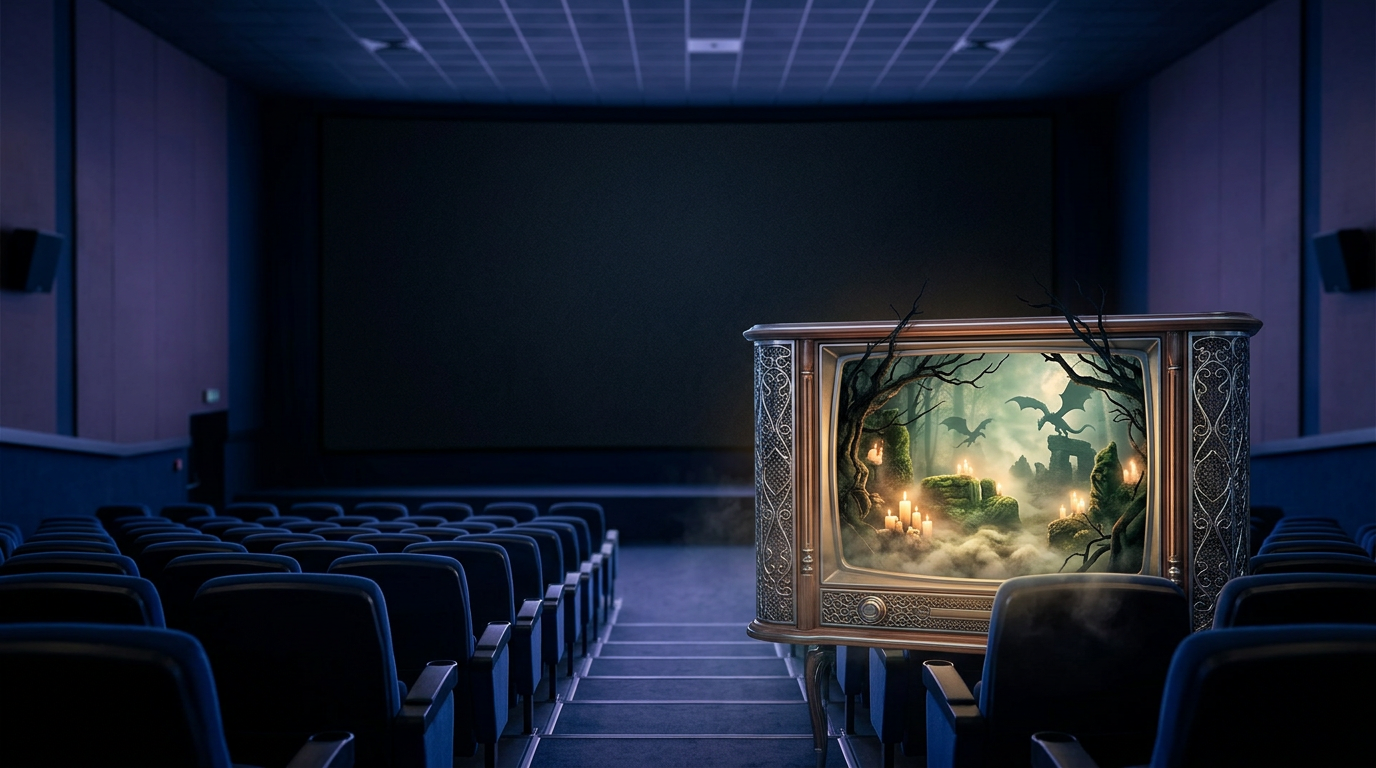
Fantasy found its nerve on television
A throne room is more revealing than a battlefield.
That, more than dragons or glowing swords, is why the strongest new fantasy has migrated to television. The movies can still mount spectacle. They can still drop a castle into an IMAX frame and make the Dolby seats tremble. But contemporary fantasy needs duration. It needs meals, rituals, bad marriages, court gossip, weird theology, inherited debt, clothes that look worn by actual bodies, and maps that feel less like production design than weather systems. TV has room for all of that. Theaters, at least right now, mostly have room for brands.
This is not an obituary for fantasy cinema. David Lowery’s The Green Knight remains one of the strangest and most tactile American studio-adjacent fantasies of the decade. Dungeons & Dragons: Honor Among Thieves was nimble, funny, and far better blocked than it needed to be. Wicked proved there is still a mass audience for theatrical enchantment when the material has songs, stars, and decades of cultural pre-sold momentum behind it. But the center of gravity has shifted. If you want fantasy that breathes, TV is where the oxygen is.
Why it matters now
Fantasy used to be cinema’s great expensive dare. The Lord of the Rings trilogy made the case that secondary-world storytelling could be popular art and industrial miracle at once: bigatures, practical costumes, digital armies, emotional clarity. It was spectacle with dirt under its fingernails.
Then Hollywood learned the wrong lesson. It saw IP, not patience. It chased lore without myth, scale without geography, prophecy without dread. The result was a run of fantasy films that often felt like two-hour trailers for larger corporate intentions. A quest begins. A chosen one is identified. A portal opens. The camera whips through a CGI city whose plumbing, economy, and cuisine apparently do not exist.
Television, meanwhile, became the unlikely guardian of the genre’s oldest pleasures. HBO and Max gave House of the Dragon the chance to make succession law feel like a horror mechanism. Prime Video’s The Rings of Power, whatever its unevenness, has been willing to spend serious money on an image of mythic history rather than a mere plot conveyor belt. Netflix’s The Sandman understood that dream logic works best episodically, with tonal whiplash built into the premise. The Wheel of Time, His Dark Materials, One Piece, Arcane, Frieren: Beyond Journey’s End, Delicious in Dungeon, and The Legend of Vox Machina have all demonstrated, in wildly different registers, that fantasy TV can be elastic: prestige tragedy one night, animated melancholy the next, culinary dungeon comedy after that.
That elasticity matters in the 2026 viewing landscape. The streamer wars have made many shows feel disposable, yet fantasy has paradoxically benefited from the hunger for durable worlds. A fantasy series is not just content. It is a place viewers return to. That can lead to franchise rot, yes. But at its best, it creates a rare modern viewing habit: attention over time.
Theaters forgot fantasy needs weather
!A candlelit fantasy council chamber with maps and an empty throne-like chair
The problem with much theatrical fantasy is not that it is too short. Spirited Away is short. Pan’s Labyrinth is short. The Wizard of Oz is short. The problem is that recent studio fantasy often uses compression as an excuse to sand off texture.
Fantasy requires the sensation that the world existed before the protagonist arrived and will remain after the end credits. That sensation is built through mise-en-scène as much as plot: the way a servant avoids eye contact, the way armor carries scratches from wars the script never explains, the way food tells you whether a kingdom is prosperous or lying to itself. Cinema can do this brilliantly. But today’s franchise model often pressures films to spend their running time on setup, escalation, and sequel-friendly incompletion.
TV has the opposite danger, of course: bloat. But when handled with discipline, serial form gives fantasy its natural habitat. A court intrigue can unfold through glances. A religion can become legible through repeated ceremonies. A magical rule can be introduced, bent, and then made morally costly three episodes later. Blocking can evolve with power: characters who once stood at the edge of a council table slowly move toward the center. Costumes can track class mobility. The world-building stops being a glossary and becomes behavior.
That is why House of the Dragon works even when no dragon is on screen. It treats fantasy as political architecture. Its rooms are traps. Its lineage charts are weapons. The fantasy element intensifies human pettiness rather than replacing it.
What TV understands about enchantment
The strongest fantasy television does not confuse enchantment with quantity. More creatures, more spells, more map locations: these are not automatically richer. The good shows understand rhythm.
The Sandman is a useful case. Its premise could have become a prestige screensaver: handsome gloom, famous faces, expensive fog. Instead, the series is at its best when it allows dream, death, desire, and storytelling itself to behave like unstable dramatic forms. Some episodes feel like chamber pieces. Others like gothic anthology. That is not inconsistency; it is fidelity to the material’s shape.
Arcane, adapted from League of Legends, is even more instructive because it should not have worked this well. Video game adaptations have historically mistaken Easter eggs for dramaturgy. Arcane uses animation not as a budget workaround but as a grammar. Its painterly surfaces, kinetic editing, and aggressive color design express class conflict and emotional damage in ways live action would likely literalize. The result is fantasy-industrial melodrama with actual visual thought behind it.
Then there is Frieren: Beyond Journey’s End, whose great subject is aftermath. It asks what happens when the adventure is over and the nearly immortal character has to understand grief on a timescale humans cannot survive. That is fantasy doing what fantasy does best: making an abstract emotional problem visible. Not bigger. Clearer.
Delicious in Dungeon, meanwhile, turns monster ecology into comedy, survival drama, and world-building. It is a reminder that fantasy can be playful without being trivial. A dungeon is not just a video game space. It is a food chain, a workplace, a ruin, a stomach.
What it gets right
!Adventurers cooking in a glowing dungeon camp beneath bioluminescent mushrooms
The best fantasy TV of the moment succeeds for four practical reasons.
- It trusts accumulation. A culture cannot be explained in one speech. It has to repeat itself until the viewer senses its habits.
- It uses casting as world-building. Paddy Considine, Emma D’Arcy, Matt Smith, Morfydd Clark, Rosamund Pike, Tom Sturridge, and the voice casts behind Arcane and Frieren are not merely decorating lore. They anchor impossible premises in bodies, breath, and timing.
- It lets genre tone vary. Fantasy can contain court tragedy, quest narrative, cosmic horror, workplace comedy, romance, and slow cinema melancholy. TV can change tempo without pretending each shift is a reboot.
- It makes magic expensive. The best shows understand that the supernatural should create obligations, not just solutions.
This is where television has outpaced most fantasy films. It can show consequences as social weather. A spell does not simply win a fight; it alters status. A prophecy does not merely foreshadow; it changes how people behave around a child. A dragon is not only a tactical weapon; it is a nuclear inheritance with a saddle.
What it gets wrong / where it stumbles
The critique matters because the triumph is not clean. Fantasy TV has plenty of bad habits.
The first is lore obesity. Some shows treat proper nouns as narrative momentum. They are not. A capitalized place name is not a character. A mythology dump is not drama. The Wheel of Time has sometimes struggled with this, trying to balance Robert Jordan’s enormous cosmology with the immediate needs of scene work. The Rings of Power has had similar issues when reverence for Tolkien’s legendarium hardens into museum lighting.
The second problem is the prestige murk. Too many fantasy shows confuse seriousness with dimness. The late Game of Thrones controversy over night battles did not end the habit; it merely made viewers better at complaining about it. Darkness can be expressive. It can also be a tax on the audience.
The third problem is cancellation anxiety. Netflix’s Shadow and Bone built a devoted audience and then ended without the long runway fantasy requires. The Dark Crystal: Age of Resistance was a marvel of puppetry and production design, then vanished after one season. Streaming has trained viewers to hesitate before investing in worlds that may be abandoned by quarterly logic. That is capitalist realism in miniature: even enchantment must justify itself to the spreadsheet.
And yes, some series simply run too long. Fantasy can turn into homework. When every side character needs a destiny and every destiny needs a spin-off, wonder becomes administration.
The bigger idea
Fantasy is often dismissed as escape, but the best version is closer to diagnosis. It changes the furniture of reality so we can see our own room more clearly.
That is why TV is especially suited to the genre now. Our lives are already serialized: feeds, work chats, rolling crises, deferred endings. Fantasy television mirrors that structure while offering symbolic pressure. Succession disputes become family trauma. Monsters become labor systems. Magic becomes technology by other means. The panopticon appears not as a lecture but as a palace, a guild, a tower, a school, a god watching from the corner of the frame.
The genre’s current strength on television also reflects a hunger for non-cynical imagination. Not naive hope. Not inspirational wallpaper. Something tougher. A belief that invented worlds can still interrogate power, grief, ecology, appetite, and memory without apologizing for swords and spells.
The theatrical marketplace, with its opening-weekend panic and four-quadrant caution, often struggles to support that. Streamers are hardly pure patrons of art, but serialized fantasy gives them what they crave: subscriber attachment. The bargain can be ugly. It can also fund a dragon court drama, a dream anthology, a painterly class-war fable, and an anime about mourning the short lives of friends.
That is not a bad trade, provided the artists keep smuggling in strangeness.
What to watch next if you liked this
If you want to test the argument, do not watch randomly. Pair titles and see what the format reveals.
- House of the Dragon with The Green Knight: one turns myth into dynastic machinery; the other turns a single quest into moral weather.
- Arcane with Dungeons & Dragons: Honor Among Thieves: both understand momentum, but Arcane shows how serial animation can deepen class, trauma, and place over time.
- The Sandman with Pan’s Labyrinth: dream logic on television beside fairy-tale horror in cinema, both using fantasy to make mortality intimate.
- Frieren: Beyond Journey’s End with The Lord of the Rings: The Fellowship of the Ring: one begins after the heroic age, the other defines it. Together they form a conversation about memory.
- Delicious in Dungeon with Princess Mononoke: ecology as fantasy structure, one comic and systemic, the other mythic and wounded.
- His Dark Materials with The Golden Compass film: the series has room for metaphysics and institutional menace; the film shows what happens when adaptation gets squeezed into franchise packaging.
For follow-up reading, start with J.R.R. Tolkien’s essay On Fairy-Stories, still essential on consolation and secondary worlds. Add Ursula K. Le Guin’s From Elfland to Poughkeepsie, a sharp argument about style, language, and the danger of fake-medieval mush. Marina Warner’s From the Beast to the Blonde is invaluable on fairy tales, gender, and cultural memory.
The best new fantasy is on TV because television has rediscovered an old truth: enchantment is not a special effect. It is a contract. Give the audience a world with rules, scars, appetite, and time, and they will believe in almost anything. Give them only a glowing portal and a brand-management plan, and they will start checking their phones before the prophecy is finished.
Discussion (0)
Loading comments…