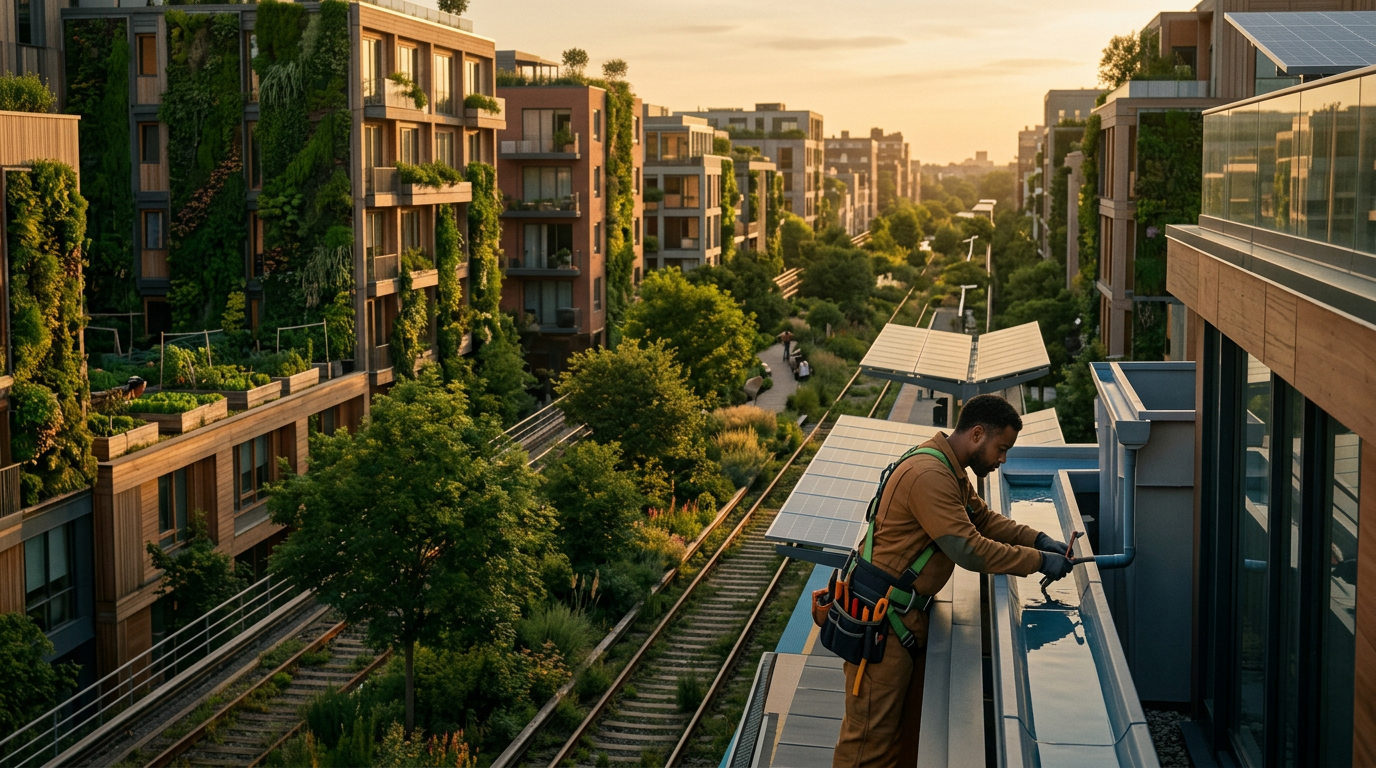
Hollywood still fears a livable future
A city covered in vines is easy. A city that has figured out water rights, public transit, food systems, energy storage, labor, grief, and boredom is harder.
That is the problem with solarpunk on screen. Not the aesthetics. Hollywood can render glass towers wrapped in greenery before lunch, then add a monorail, drone pollinators, and a schoolchild in linen for scale. The deeper challenge is dramatic: solarpunk asks cinema and television to imagine a future where the point is not conquest, escape, collapse, or revenge, but repair. Maintenance. Mutual aid. Design as ethics. The good life as a collective project rather than a billionaire’s bunker with better lighting.
For an industry addicted to apocalypse because apocalypse photographs beautifully, that is almost offensive.
Solarpunk has become a useful word precisely because it names a gap. We have cyberpunk’s rain-slick corporate hellscapes, post-apocalyptic survivalism, space opera empires, AI paranoia, asteroid dread, plague dread, multiverse dread, and prestige-TV dread in extremely nice knitwear. What we do not have, at least not in any robust Hollywood tradition, is a cinema of plausible, contested, non-idiotic hope.
Not utopia. Utopia is the dead end. Solarpunk is more interesting: a future that has not abolished conflict, but has changed what conflict is for.
Why it matters now
The 2026 viewing landscape is full of expensive despair. Streamers still court sci-fi because it travels well, feeds fandom, and looks premium in Dolby Vision. Apple TV+ has made speculative seriousness part of its brand with shows like Severance, Silo, and Foundation. Netflix keeps mining apocalypse, techno-paranoia, and puzzle-box dread, from Black Mirror to 3 Body Problem. Max, Amazon MGM, Paramount+, and Disney all understand that genre can turn a platform into a habit.
But most screen futures remain variations on a stuck mood: the state failed, the corporation won, the planet burned, the algorithm ate intimacy, and your child will inherit either a bunker or a branded subscription tier.
There are good reasons for that. Dystopia has dramatic clarity. A collapsed world externalizes anxiety. It makes production design do moral work. Rust, smoke, scarcity, surveillance architecture, the blue wash of a server farm: instantly legible. Solarpunk, by contrast, risks looking like a wellness retreat with better zoning.
That risk matters because mainstream sci-fi does more than entertain. It trains expectation. The future on screen becomes a rehearsal space for what viewers think is politically, technologically, and emotionally possible. This is where Mark Fisher’s idea of capitalist realism still bites: it is easier for Hollywood to imagine planetary ruin than a post-carbon public works project that actually functions.
And yet audiences are not allergic to hope. The theatrical revival around event cinema, the hunger for original speculative films when they have scale and conviction, the lingering affection for Arrival, Interstellar, Everything Everywhere All at Once, and WALL-E all suggest something more complicated. Viewers will accept sincerity if the film earns it. They just do not want a brochure.
What solarpunk cinema actually is
!A communal repair hall filled with tools, plants, and neighbors fixing machines
Solarpunk is not merely “plants on buildings.” That is the lazy Pinterest version. On screen, a real solarpunk film or show would need three things:
- A future built around ecological repair rather than extraction
- Technology shown as civic infrastructure, not magic consumer hardware
- Conflict rooted in governance, memory, access, and compromise, not just villains who hate trees
That is why the best solarpunk-adjacent screen works often come from animation, not live-action Hollywood. Animation can make infrastructure lyrical without pretending it is documentary realism. Hayao Miyazaki’s Nausicaä of the Valley of the Wind and Princess Mononoke are not solarpunk in the cozy sense. They are too angry, too haunted by violence, too clear-eyed about ecosystems that do not exist to comfort humans. But they understand the essential solarpunk tension: living with nature does not mean nature becomes cute.
WALL-E is another key text, though it begins in garbage and corporate abandonment. Pixar’s robot fable is often remembered for its silent-film tenderness and obese cruise-ship satire, but its most radical image is agricultural: a tiny sprout treated not as symbol alone, but as responsibility. The film’s hope depends on bodies relearning labor, not on a genius inventing salvation.
Brad Bird’s Tomorrowland is the cautionary case. It wants to defend optimism against doom-scrolling before doom-scrolling had fully matured as a cultural posture. That impulse is admirable. The movie even has a valuable complaint: pessimism can become vanity, a pose that mistakes fatalism for intelligence. But Tomorrowland stumbles because its future is too abstract, too theme-park immaculate, too dependent on chosen geniuses. It scolds despair without building a persuasive social world to replace it.
More recently, The Wild Robot brought a gentler version of the conversation into family cinema. Its premise is not civic-scale solarpunk, but its emotional engine is: adaptation, interdependence, and the reprogramming of a tool into a participant in an ecosystem. That may be the form solarpunk sneaks through Hollywood most easily — not as a manifesto, but as a story about care becoming design.
What it gets right when it works
Solarpunk works when it resists purity. The strongest examples understand that ecological futures will still be messy, political, and full of competing needs.
That is why Miyazaki remains the towering reference point. His mise-en-scène never treats nature as wallpaper. Forests breathe, rot, listen, and retaliate. Machines are wondrous and dangerous. Flying craft in Nausicaä and Castle in the Sky have weight and personality; they are not frictionless gadgets from a product launch. The blocking often places humans as small figures inside systems bigger than ideology. That humility is the genre’s secret weapon.
A solarpunk screen language would need to make infrastructure dramatic. Cinema already knows how to do this with war rooms, heists, space stations, and surveillance grids. It can absolutely learn how to shoot water reclamation, seed banks, community energy, repair shops, rewilded transit corridors, and urban farms without turning them into educational television. The trick is to photograph systems as lived spaces.
Look at Andor, which is not solarpunk, but is instructive. Tony Gilroy’s series makes political organization legible through rooms, rituals, tools, and risk. Its production design tells you who holds power before anyone says so. A solarpunk film needs that same respect for process. Not “here is the green city.” Show the meeting where the green city almost fails. Show who cleans the filters. Show who gets displaced when the seawall becomes a park. Show the argument over whether a forest has legal standing.
The genre also benefits from soft sci-fi. Hard sci-fi has its place, and nobody wants magical batteries hand-waved with a line of dialogue. But solarpunk’s core is social, not merely technical. The big invention is not a solar panel. It is a culture that refuses to organize itself around waste.
What it gets wrong where it stumbles
!A coastal flood barrier redesigned as a public wetland park with solar structures
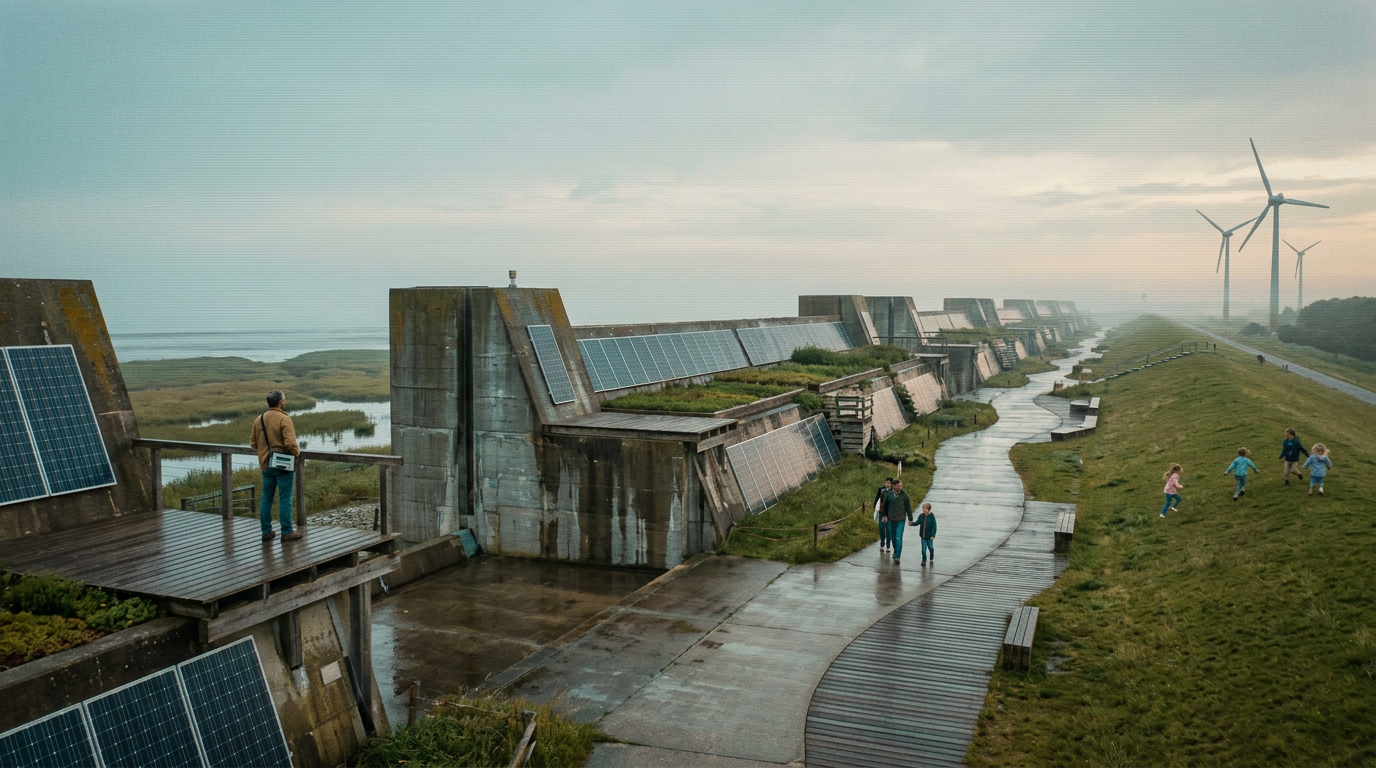
Solarpunk’s weakness is smugness. Too often, the aesthetic arrives before the drama: sun-dappled terraces, wind turbines, linen, bicycles, tea, a suspicious absence of sewage. The result can feel less like cinema than a municipal rebrand.
Hope without friction is not hope. It is décor.
This is where Hollywood’s skepticism is not entirely foolish. A two-hour movie needs pressure. Prestige TV needs escalation. Even slow cinema needs formal tension. If solarpunk cannot generate conflict beyond “bad corporation wants to bulldoze the garden,” it will deserve the limited shelf space it currently gets.
The other trap is techno-moral innocence. A film may reject cyberpunk’s corporate nihilism only to replace it with artisanal fantasy: small communities, beautiful tools, no large-scale coordination, no ugly trade-offs. That is not a future. That is an Airbnb listing with compost.
There is also a class problem. Much solarpunk imagery borrows from architecture and lifestyle design that, in the real world, is expensive. Green roofs and pedestrian plazas can be instruments of repair or engines of gentrification. A serious solarpunk movie would have to admit that the future’s prettiest neighborhood may still have a landlord.
This is the genuine criticism the subgenre must absorb: solarpunk can become a way to aestheticize survival while avoiding power. If it wants to matter on screen, it has to dramatize ownership, law, debt, migration, and labor. It needs antagonists more complex than polluters with black SUVs. It needs compromised heroes. It needs bureaucracy. Sexy? Not automatically. But neither is a spice-mining supply chain until Dune frames it with enough mythic dread.
The bigger idea
Hollywood avoids hopeful futures because despair is narratively efficient and commercially familiar. Dystopia flatters the audience: you saw through the lie, you knew the system was rotten, you were right to distrust the screen in your pocket. Solarpunk asks for a more vulnerable response. What if cynicism is not wisdom? What if the future is not saved by escape velocity but by committee meetings, engineering standards, grief work, and public budgets?
That sounds anti-cinematic only if your idea of cinema is limited to explosions and lone saviors.
Film is superb at showing collective life when it wants to. Neorealism did it. The best disaster movies do it. Heist films do it through planning and timing. Space films do it through procedure: Apollo 13, The Martian, and parts of Interstellar understand that competence can be thrilling. Solarpunk needs to steal from those grammars. Make repair suspenseful. Make governance tactile. Make a seed archive feel as charged as a vault.
The genre also has a moral advantage over much contemporary sci-fi: it can restore scale without resorting to cosmic annihilation. Not every ambitious film needs the Fermi paradox, a multiverse, or a planet-killer. Sometimes the biggest question is whether a coastal city can remain livable without becoming a fortress. Sometimes the antagonist is not an alien fleet but a century of bad incentives.
The missing solarpunk masterpiece will not be a spotless utopia. It will probably look partly broken. It will have old infrastructure beside new growth, practical effects dirt under the fingernails, anamorphic warmth without nostalgia, and a soundscape where machines hum as part of the commons rather than menace from the walls. Its world-building will include conflict because any future worth inhabiting will contain disagreement.
The point is not that Hollywood should stop making dystopias. Blade Runner 2049, Children of Men, Mad Max: Fury Road, and The Matrix remain vital because they turn nightmare into form. The point is that nightmare has become too easy a default. A culture that only funds visions of collapse eventually mistakes collapse for sophistication.
What to watch next if you liked this
If you want the closest thing to a solarpunk viewing path, do not look for one neat canon. Build a constellation.
- Nausicaä of the Valley of the Wind paired with WALL-E: one sees ecological catastrophe as myth and poison; the other turns cleanup into slapstick romance and moral awakening.
- Princess Mononoke paired with The Wild Robot: two animated works about coexistence without pretending coexistence is easy.
- Tomorrowland paired with Her: one argues for optimism at blockbuster volume; the other shows how a beautiful near-future can still leave people lonely.
- Scavengers Reign paired with Annihilation: neither is solarpunk, exactly, but both reject human dominion as the default mode of encountering the nonhuman.
- Black Panther paired with Andor: Wakanda’s Afrofuturist design imagines technological sovereignty; Andor supplies the missing texture of political organization and cost.
- The Expanse paired with Silo: useful counterweights, because both show how infrastructure and governance can become cages when scarcity defines the social contract.
For reading, start with Becky Chambers’ Monk and Robot novellas, beginning with A Psalm for the Wild-Built. They are not cinema, but they understand the emotional temperature Hollywood keeps missing: gentle without being stupid, philosophical without embalming the characters. Kim Stanley Robinson’s The Ministry for the Future is messier, wonkier, and more global in scope, with the virtues and limits that implies. For a sharper theoretical frame, Fisher’s Capitalist Realism remains short, bracing, and useful, even when you want to argue with it.
The verdict on Hollywood’s green blind spot
Solarpunk cinema has not failed. It has barely been attempted at scale.
Hollywood knows how to sell ruin. It knows the grammar: ash, sirens, chrome, neon, bunkers, a child clutching a toy in the dust. It is less confident with abundance that has been earned, with communities that are neither cults nor punchlines, with technology that serves public life rather than replacing it.
That avoidance is starting to look less like commercial caution than imaginative laziness.
The hopeful future worth filming is not clean. It is argumentative, patched together, funny, sensual, and unfinished. It has weeds in the sidewalk and minutes from the zoning meeting. It has grief for what was lost and appetite for what can still be built. It needs movie stars, character actors, production designers, climate consultants, and screenwriters who understand that optimism is not the absence of conflict. It is a different theory of conflict.
A livable future would be hard to make convincing. Good. Difficulty is where cinema usually gets interesting.
Discussion (0)
Loading comments…