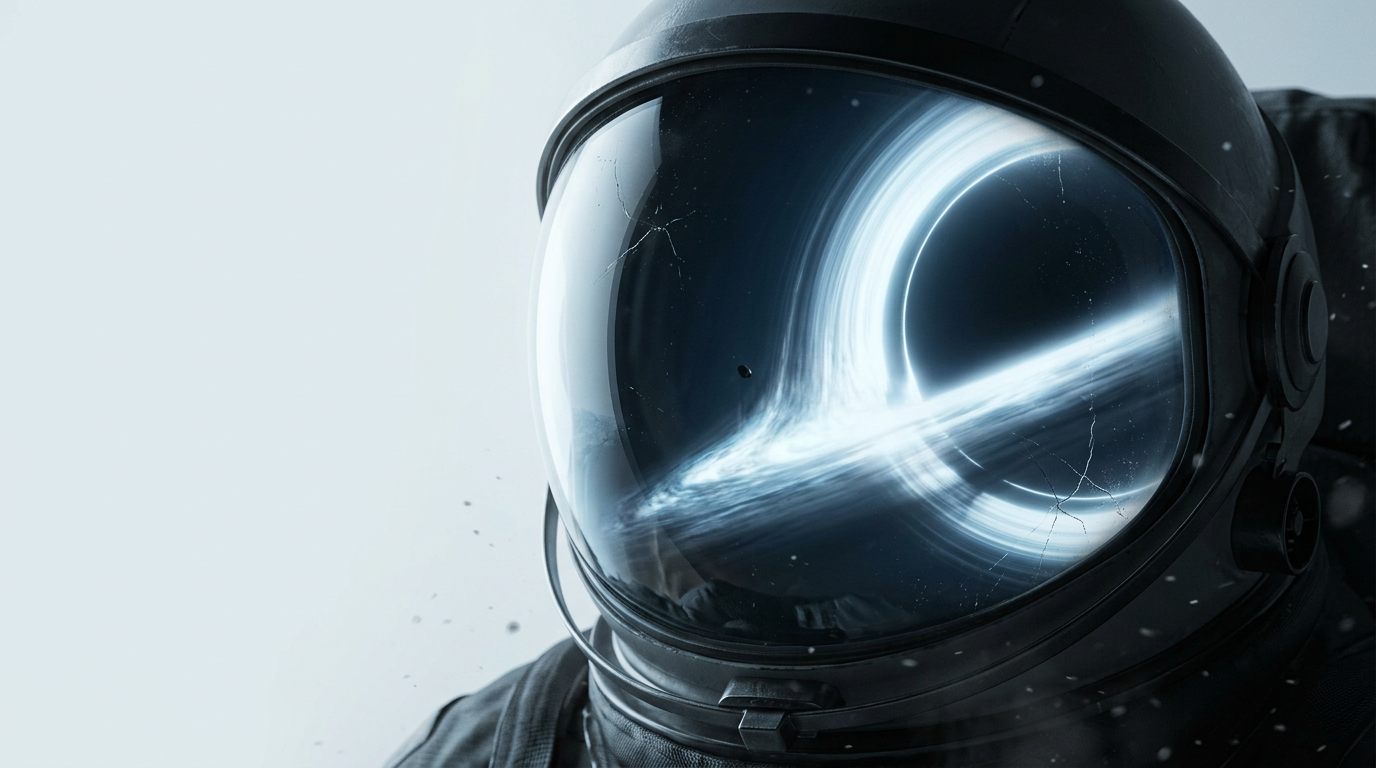
Interstellar still speaks fluent hard sci-fi
A wave the height of a city rises on the horizon, and nobody has time to admire it.
That is the key to Interstellar. Christopher Nolan’s 2014 space epic is often remembered for Hans Zimmer’s organ, Matthew McConaughey’s wet-eyed paternal panic, and that enormous black hole rendered with the help of physicist Kip Thorne. Fair enough. The film has no shortage of monumentality. But its real achievement is quieter and more durable: Interstellar makes hard sci-fi legible as cinema. Not as a lecture. Not as a prestige screensaver with equations. As grammar.
Hard science fiction is usually discussed as a matter of accuracy: Did the gravity work? Did the spacecraft rotate? Would the time dilation be plausible? Nolan’s film cares about those questions, but its stronger move is formal. Physics determines blocking. Relativity becomes editing. Distance becomes performance. The mise-en-scène is built around constraints rather than wishes. That is why, more than a decade later, Interstellar still feels sturdier than many of the streaming-era sci-fi projects that came after it. It does not merely say space is hostile. It lets hostility shape the shot.
In 2026, when science fiction is split between algorithmic IP maintenance and a revived appetite for original speculative cinema, Interstellar looks less like a singular blockbuster miracle and more like a lesson nobody quite copied. Apple TV+ can fund grand-scale world-building in Foundation and Silo. Netflix can turn 3 Body Problem into serialized crisis management. Denis Villeneuve can make Dune feel like sacred architecture in IMAX. Yet Nolan’s film remains a rare studio object: cerebral, sentimental, expensive, and unembarrassed by the physical universe.
Why it matters now
The current sci-fi landscape is crowded, but not always rigorous. We have prestige dystopias, multiverse comedies, sleek tech paranoia, franchise space opera, and prestige TV puzzle boxes. The good work is very good: Severance turns corporate architecture into a panopticon with fluorescent lighting; Andor restores political consequence to Star Wars; The Expanse treated orbital mechanics as drama rather than trivia. But the center of gravity has shifted toward systems, conspiracies, and institutions. Space itself often becomes wallpaper.
Interstellar refuses that. Its universe is not a content library of planets and lore. It is a set of punishing rules. Oxygen is finite. Fuel matters. Time is not a metaphor until it has first been a measurement. The film’s hard sci-fi credentials are not just in Thorne’s consultation or the scientifically informed depiction of Gargantua’s accretion disk. They are in the way every major scene is governed by a material limit.
That matters because contemporary viewers are now fluent in cinematic spectacle but skeptical of weightless spectacle. Marvel’s multiverse fatigue, the uneven afterlife of Westworld, and the general churn of expensive streaming sci-fi have made scale feel cheap unless it comes with pressure. Nolan understood this before the streamer wars made abundance look aesthetically suspicious. Interstellar is huge, but it is never loose.
It also belongs to the theatrical revival conversation. Seen in IMAX 70mm, the film is not simply bigger. Its grammar changes. The cut from a dusty farmhouse to a spacecraft crossing Saturn is not just spectacle; it is a change in human scale. On a laptop, that contrast survives. In a proper theater, it accuses you.
Hard sci-fi as cinematic grammar
!A cramped spacecraft interior with an empty pilot chair and stars beyond the window
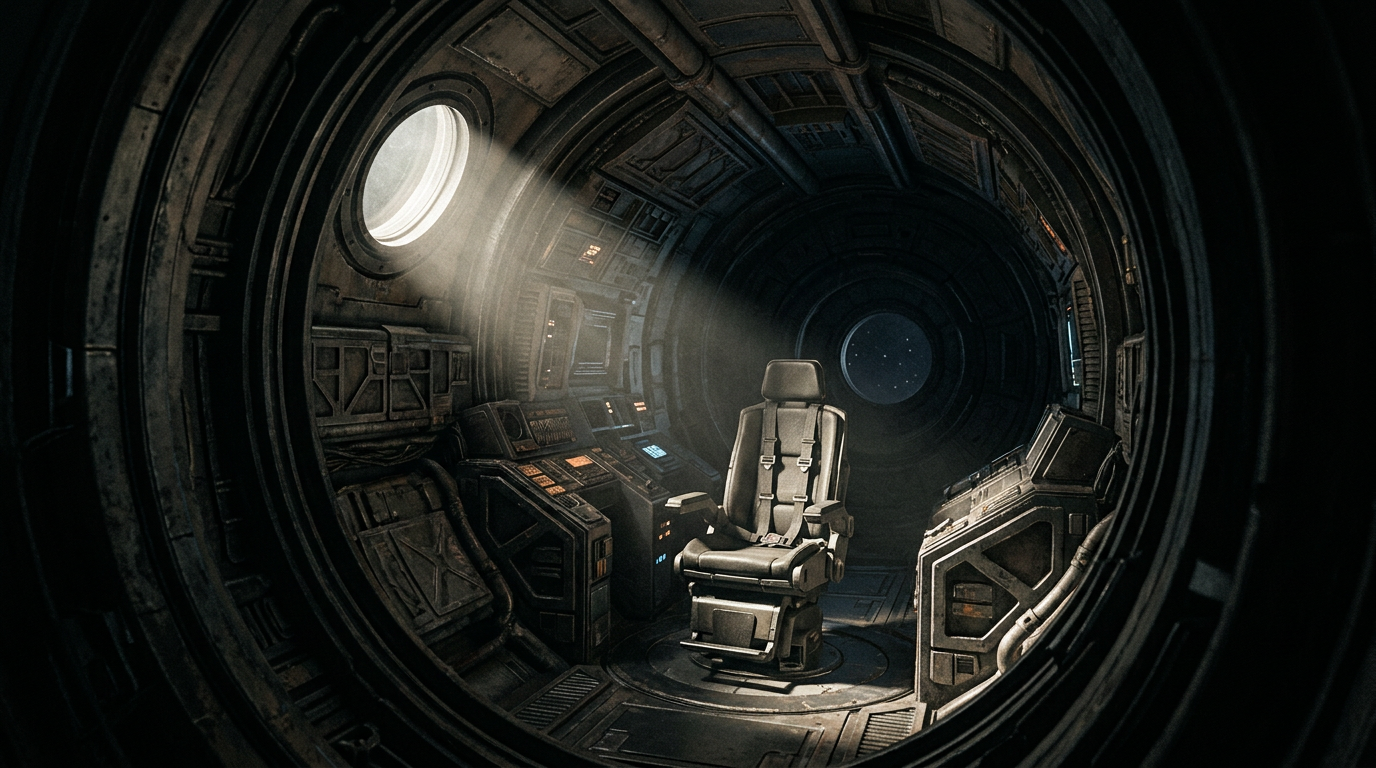
Hard sci-fi often fails on screen because it mistakes explanation for intelligence. Characters point at diagrams. Someone says “quantum” with a straight face. A whiteboard absorbs the anxiety the movie cannot dramatize. Interstellar has exposition, sometimes too much of it, but its best passages do not explain science. They stage it.
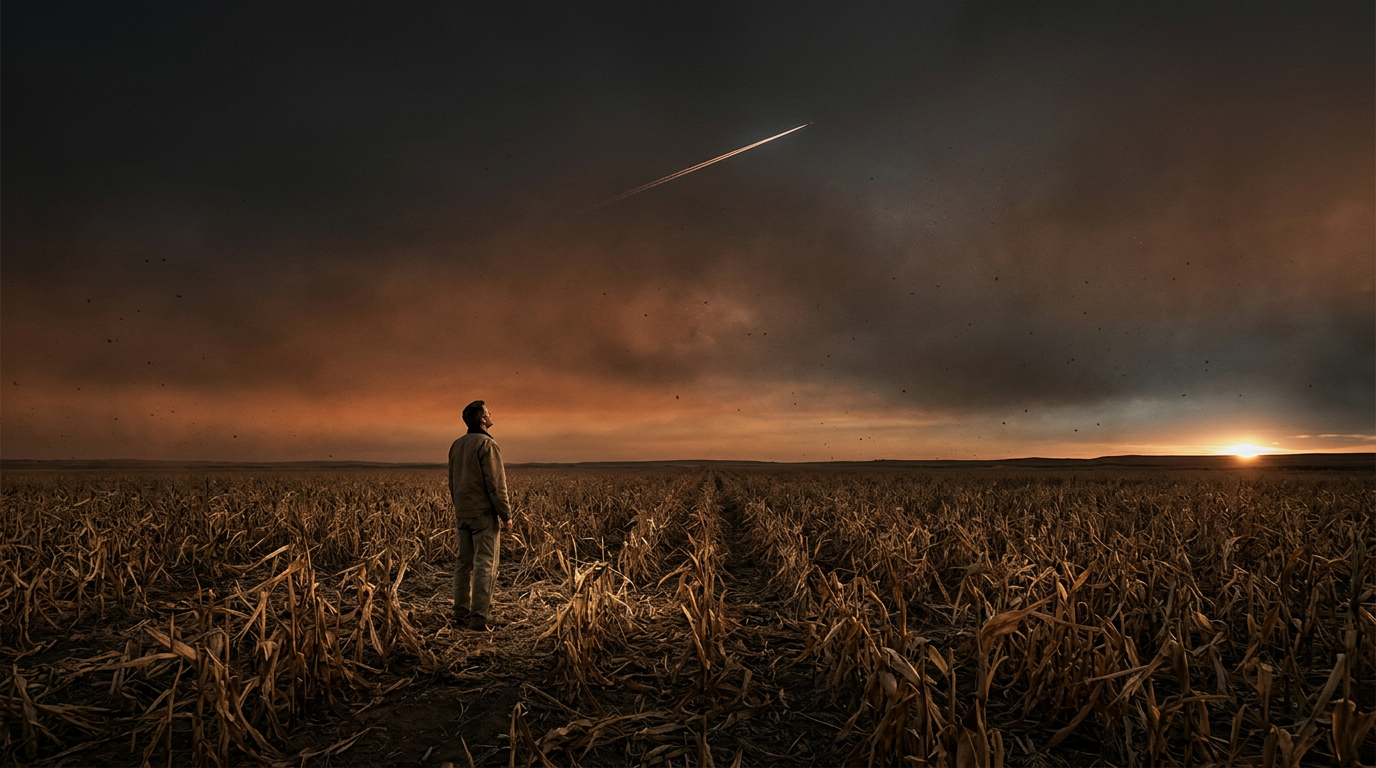
The docking sequence is the obvious example, but the film’s grammar is established earlier. The endurance of the cornfields, the dust in the house, the analog tactility of trucks and farm equipment: this is not rustic decoration. It is a world where technology has retreated from wonder into survival. Nolan and cinematographer Hoyte van Hoytema give Earth a worn, particulate texture. The future looks like the past because aspiration has been starved out of it. That is a blunt bit of world-building, and it works.
Then space arrives without the usual neon gloss. No cyberpunk clutter, no frictionless Apple-store futurism. The spacecraft interiors are practical, cramped, modular. The robots TARS and CASE are not humanoid companions engineered for easy merchandising; they are slabs, tools, jokes with load-bearing function. Their design is one of the film’s smartest choices. The uncanny valley is avoided by refusing the valley altogether.
Nolan’s editing turns relativity into cruelty. Time dilation is not an abstract concept. It becomes a cut between one location and another, between lived minutes and stolen years. The film’s structure teaches the viewer to feel duration as damage. This is what cinematic grammar means: a scientific principle translated into rhythm, shot scale, sound, and absence.
Zimmer’s score is part of that system. The organ is not merely grand. It is ecclesiastical without promising God, mechanical without becoming cold. The music suggests that awe and terror may be the same sensation under different lighting. Nolan is often accused, not unfairly, of pushing emotion through volume. Here the volume has an argument. Space is silent; the film is not.
What it gets right
The film’s strongest accomplishment is that it makes intelligence dramatic without making curiosity smug. Cooper is not a superhero physicist. He is a pilot and engineer whose competence is physical, procedural, and emotional. McConaughey plays him with a looseness that keeps Nolan’s machinery from sealing itself shut. He understands how to look at a control panel like it has betrayed him personally.
Anne Hathaway’s Brand is more divisive, partly because the screenplay gives her one of its most debated speeches about love as a force. Yet Hathaway’s performance is better than the discourse around that speech. She brings a brittle professionalism to a character fighting to keep private feeling from contaminating public duty. Jessica Chastain, Mackenzie Foy, Michael Caine, David Gyasi, Wes Bentley, and Bill Irwin’s voice work all contribute to a cast that treats the premise with seriousness without lacquered solemnity.
The film also gets scale right. Nolan cuts between the intimate and the astronomical without pretending they are equal. A hand on a window matters differently from a black hole bending light. The movie’s emotional engine depends on that inequality. Human life is tiny. Human attachment is not.
Its production design remains unusually persuasive. The Endurance is readable. You understand its circular logic. You understand why rotation matters. You understand that the ship is not a magical vessel but a rotating habitat in a hostile environment. That clarity is rarer than it should be. Many science-fiction films mistake visual density for world-building; Interstellar prefers functional design.
It also knows when to withhold. The space travel has grandeur, but it is not busy. Nolan’s preference for practical effects, large-format photography, and physical sets gives the film a material authority. Digital imagery is present, of course, but it is anchored. The spectacle feels photographed rather than merely rendered.
[SPOILERS AHEAD]
Where it stumbles
!A dusty cornfield at dusk with a faint rocket trail cutting across the sky
The criticism worth making is not that Interstellar becomes emotional. It is that it occasionally becomes too eager to translate its cosmic mystery into a solvable family diagram.
The tesseract sequence is the fault line. As an image of nonlinear time made spatial, it is bold and memorable: a library of moments, grief turned into architecture. As drama, it is powerful. As writing, it is also where the film begins narrating its own metaphysics with a little too much confidence. Nolan wants the unknowable to remain awe-inspiring, but he also wants a closed emotional circuit. The result is moving and slightly overdetermined.
The “love” argument suffers from a similar tension. Defenders sometimes overcorrect by claiming the film is not being sentimental at all, that love is merely a heuristic or human intuition pointing toward hidden information. That is too tidy. The movie absolutely wants love to matter in a cosmic sense. The problem is not sentiment. The problem is phrasing. When Nolan states his themes directly, they can stiffen.
There is also a gendered imbalance that becomes harder to ignore with time. Murph is the film’s moral and intellectual heir, and Chastain gives the adult version a fierce, wounded clarity. But the story’s emotional architecture still bends overwhelmingly around Cooper’s paternal anguish. Brand’s interior life is thinner than Hathaway’s performance deserves. The film imagines humanity’s future at colossal scale, then sometimes narrows its emotional universe to one father’s redemption.
And yes, some of the dialogue clunks. Nolan has never been afraid of characters saying the thesis aloud. Sometimes that bluntness has power. Sometimes it sounds like a margin note escaped into the scene.
The bigger idea
What Interstellar understands is that hard sci-fi is not the opposite of feeling. It is a way to make feeling costly.
Soft sci-fi often uses technology as metaphorical permission: memory machines, cloned bodies, alternate timelines, artificial minds. Hard sci-fi, at its best, uses constraint as pressure. The drama comes from what cannot be negotiated. You cannot charm gravity. You cannot argue with orbital mechanics. You cannot recover years lost to relativistic time because you finally understand what they meant.
That is why Interstellar has aged better than its loudest skeptics expected. Its science is not a credibility badge; it is a moral structure. The film lives near the Fermi paradox not because it stages a seminar about cosmic silence, but because it makes human survival feel lonely on a galactic scale. If no one is coming, then rescue must be engineered from inside the catastrophe.
This is also where Nolan’s old-fashioned streak becomes useful. He believes in sacrifice, competence, analog courage, and the stubborn dignity of professionals doing impossible jobs. In lesser hands, that becomes cornball engineering worship. Here, it mostly holds because the universe does not flatter those professionals. Every triumph costs something. Every solution arrives late.
Compare it with Arrival, Denis Villeneuve’s more linguistically elegant and philosophically graceful science-fiction drama. Arrival bends time through perception and language; Interstellar bends it through gravity and loss. One whispers, the other bellows. Both understand that speculative cinema needs form to match concept. Compare it also with Gravity, Alfonso Cuarón’s survival thriller, which is less hard sci-fi than kinetic ordeal but similarly committed to spatial clarity. Or The Martian, Ridley Scott’s buoyant problem-solving procedural, where science becomes workplace comedy under lethal conditions.
Interstellar is more ungainly than all three in places. It is also more ravenous. It wants dust-bowl Americana, space opera, relativity, ecological collapse, family melodrama, and metaphysical uplift in one machine. That machine rattles. It does not break.
What to watch next if you liked this
If Interstellar sends you looking for more hard sci-fi, do not settle for anything with a spaceship and a sad piano cue. Chase the films and shows that let rules shape drama.
- Arrival: Pair it with Interstellar for a double-bill about time, grief, and communication. Villeneuve is subtler; Nolan is more muscular. The contrast is revealing.
- The Martian: The optimistic cousin. Less cosmic dread, more procedural pleasure. A good reminder that competence can be entertaining without becoming macho mythology.
- Gravity: Watch for blocking and spatial orientation. Cuarón turns geography into suspense with ruthless elegance.
- 2001: A Space Odyssey: Still the cathedral. Kubrick’s film is colder, stranger, and more formally radical. Interstellar argues with it constantly, whether it admits it or not.
- Contact: Robert Zemeckis and Jodie Foster give scientific faith a human face, with a skepticism that makes the awe feel earned.
- The Expanse: For television, this is the major modern reference point. Political intrigue, class conflict, and orbital mechanics actually share the same frame.
- For All Mankind: Apple TV+’s alternate-history space drama is more soap-forward, but its best stretches understand engineering as national psychology.
- Aniara: A bleaker Swedish counterpoint. If Interstellar believes survival can be wrestled from cosmic indifference, Aniara asks what happens when meaning runs out before the oxygen does.
For reading, start with Kip Thorne’s The Science of Interstellar, which remains unusually accessible without sanding off the complexity. Follow it with Carl Sagan’s Contact for the novelistic version of scientific longing, and Kim Stanley Robinson’s Aurora if you want a colder argument about the fantasy of leaving Earth behind.
The verdict
Interstellar endures because it treats the laws of physics as dramatic collaborators. Not obstacles to spectacle. Not homework. Collaborators.
Its flaws are real: the declarative dialogue, the tidied metaphysics, the emotional narrowing around Cooper. But those flaws belong to an ambitious film straining toward synthesis, not a timid one hiding behind polish. Nolan made a blockbuster where relativity changes the editing pattern, where production design teaches physics, where a black hole is both an object and an accusation.
That is the cinematic grammar of hard sci-fi: the cut as consequence, the frame as measurement, the spectacle as limit. Interstellar speaks it fluently. Sometimes too loudly. But in a culture drowning in frictionless futures, volume is not the worst sin.
Discussion (0)
Loading comments…