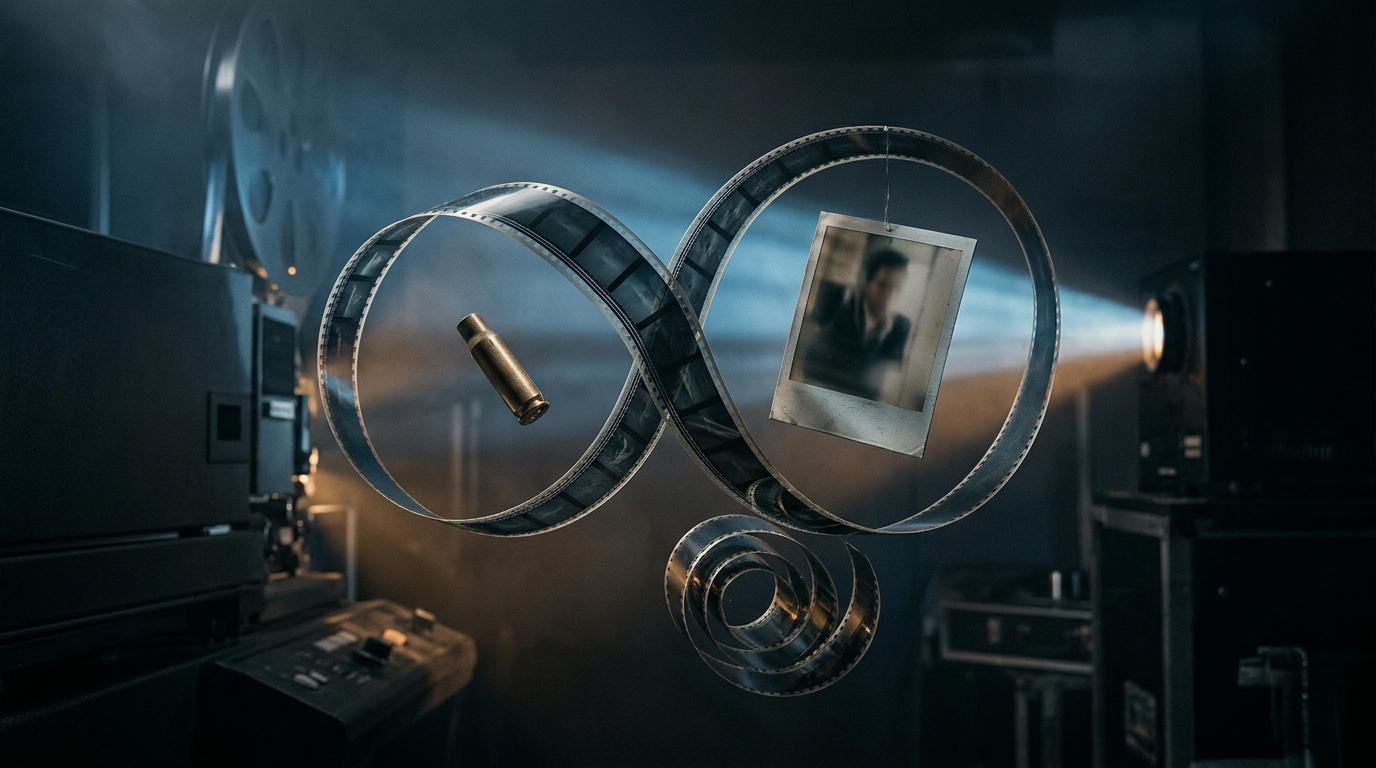
Nolan makes time behave like guilt
A Polaroid fades in reverse, and Christopher Nolan’s career announces its obsession before it has the budget to decorate it.
That image from Memento is still the cleanest thesis statement Nolan has ever filmed. Not because it is tricky. Trickery is the cheap reading of Nolan, the one that reduces him to flowcharts and Reddit diagrams. The better reading is harsher and more interesting: Nolan uses time as a moral instrument. He bends chronology to expose what people refuse to know, what systems refuse to admit, and what violence looks like when cause and effect stop behaving politely.
By the time Tenet arrived in 2020, with bullets returning to guns and soldiers fighting through time like it was hostile weather, the grammar had swollen from noir device to blockbuster physics. The result is both exhilarating and absurdly overbuilt. But it is not a departure. It is the same sentence Nolan began writing in Memento, only now scored by Ludwig Göransson, mounted on IMAX scale, and delivered with the blunt confidence of a director who no longer asks permission to make mass audiences work.
Why it matters now
In 2026, Nolan’s cinema looks less like an outlier than a provocation aimed at the whole viewing economy. Streamers have trained audiences to graze. Prestige TV has trained them to defer judgment across eight episodes. Franchise storytelling has trained them to wait for the post-credit explanation. Nolan keeps insisting on the opposite: sit down, submit to the cut, and let structure do the thinking.
That stubbornness matters in a landscape where Apple TV+ can fund cerebral sci-fi like Severance and Silo, Netflix can turn speculative premises into global inventory, and theatrical exhibition is still trying to prove that Dolby Cinema and IMAX 70mm offer something your living room cannot. Nolan’s cinema is one answer. Not the only answer, and not always the most graceful one. But he understands that scale is not merely size. Scale is attention.
His films ask for a kind of viewing that feels almost old-fashioned now: temporal patience. Oppenheimer, though outside the Memento-to-Tenet corridor in one sense, made that argument commercially undeniable. It won Best Picture and Best Director at the 2024 Oscars without behaving like frictionless content. It cut between timelines, hearings, memory, guilt, science, politics, and dread. The public followed. Apparently audiences do not hate complexity. They hate being condescended to.
So revisiting the path from Memento to Tenet is not a nostalgia exercise. It is a way of understanding how one filmmaker turned editing into worldview.
The grammar begins with Memento
!A noir motel room with photographs, a lamp, and fractured mirror reflections
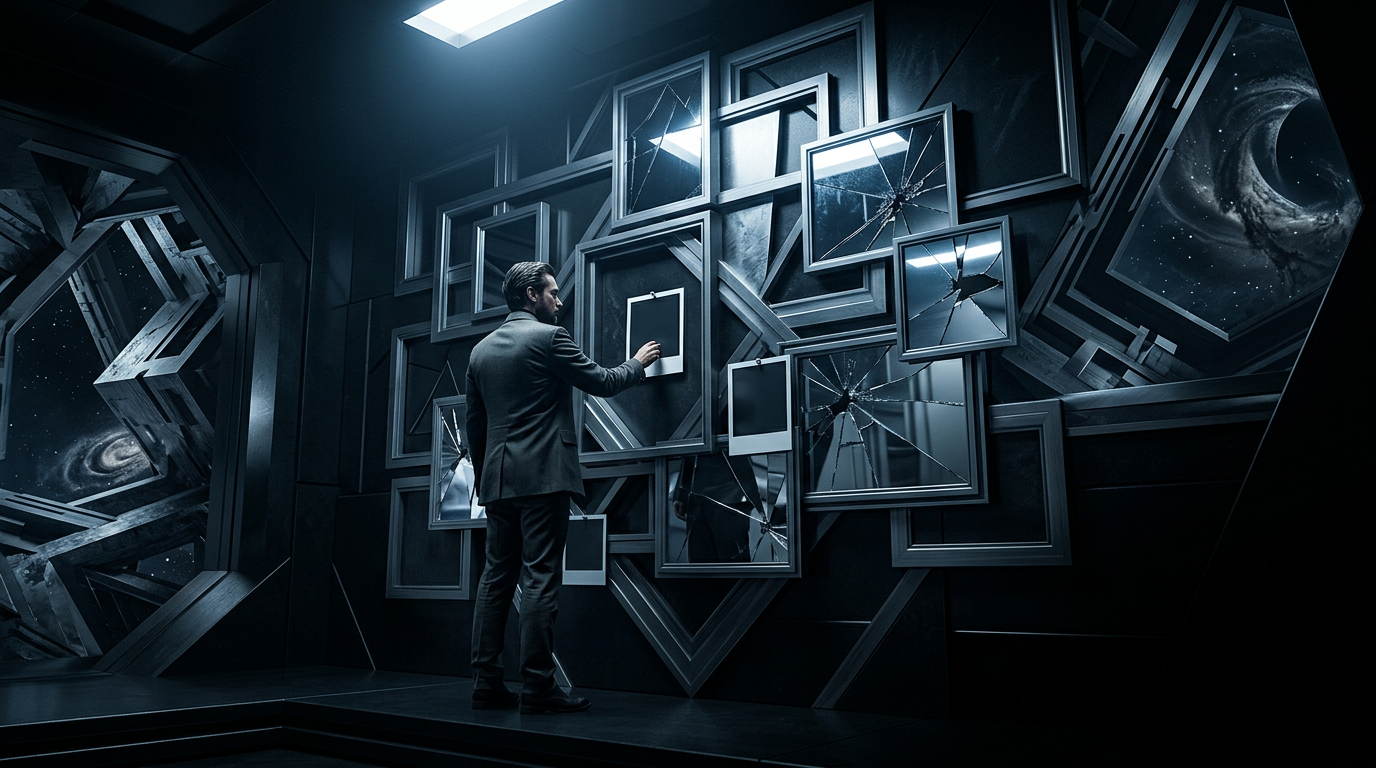
Memento is often described as a puzzle film, which is true in the same way a scalpel is a shiny object. The structure matters because it makes the viewer inhabit Leonard Shelby’s damage without romanticizing it. Nolan and editor Dody Dorn split the film into competing temporal systems: black-and-white scenes that move forward, color scenes that move backward. The design is elegant enough to teach itself as it goes.
What makes it durable is not the mechanism but the cruelty of the mechanism. Every scene begins with confusion and ends with temporary confidence. Then the next scene steals that confidence away. The audience is made to experience knowledge as something perishable. In most thrillers, revelation feels like progress. In Memento, revelation is unstable, maybe even poisonous.
That becomes Nolan’s recurring move. Time is not just chronology. It is architecture. In The Prestige, the structure turns rivalry into recursion. In Inception, dream levels create a vertical system of action, with each layer moving at a different speed. In Interstellar, relativity is not an exotic garnish; it is the film’s emotional knife, turning minutes into decades. In Dunkirk, three timelines compress land, sea, and air into one survival rhythm. In Tenet, entropy becomes blocking, choreography, and spectacle.
This is why Nolan’s best work cannot be reduced to plot summaries. The story is often less important than the rules by which the story is permitted to unfold.
What it gets right
Nolan’s great strength is that he makes temporal structure visible without making it inert. His cinema is full of exposition, yes, sometimes enough to qualify as a weather system. But the real instruction happens through movement: a van falling in slow motion in Inception, a wave hitting in Interstellar, a Spitfire gliding in Dunkirk, an inverted fight in Tenet where the body seems to remember injuries before it receives them.
He also trusts editing as a primary dramatic language. Many contemporary blockbusters use montage as compression: a way to get from one expensive thing to the next. Nolan uses montage as collision. Cross-cutting in his films is rarely neutral. It creates philosophical pressure. The cut says two moments belong together even when linear time says they do not.
That is clearest in Dunkirk, his most formally disciplined film. The one-week beach timeline, the one-day sea timeline, and the one-hour air timeline should feel like a diagram. Instead, they build toward a shared pulse. The film has minimal dialogue and almost no conventional character psychology, yet it is emotionally legible because the mise-en-scène is so exact: bodies trapped on open beaches, ships as temporary coffins, cockpit glass turning the sky into a prison cell. Time is not an abstraction. It is fuel, tide, distance, breath.
Tenet is messier, but its best sequences push this further. Inversion is not just a concept; it alters blocking. People move as if the world has rejected their joints. Objects do not simply fly backward. They seem to obey a competing contract with reality. The practical effects help. Nolan’s resistance to purely weightless digital spectacle gives the impossible a tactile irritation. You may not always understand the sentence, but you can feel the grammar scraping against the image.
[SPOILERS AHEAD]
From puzzle box to battlefield
!Opposing figures cross a smoky concrete battlefield in mirrored motion
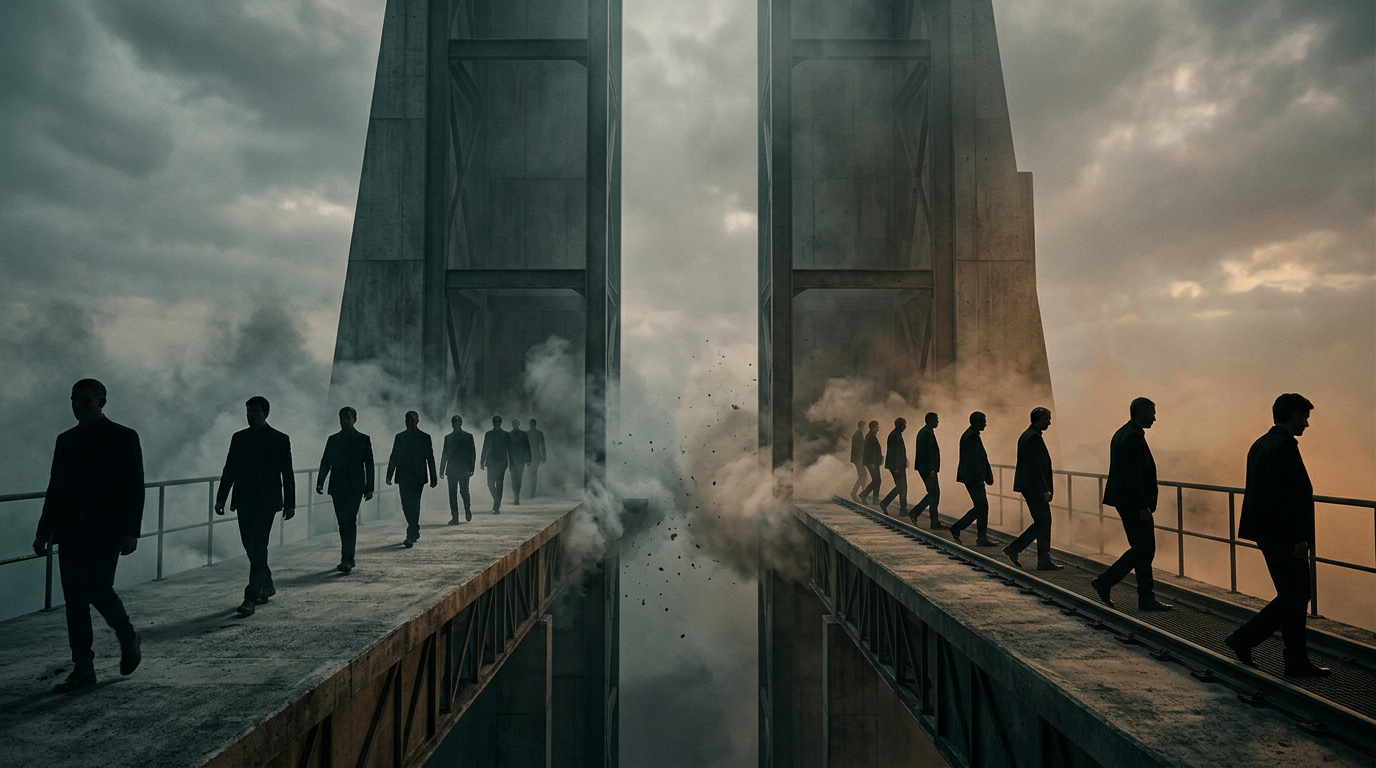
The most revealing difference between Memento and Tenet is ethical scale. Memento is private damnation. Leonard’s tragedy is that his condition does not merely trap him; it gives him cover. The backward structure lets us discover that ignorance can be chosen, maintained, even weaponized. Memory failure becomes moral failure. Nolan’s noir is not about a man who cannot remember. It is about a man who may prefer not to.
Tenet expands that problem until it becomes geopolitical. The future attacks the past because the present has poisoned the planet. That premise brushes against the Dark Forest mood of modern sci-fi: history as a hostile field, survival as preemptive violence, knowledge as strategic danger. Nolan does not linger on the ecological politics long enough to make Tenet a climate film, but the premise has a nasty charge. The future is not grateful. It is suing us with bullets.
The Protagonist’s final discovery, that he has been moving through an operation he will later create, is Nolan’s favored loop in its most militarized form. Memento asks whether identity survives without memory. Tenet asks whether agency survives inside a closed causal system. Both are variations on the same anxiety: if the end is already embedded in the beginning, what does responsibility mean?
Nolan’s answer is rarely nihilistic. His characters may be trapped by structure, but they are judged by conduct. Cooper in Interstellar cannot defeat relativity, but he can act out of love and persistence. Farrier in Dunkirk cannot end the war, but he can spend the last of his fuel protecting men below. The Protagonist cannot stand outside time, but he can choose loyalty inside the loop. Nolan is fascinated by determinism, yet he keeps smuggling in duty.
What it gets wrong / where it stumbles
The genuine criticism is not that Nolan is cold. That complaint has always felt lazy. He is often sentimental, sometimes embarrassingly so. The real problem is that his people can become functions in a temporal machine.
Tenet suffers most from this. John David Washington gives the film physical intelligence and dry humor, and Robert Pattinson finds a relaxed, melancholy frequency as Neil. But the film’s human stakes are thinner than its architecture. Elizabeth Debicki’s Kat is written with more anguish than agency for too long, and Kenneth Branagh’s Sator pushes into operatic villainy without enough texture to make his monstrousness interesting. The result is a film where the rules are more alive than some of the characters obeying them.
Nolan’s sound mix, a perennial argument, also becomes part of the issue. Obscured dialogue can be an aesthetic choice; it can place us inside chaos, machinery, panic. But in a film already asking viewers to track entropy, espionage, temporal pincer movements, and shifting allegiances, muffled exposition starts to feel less like immersion than needless abrasion.
There is also a ceiling to Nolan’s puzzle-box impulse. When structure becomes too dominant, emotion can arrive as proof rather than experience. Interstellar mostly avoids that because Matthew McConaughey and Jessica Chastain give the film a bruised, open nerve. Tenet does not always have that counterweight. It is magnificent at momentum, weaker at ache.
The bigger idea
Nolan’s grammar of time is really a grammar of consequence. He distrusts the comforting fiction that life unfolds in clean moral order: cause, effect, lesson, redemption. His films break sequence because guilt does. Trauma does. History does. Scientific discovery certainly does.
That is why his work sits oddly beside both hard sci-fi and soft sci-fi. He borrows from physics, but he is not primarily a physicist-filmmaker. He is a dramatist of systems. The wormhole in Interstellar, the dream tech in Inception, the inversion in Tenet: these are speculative engines built to pressure human behavior. The science matters less as textbook accuracy than as cinematic constraint.
The closest philosophical neighbor may be the Ship of Theseus problem, though Nolan applies it to identity under temporal stress. If memory changes, is the self intact? If a future version of you causes your present action, are you still choosing? If a nation retells its past in a different order, has it changed what happened or merely what it can bear to admit?
This is where Oppenheimer feels like the afterimage of the whole project. Nolan no longer needs science-fiction machinery to fracture time. History itself does the work. The film’s cross-cutting turns biography into fallout. The blast is not one event; it is an expanding moral waveform.
From Memento to Tenet, then, the progression is not from small puzzle to big puzzle. It is from subjective fracture to cosmic logistics. Nolan keeps widening the frame while asking the same question: what happens when time stops protecting us from the consequences of our actions?
What to watch next if you liked this
If this is the version of Nolan that interests you, skip the lazy algorithmic queue and program your own double bills.
- Memento with Point Blank: John Boorman’s 1967 crime film is a cooler, stranger ancestor in fractured noir psychology.
- Inception with Paprika: Satoshi Kon’s anime landmark shows dream logic with a more elastic, destabilizing visual imagination.
- Interstellar with Arrival: Denis Villeneuve and Nolan both turn time into feeling, but Villeneuve moves with a quieter, more linguistic sense of grief.
- Dunkirk with The Thin Red Line: Nolan’s temporal compression plays beautifully against Terrence Malick’s war film, which treats combat as memory, nature, and metaphysical rupture.
- Tenet with Primer: Shane Carruth’s microbudget time-travel film remains the sterner, more claustrophobic cousin to Nolan’s maximalist spectacle.
- Oppenheimer with JFK: Oliver Stone’s montage paranoia and Nolan’s historical fragmentation make a bracing pair about American mythmaking.
For television pairings, Devs is the cleanest match: Alex Garland’s series is colder, more explicitly deterministic, and more willing to stare into the machinery. Dark is the maximalist cousin, a family-tree nightmare built from causal loops. Severance belongs nearby too, not because it is about time travel, but because it understands structure as captivity.
For follow-up reading, start with Jorge Luis Borges’ short fiction, especially stories that treat labyrinths and time as metaphysical traps. Then read Ted Chiang’s Story of Your Life, the basis for Arrival, for a more tender approach to nonlinear experience. If you want the film-craft lane, David Bordwell’s writing on narrative comprehension and film form remains useful without flattening the pleasure out of the movies.
The verdict
Christopher Nolan’s time games endure because they are not games, exactly. They are stress tests. He scrambles chronology to reveal character, not to decorate it. At his best, the result is blockbuster cinema with a working brain and a guilty conscience. At his worst, the diagram outmuscles the pulse.
Tenet remains the limit case: dazzling, bruising, sometimes ridiculous, often brilliant. Memento remains the key: a cheap room, a damaged man, a photograph refusing to stay fixed. Between them runs one of modern cinema’s most persistent formal arguments. Time is not the container of Nolan’s stories. Time is the antagonist, the editor, the witness, and the crime scene.
Discussion (0)
Loading comments…