Severance turns the office into a crime scene
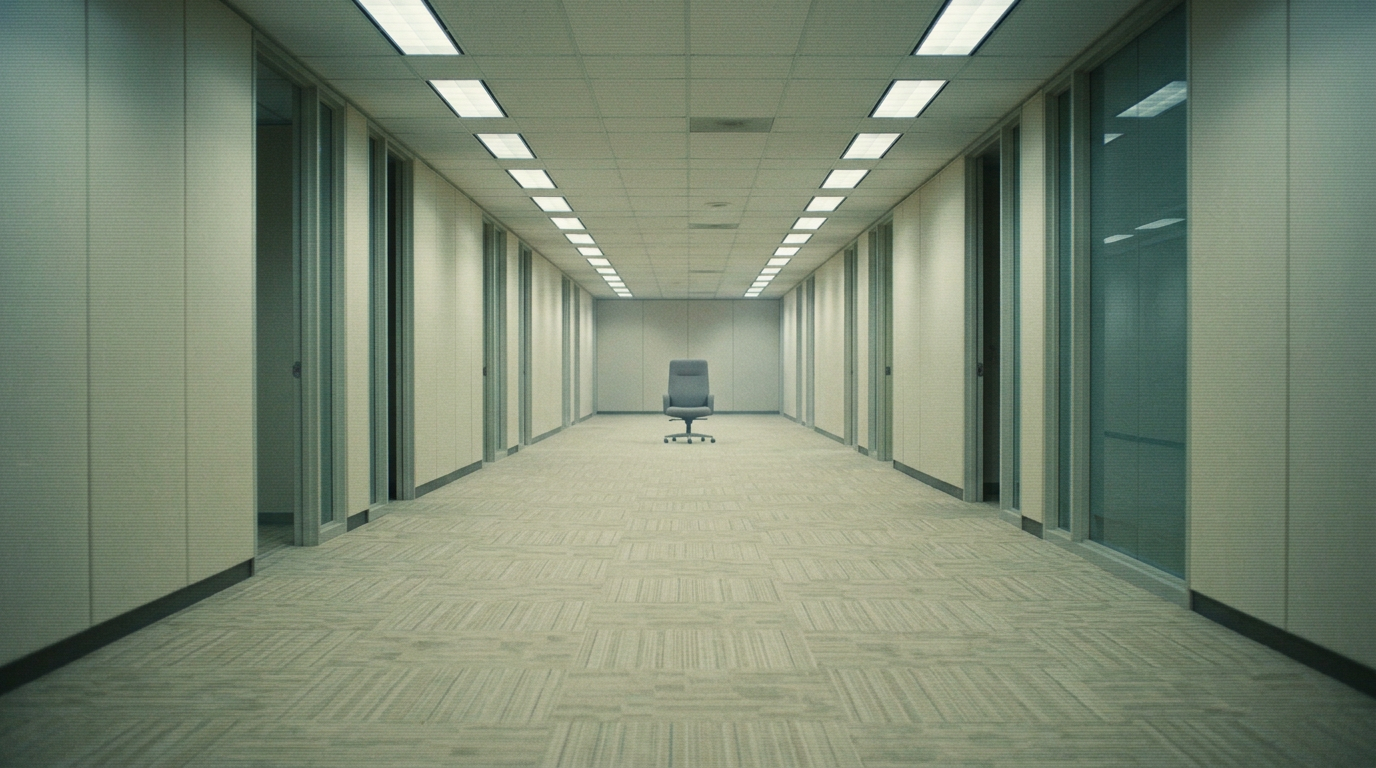
The scariest room on television is a white hallway with carpeting.
That is the genius of Severance, Apple TV+’s immaculate corporate nightmare from creator Dan Erickson, with Ben Stiller among its defining directors. The show’s premise is famous by now: Lumon Industries allows employees to split their consciousness, creating an office self with no memory of home and a home self with no memory of work. It is a science-fiction hook with the clean cruelty of a legal document. But the true achievement is not the chip. It is the building.
Severance understands something most dystopias miss: modern power rarely arrives dressed as a tyrant. It arrives as onboarding. It arrives as a wellness room, an employee handbook, a floor nobody can quite map. Lumon’s severed floor is not merely a setting; it is the show’s operating system. The architecture produces the psychology. The blocking produces the politics. The mise-en-scène does half the writing before anyone speaks.
Two seasons in, with the series now a central pillar of Apple TV+’s prestige sci-fi identity alongside Silo and Foundation, Severance still feels less like puzzle-box television than a workplace injury report filed from the soul.
Why it matters now
The timing of Severance has only become sharper. When the show premiered in 2022, remote work, return-to-office mandates, surveillance software, and burnout had already turned the American workplace into a cultural argument. By 2026, the argument has curdled. Companies sell flexibility while measuring keystrokes. Offices promise collaboration while quietly restoring hierarchy. AI tools are pitched as liberation and then used to intensify output. Everyone is invited to bring their whole self to work, then punished for having one.
Severance does not satirize corporate life by exaggerating it into absurdity. It simply literalizes what already exists. Most people are asked to partition themselves: pleasant Slack self, exhausted commute self, medicated Sunday-night self, brand-safe LinkedIn self. Lumon turns that psychic compartmentalization into hardware.
That is why the show has outlasted the novelty of its premise. It is not really about whether severance technology could exist. As hard sci-fi, the procedure is intentionally vague. As soft sci-fi, it is brutally precise. The show cares less about neuroscience than ritual: badges, elevators, cubicles, wellness sessions, compliance theater. It knows the office is a machine for shaping behavior, and every machine has an architecture.
In the current streamer wars, where Netflix still favors scale, Max leans on library power, Amazon MGM hunts for franchises, and Apple TV+ keeps buying expensive seriousness, Severance occupies a rare lane. It is cerebral without looking ashamed of entertainment. It has cliffhangers, but it is not only cliffhangers. It builds memes out of waffle parties and finger traps, then smuggles in a bleak thesis about labor, grief, and consent.
The office as a weapon
!Empty corporate cubicles isolated under fluorescent lights

Lumon’s severed floor is designed like an HR department swallowed a mausoleum. The hallways are too wide and too empty. The cubicles sit in an ocean of negative space. Fluorescent light flattens faces. The color palette has the sickly calm of institutional optimism: mint, beige, corporate blue, fluorescent white. It is midcentury modern after the soul has been repossessed.
Production designer Jeremy Hindle’s work is crucial here. Lumon is not cyberpunk clutter. There are no rain-slick neon alleys, no visible megacity, no sexy decay. The horror is sterile. The building feels both futuristic and archaic, as if IBM, a cult compound, and a suburban medical park merged during a bad dream. That hauntological quality matters: Lumon’s future is built from dead office futures, from the promises once attached to mainframes, productivity seminars, and paternalistic employers who offered purpose in exchange for obedience.
The show’s spatial logic is deliberately humiliating. Mark S. and his fellow innies can walk, but not leave. They can perform tasks, but not understand them. They can form relationships, but only under supervision. The labyrinth is not complicated because Lumon lacks efficiency. It is complicated because disorientation is discipline.
This is where Severance becomes one of television’s great architectural dystopias, closer in spirit to Jacques Tati’s PlayTime than to many obvious sci-fi comparisons. Tati saw modern glass-and-steel environments as comic machines for making humans ridiculous. Severance sees the corporate campus as a machine for making humans govern themselves.
There is a touch of the panopticon in Lumon, but the show is smarter than simply saying surveillance is bad. The severed workers are watched, yes, especially by Seth Milchick, played by Tramell Tillman with a smile so polished it becomes a blade. Yet the more frightening control is internal. The innies absorb the rules. They police their own curiosity. They learn which doors not to open.
What it gets right
The performances are calibrated to the show’s architecture. Adam Scott gives Mark S. a stunned, clerical sadness; his body seems to have learned obedience before his mind has caught up. Britt Lower’s Helly is the show’s live wire, a person whose refusal exposes the moral obscenity everyone else has normalized. Zach Cherry’s Dylan weaponizes deadpan office banter until it cracks into need. John Turturro and Christopher Walken make Burt and Irving’s connection feel fragile, formal, and devastating, all glances and careful posture. Patricia Arquette’s authority is terrifying because it keeps changing temperature.
But the standout may be Tillman, whose Milchick turns middle management into performance art. He is not a henchman in the usual dystopian sense. He is something worse: a believer with excellent soft skills. Watch the way he uses rhythm. Praise, pause, correction, smile. He understands that corporate violence is most effective when delivered in a tone suitable for a birthday card.
Stiller’s direction favors symmetry and negative space without turning the show into an empty design object. The camera often holds back, letting bodies look small inside rooms built to erase them. The blocking is exact. Characters stand too far apart at desks, too centered in doorways, too visible in open space. Even the jokes depend on distance. The absurdity lands because the frame refuses to wink.
The editing also respects dread. Severance is patient, but not inert. It lets procedures accumulate until they become theology. Macrodata Refinement, Optics and Design, the Break Room, the Perpetuity Wing: each location has its own ritual grammar. The series is very funny about corporate mythology, especially the way companies invent founders, values, mascots, acronyms, and rewards to disguise the absence of meaning.
And crucially, the show never forgets the body. So much contemporary tech fiction drifts into screens, code, and abstraction. Severance remains tactile: elevator doors, keycards, desks, melon bars, paper forms, old computers, stiff dancing, fluorescent rooms. Its dystopia is diegetic and physical. The future hurts because you have to walk through it in dress shoes.
What it gets wrong / where it stumbles
!Closed elevator door glowing faintly in a sterile office corridor
The weakness of Severance is also the risk of its success. The stranger Lumon becomes, the more the show has to fight against becoming a lore dispenser. The goats, the rituals, the Kier Eagan theology, the secret departments: all of it is compelling, but some of it flirts with the prestige-TV disease of multiplying mysteries faster than meanings.
Season two, in particular, benefits from confidence but occasionally tests patience with coyness. Not slowness. Slowness can be a virtue, and Severance often earns it. The issue is withholding. There are moments when the series seems to know exactly what emotional question matters, then steps sideways to protect the machinery of suspense.
That matters because the best version of Severance is not a riddle. It is a moral horror story. The severance procedure is not scary because viewers need a flowchart. It is scary because it creates a person and then calls that person a resource. Whenever the series foregrounds that ethical wound, it is extraordinary. Whenever it behaves too much like a mystery franchise guarding its IP, it becomes merely clever.
A smaller complaint: the show’s pristine control can sometimes make grief feel over-designed. Mark’s pain is central, and Scott plays it beautifully, but the series occasionally frames trauma with such compositional elegance that you can feel the glass case around it. The chill is part of the point. Still, now and then, a little mess would help.
[SPOILERS AHEAD]
The bigger idea
The first season’s famous finale works because it turns geography into rebellion. The characters do not simply learn facts; they breach the boundaries that define their existence. The elevator, once a neutral transition space, becomes a moral weapon. The office map becomes a prison diagram. The outside world, which should represent freedom, reveals its own architecture of performance, money, family, class, and corporate reach.
That is the show’s darkest joke. The innies are trapped, but the outies are not exactly free. They have more space and fewer answers. Mark’s grief, Helly’s public identity, Irving’s private discipline, Dylan’s discovery of a life beyond the office: each reveals that severance does not create alienation from scratch. It formalizes it.
This is where Severance brushes against capitalist realism, the idea that it has become easier to imagine bizarre technologies than a genuine alternative to the systems that organize our lives. Lumon’s miracle procedure does not abolish work. It makes work more total. It solves the inconvenience of human interiority.
The brilliance of the show’s corporate dystopia is that Lumon rarely needs to shout. It offers perks. It offers purpose. It offers a family language without family obligations, a religion without salvation, a bureaucracy without accountability. It weaponizes cheer. The architecture enforces all of this by making alternatives physically unimaginable. Every hallway says: continue.
That is why Severance belongs in conversation with Brazil, The Matrix, Office Space, Black Mirror, Mr. Robot, Devs, and Andor, despite looking unlike most of them. Terry Gilliam made bureaucracy grotesque. The Wachowskis made the simulation sleek and martial. Mike Judge found the deadpan absurdity of cubicle life. Sam Esmail turned systems paranoia into a subjective fracture. Alex Garland made determinism glow inside a tech campus. Tony Gilroy made authoritarianism procedural. Severance takes the office itself and asks what kind of person it needs you to become in order to function.
Why the building stays with you
Many shows build worlds by expanding outward. Severance builds inward. It makes a few rooms feel cosmological. This is a rare discipline in contemporary television, especially at a time when streamers often mistake scale for imagination. Bigger maps, more factions, more mythology, more expensive skylines. Severance understands that a hallway can be more frightening than a spaceship if the hallway controls who you are.
Its corporate dystopia is also more durable than the usual evil-company plot because Lumon is not merely greedy. It is metaphysical. The company wants profit, surely, but it also wants reverence. It wants to define reality for its workers, to decide which memories count, which selves matter, which pain can be outsourced to another version of you.
That is why the show’s retrofuturist design feels so potent. Lumon is not the future of work as Silicon Valley markets it. It is the old dream of total institutional belonging resurrected with biotech. Company town, cult, laboratory, office park. Same elevator.
The severed floor is not a metaphor laid on top of the story. It is the story. Every wall is a policy. Every room is an argument. Every corridor is a sentence with no period.
What to watch next if you liked this
If Severance left you staring suspiciously at your badge scanner, pair it with work that understands systems as environments, not just villains.
- Double-bill: Severance and PlayTime — Tati’s 1967 comedy turns modern architecture into choreography. It is lighter, stranger, and essential for understanding how built spaces can bully the human body.
- Double-bill: Severance and Brazil — Terry Gilliam’s bureaucratic nightmare is messier and more baroque, but its paperwork panic shares Lumon’s hatred of individual life.
- Follow-up TV: Mr. Robot — Sam Esmail’s series is more overtly cyberpunk and conspiratorial, yet it shares Severance’s concern with fractured identity under corporate power.
- Follow-up TV: Devs — Alex Garland’s limited series turns a tech campus into a temple of determinism. Colder, more philosophical, and worth the comparison.
- Follow-up TV: Silo — Apple TV+’s other great architecture-of-control series, built around vertical space, secrecy, and managed knowledge.
- Follow-up film: Ex Machina — Garland again, with a glass-box workplace where design, gender, power, and the uncanny valley do the real talking.
- Follow-up film: The Matrix — Still the cleanest pop articulation of reality as managed infrastructure, even if Severance swaps leather coats for lanyards.
- Reading: Mark Fisher’s Capitalist Realism — Short, sharp, and useful for thinking about why Lumon feels less invented than recognized.
Final verdict
Severance is the rare prestige sci-fi series whose design is not decoration. It is diagnosis. The show’s most unsettling idea is not that a corporation might split your mind in two. It is that the modern workplace already asks for the split, then calls the wound professionalism.
The series can be too enamored of its own mysteries, and its immaculate surfaces occasionally risk sealing off the messier human ache underneath. But when Severance is at its best, which is often, it turns corporate architecture into existential horror. Not a monster in the building. The building as monster.
That white hallway still scares me. It should.
Discussion (0)
Loading comments…