Silo turns apocalypse into architecture
The stairwell is the star.
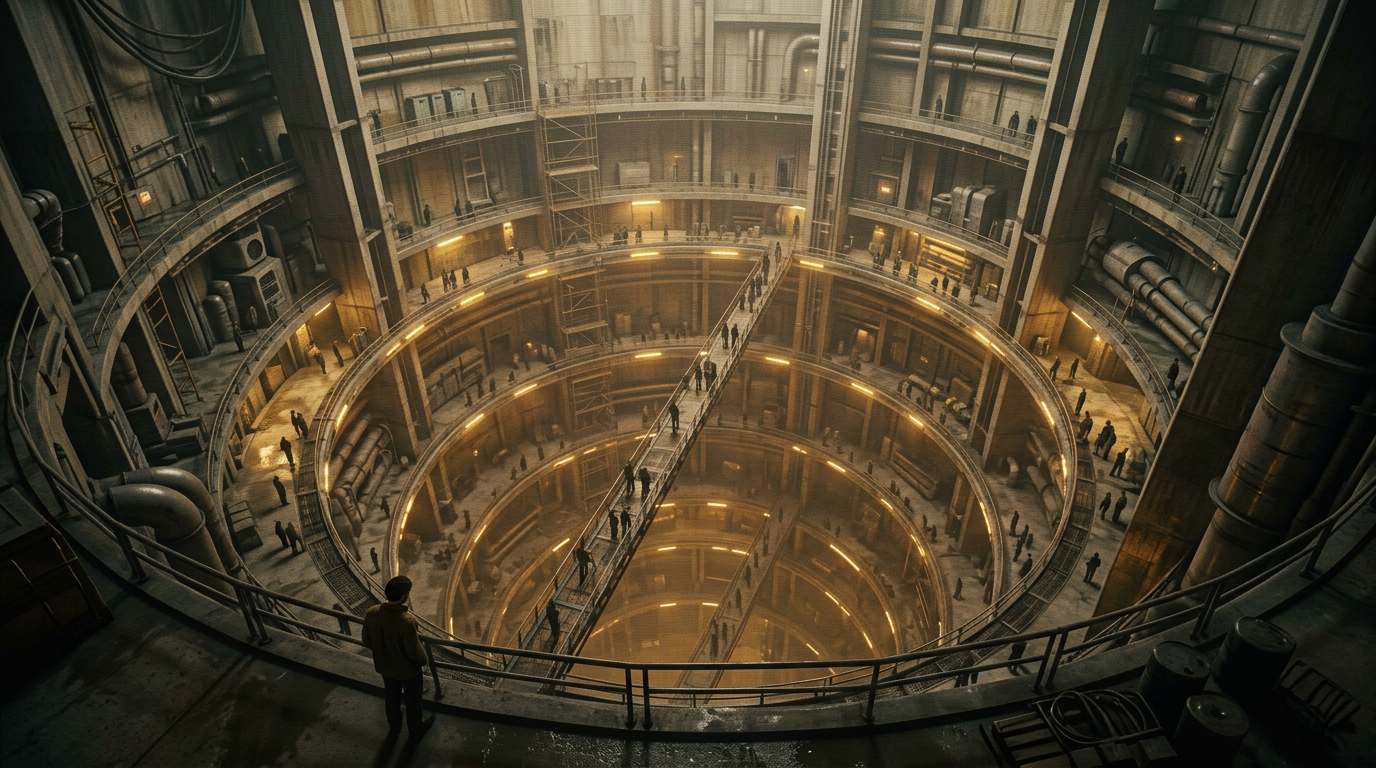
Apple TV+’s Silo has plenty of human assets: Rebecca Ferguson’s clenched, watchful performance as Juliette Nichols; Tim Robbins turning institutional rot into a vocal register; Harriet Walter giving grief the texture of old steel. But the show’s real lead is the silo itself, a buried city of concrete rings, humming machines, rationed light, and vertigo. It does not merely house the drama. It authors it.
That is the difference between competent dystopian television and science fiction with a pulse. Silo, adapted from Hugh Howey’s novels and developed for television by Graham Yost, understands that a post-apocalyptic city should not be wallpaper with pipes. It should exert pressure. It should make some gestures possible and others unthinkable. It should decide who gets air, who gets knowledge, who gets a view, and who gets disappeared into the lower levels with a wrench in hand.
For viewers coming to Silo after Severance, Fallout, Foundation, The Last of Us, or Netflix’s 3 Body Problem, the hook is not just mystery-box plotting. It is urban design as ideology. The silo is a vertical panopticon disguised as a shelter. Its citizens are told the outside world is death, which may be true, but the deeper horror is that the inside has learned to imitate a world.
Why it matters now
Post-apocalyptic storytelling used to sell itself on emptiness: abandoned freeways, weeds through shopping malls, cities reduced to matte paintings of regret. Silo flips the emphasis. Its apocalypse is crowded. Bureaucratic. Badly lit. Full of maintenance requests.
That feels right in 2026. The contemporary screen apocalypse is no longer only about nuclear ash or zombie herds; it is about systems that continue working after their moral purpose has expired. Apple TV+ has built one of the stranger prestige sci-fi portfolios in streaming, from the corporate metaphysics of Severance to the imperial sprawl of Foundation and the alternative-history engineering dream of For All Mankind. Silo sits in that lineup as the infrastructure show: a drama about pipes, stairs, cameras, power grids, information choke points, and the politics of keeping a population alive while keeping it misinformed.
The timing also matters because original-feeling science fiction has become oddly precious. The theatrical side has seen renewed appetite for scale and seriousness, from Denis Villeneuve’s Dune films to Christopher Nolan’s IMAX-era event filmmaking, while streamers still prefer brands, continuations, and algorithm-friendly premises. Silo is based on novels, yes, but it plays less like franchise management than like an argument for patient world-building. It trusts that a generator room can be as suspenseful as a gunfight if the blocking, sound design, and social stakes are sharp enough.
Its city belongs to a lineage: Fritz Lang’s Metropolis, Terry Gilliam’s Brazil, Bong Joon-ho’s Snowpiercer, Ridley Scott’s Blade Runner, Alex Garland’s Devs, Andor’s Narkina 5 prison arc. These works know architecture is never neutral. It channels labor. It arranges obedience. It turns the body into a citizen before anyone says a word.
The city as character, not set decoration
!A vast underground silo city spirals downward through industrial haze
The smartest thing Silo does is give the city habits.
The staircase is not just a practical solution for a subterranean society. It is the show’s social diagram. Power lives higher. Labor sinks lower. Every ascent costs time, breath, and status. Characters do not simply move through space; they negotiate a hierarchy with their knees and lungs. The absence of elevators is not a world-building quirk. It is politics turned into cardio.
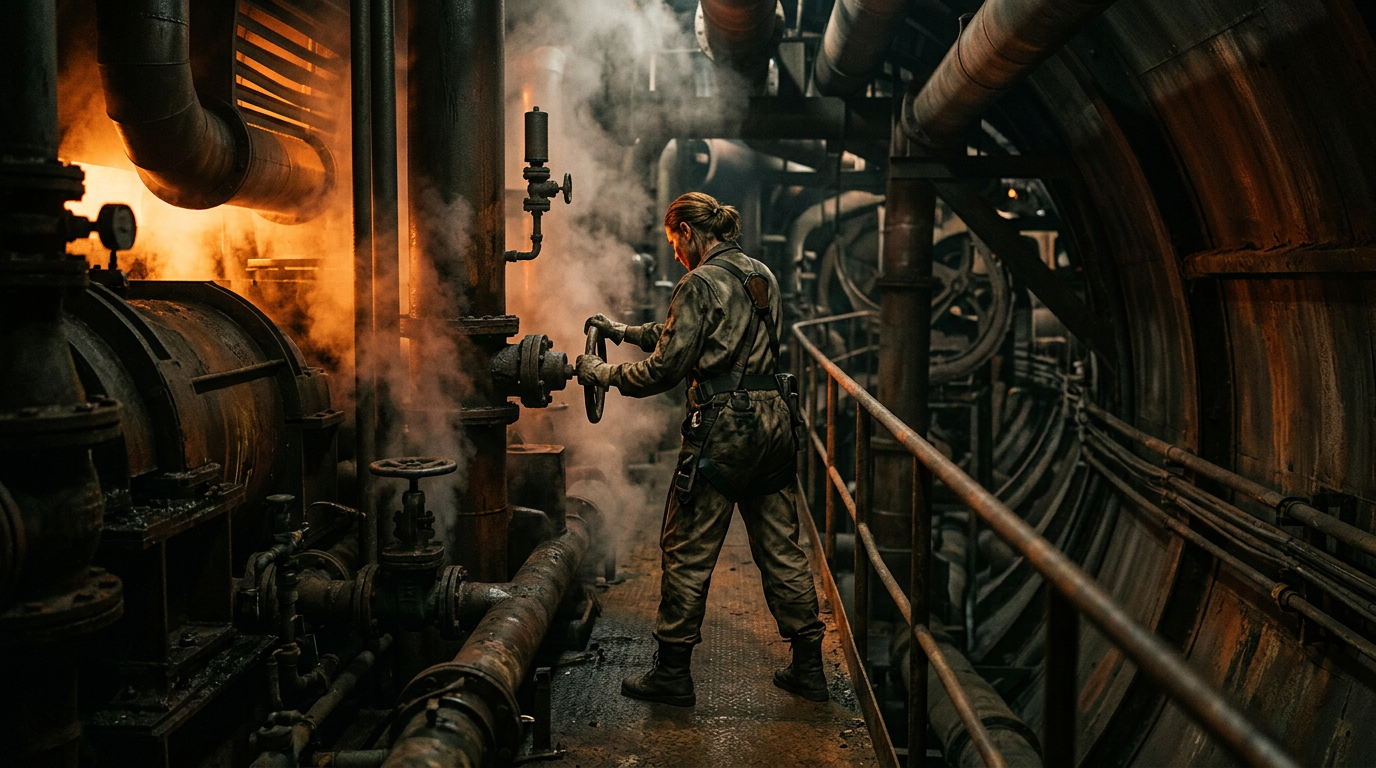
That verticality gives Silo a cleaner metaphor than many dystopias manage. The mise-en-scène keeps reminding us that class is spatial. Judicial and IT occupy the sleek, surveilling parts of the silo. Mechanical is hot, loud, grimy, and indispensable. The middle levels feel like an uneasy compromise between civic life and managed scarcity. You can read the society by reading the walls: clean surfaces near authority, sweat near survival.
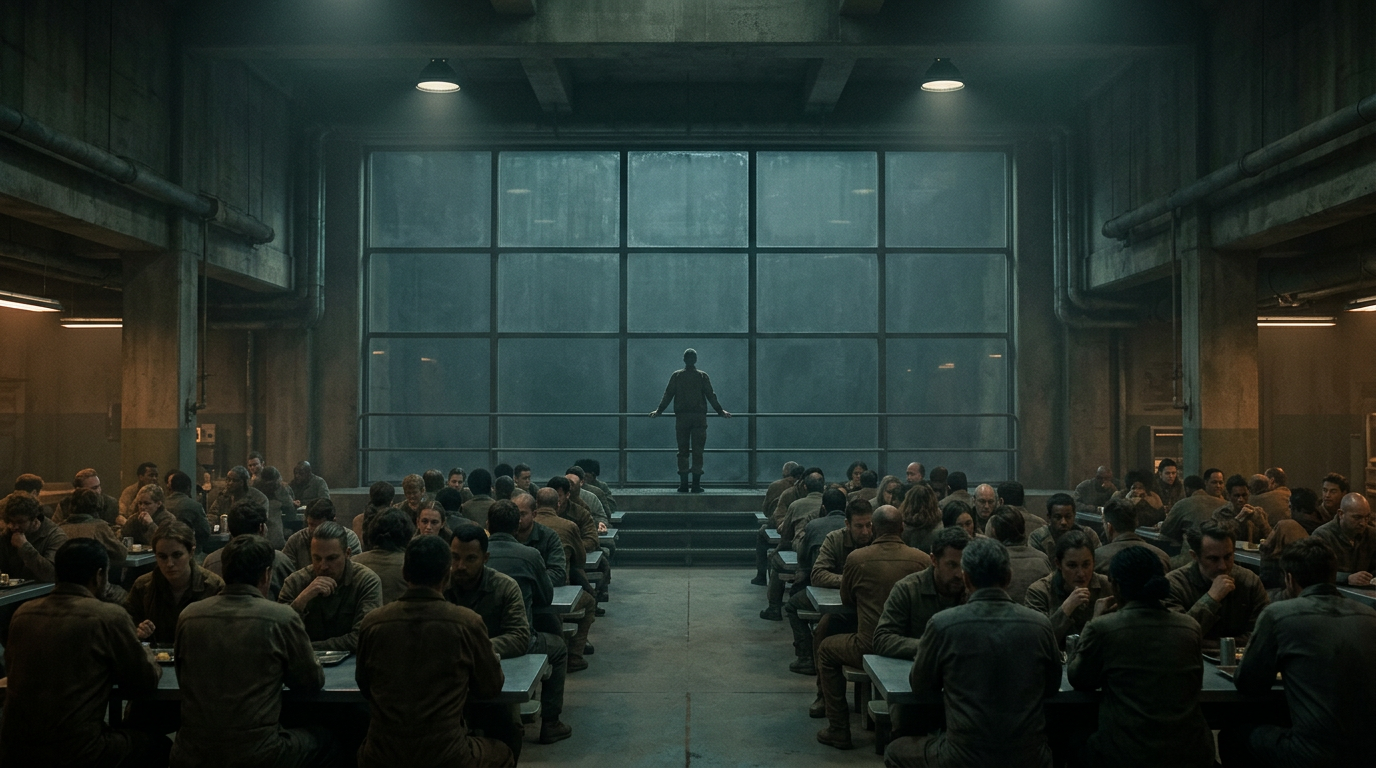
The production design favors tactile density over sci-fi gloss. The show’s future is not chrome and holograms but repurposed metal, analog screens, heavy doors, industrial corridors, and rooms that seem to have absorbed generations of breath. That matters. A less confident series would keep cutting to digital wonder. Silo lets us feel the drag of place: the way a corridor narrows a choice, the way a cafeteria window becomes a civic altar, the way a relic can make a room suddenly dangerous.
Sound is crucial, too. The silo has a diegetic nervous system: fans, alarms, footsteps, murmuring crowds, the thud of machinery beneath dialogue. It is never silent because a silent silo would be a dead one. The hum becomes a kind of civic religion, the audible proof that the world has not ended today.
What it gets right
Silo is best when it treats knowledge as a built environment. Information does not float freely. It is stored in rooms, hidden in objects, blocked by rules, or transmitted through people who may not survive the transfer. That gives the mystery a material weight. A secret is not just a plot coupon; it has to be carried up stairs, smuggled through checkpoints, repaired, decoded, or protected from decay.
Rebecca Ferguson is central to why this works. Juliette is not written or played as a chosen-one abstraction. She thinks like an engineer. She tests, listens, disassembles, mistrusts convenient answers. Ferguson’s physical performance is wonderfully unsentimental: shoulders forward, eyes narrowed, body always measuring the room. In a show obsessed with systems, she gives us cognition as action.
The series also understands the moral ambiguity of survival governance. The silo is monstrous, but it is not stupid. Its authorities often speak the language of preservation. That is what makes them more interesting than cartoon tyrants. A society built after catastrophe would not need villains twirling keys in the dark; it would need managers, archivists, security men, true believers, opportunists, and exhausted people who have mistaken continuity for justice.
Tim Robbins is especially good at embodying that institutional chill. His Bernard is frightening not because he rants, but because he files panic into procedure. Common’s Sims can be blunt as a character construction, but the show uses him effectively as a man who has confused proximity to power with possession of it. Harriet Walter, meanwhile, gives the series a sense of memory: the knowledge that private loss becomes political when a state insists on owning the past.
The show’s pacing, often criticized as slow, is mostly a virtue. Silo is not slow because it has nothing to say. It is slow because stairs take time, trust takes longer, and authoritarian systems are designed to make every act of curiosity exhausting. That is form matching content.
Where it stumbles
!A lone engineer stands in a hot mechanical room filled with steam and valves
The genuine weakness of Silo is that it sometimes explains what its architecture has already made clear.
Prestige television remains addicted to the clarifying conversation: two characters in a dim room stating the moral geometry of the episode with admirable diction. Silo is better than most, but it still occasionally lets dialogue flatten the visual intelligence of the show. We do not always need to be told that the system is stratified. The frame has already told us. The staircase has told us. Juliette’s boots have told us.
There are also stretches where the series mistakes withholding for tension. Mystery-box structure is a dangerous machine; run it too hard and characters become delivery systems for delayed answers. Silo usually avoids the worst habits that damaged late-period Westworld, but not always. A few midseason movements feel padded by procedural detours that deepen mood more than drama.
And while the silo’s geography is conceptually strong, it can be visually repetitive. Claustrophobia is the point, but claustrophobia on television still needs modulation. The best episodes find fresh textures: steam, crowd movement, mechanical heat, bureaucratic stillness, domestic warmth under surveillance. The weaker ones return to familiar corridors without adding much new pressure.
This is not a fatal problem. It is the cost of building a series around enclosure. But Silo should trust its own production design even more. The city is already talking. The scripts occasionally interrupt it.
The bigger idea
Silo’s central idea is not that people are lied to. That is old dystopian furniture. Its sharper idea is that a city can make lies livable.
The most durable authoritarian systems do not rely only on fear. They produce routines. Holidays. Jobs. Status markers. Romantic possibilities. Petty rivalries. Repair schedules. They make the false world administratively convincing. Silo understands this better than most post-apocalyptic TV. Its citizens are not fools for believing in the silo; they are inhabitants of a total environment that has aligned architecture, law, education, and scarcity into one story.
This is where the panopticon comparison earns its keep. Jeremy Bentham’s prison design, later reworked by Michel Foucault into a broader theory of surveillance and discipline, is not simply about being watched. It is about internalizing the possibility of being watched until behavior edits itself. Silo literalizes that idea through screens, rules, watchers, and social suspicion, but its more subtle surveillance is spatial. The city trains citizens to know where they belong.
That is why the outside matters so much even when the show remains inside. The forbidden exterior is not merely a location. It is the negative space around the entire civic imagination. If no one can verify the world, authority can define reality. The cafeteria view becomes a ritual image. The border between safety and truth becomes indistinguishable.
What makes Silo more than grim machinery is that it also believes in craft. Repair is its counter-politics. Juliette’s engineering mind resists ideology because machines punish fantasy. A generator either works or it does not. A seal holds or fails. A body can endure only so much heat. In a society built on managed perception, material reality becomes rebellion.
What to watch next if you liked this
Do not pair Silo only with other apocalypse shows. Pair it with works about cities, systems, and built captivity.
- Snowpiercer: Bong Joon-ho’s 2013 film is the obvious double-bill: another sealed, class-stratified society arranged along a single axis. Train horizontal, silo vertical. Same brutal joke.
- Severance: Apple TV+’s corporate nightmare makes office architecture feel metaphysical. Watch it with Silo and notice how both shows turn workplace design into mind control.
- Andor: Especially the Narkina 5 arc, where production design, blocking, and institutional language create one of the finest recent portraits of fascist efficiency in franchise television.
- Brazil: Terry Gilliam’s bureaucratic dystopia is messier, funnier, and more baroque, but it shares Silo’s sense that paperwork can be a horror effect.
- Metropolis: Fritz Lang’s silent landmark remains the ancestral text for vertical class allegory. Its workers below and elites above still echo through modern sci-fi.
- The Expanse: For viewers interested in political geography, the show’s Belter culture and station life offer a richer hard-sci-fi cousin to Silo’s enclosed society.
- Fallout: Amazon’s series is pulpier and more satirical, but its vaults make a useful comparison: closed societies as experiments, shelters as ideological traps.
For reading, start with Hugh Howey’s Wool, the first Silo novel. Then go sideways: J.G. Ballard’s High-Rise for architecture as social breakdown, Ursula K. Le Guin’s The Dispossessed for political world-building without easy binaries, and Jane Jacobs’ The Death and Life of Great American Cities if you want the non-fiction ghost behind the question Silo keeps asking: what does a city owe the people who keep it alive?
The verdict
Silo is not the flashiest science-fiction series on television, and that is part of its integrity. It is a show of pressure gauges, stairwells, sealed doors, and people learning that the map of their world may be a weapon. Its best image is not destruction but maintenance: someone in the dark keeping the system alive while slowly realizing the system may not deserve it.
The post-apocalyptic city has become a familiar screen object, from irradiated wastelands to luxury bunkers for the guilty rich. Silo makes it strange again by refusing the postcard of ruin. Its apocalypse is not outside the city. It is embedded in zoning, ritual, labor, and memory. The city survives. That is the triumph and the threat.
Apple TV+ has many polished science-fiction objects. Silo has grime under its nails. More importantly, it has an architectural imagination. It knows that the scariest prison is not the one with the thickest walls. It is the one that teaches you to call the walls home.
Discussion (0)
Loading comments…