Silo makes the apocalypse climb stairs
The most frightening thing in Silo is not the ruined world outside. It is the staircase.
Apple TV+’s adaptation of Hugh Howey’s novels understands something many post-apocalyptic shows forget: civilization is not only a set of laws or a pile of canned food. It is a floor plan. A traffic pattern. A rumor that travels upward faster than a body can. Across its first two seasons, Silo has become one of the most intelligently designed pieces of science-fiction television on streaming because its city is not backdrop, lore dump, or production-design brag. It is the antagonist, the workplace, the church, the prison, and the family home. A vertical city with bad air, worse history, and a bureaucracy that has mistaken survival for morality.
That is the series’ great trick. It makes a post-apocalyptic settlement feel less like a bunker than a living organism with circulation problems.
Why it matters now
By 2026, prestige sci-fi has split into two dominant habits. One builds outward: galaxies, empires, timelines, multiverses, factions, glossary terms. Think Foundation, The Three-Body Problem, or the more ambitious stretches of Doctor Who. The other builds inward: office floors, labs, memory partitions, domestic rooms with surveillance baked into the paint. Severance, Devs, Black Mirror, and Mr. Robot belong to that second tradition, where the future is not a chrome skyline but a management system.
Silo is fascinating because it does both while barely leaving one structure. Its world-building is architectural, not encyclopedic. The show does not need to keep expanding the map to enlarge the story. It changes the meaning of a corridor.
That is an unfashionably patient choice in the streamer wars, where genre television is often pressured to become either franchise bait or puzzle-box content. Apple TV+ has made a specialty of expensive, slow-burn science fiction, sometimes to a fault. Silo benefits from that house style more than most. It has the confidence to let a landing, a cafeteria, a generator room, and a sheriff’s office accrue dramatic force over time. The mise-en-scène does the world-building. Rust, concrete, pipes, signage, uniforms, bottlenecks. You can feel class hierarchy before anyone gives a speech about it.
The result is not merely “post-apocalyptic TV.” It is civic horror.
The silo as a city that acts
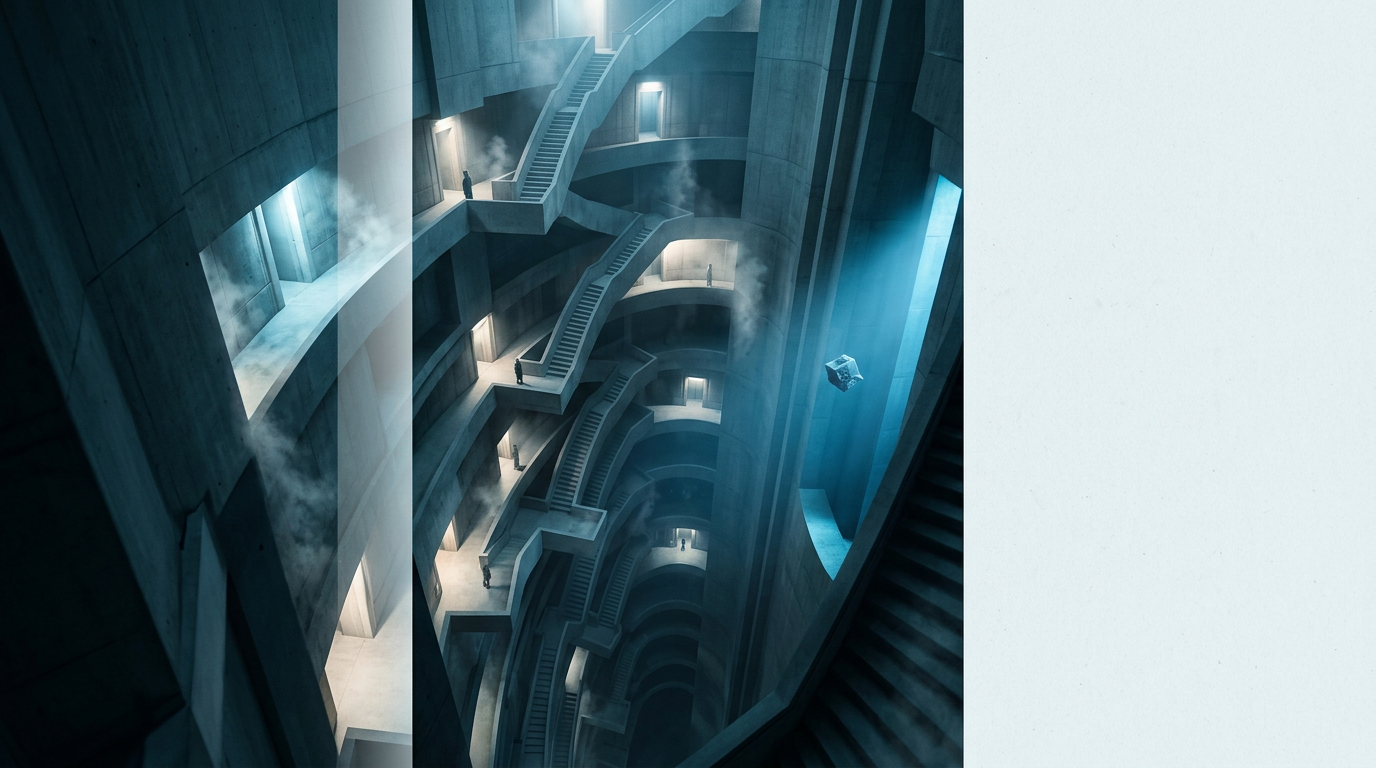
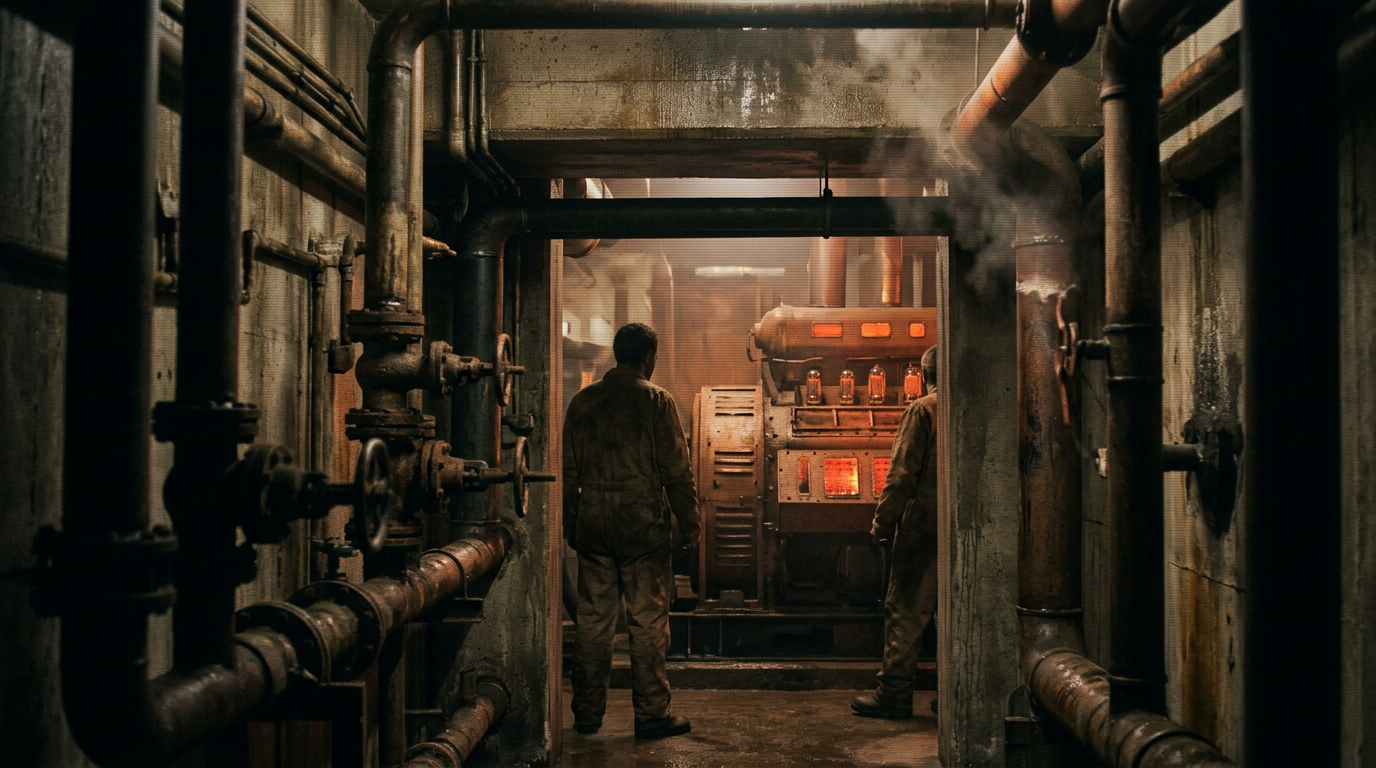
!A vast underground silo city with a central staircase fading into darkness
A good screen city has agency. Gotham corrupts. Los Angeles dreams and decays in Blade Runner and Blade Runner 2049. Mega-City One in Dredd turns density into fatalism. The train in Snowpiercer literalizes class as forward motion. The underground compound in 10 Cloverfield Lane weaponizes domestic space. Silo joins that lineage by making verticality the organizing principle of power.
The upper levels govern, observe, and interpret. The lower levels labor, repair, and absorb punishment. Between them sits the staircase: a democratic-looking space that is anything but. Everyone can technically climb it. Few can afford the time, stamina, or social risk. The geography becomes policy.
That is why the show’s blocking matters. Characters are often framed looking up or down, rarely across. Conversations happen through railings, on landings, in cramped rooms where privacy is a rumor. The camera understands that this society has no true horizon. Even its public spaces are inward-facing. The famous screens showing the outside world are not windows; they are civic liturgy, a daily ritual of managed despair.
Rebecca Ferguson’s Juliette Nichols is such a strong lead because she feels physically wrong for the place. As an engineer from Mechanical, she belongs to heat, grease, noise, and function. She moves through the silo as someone who knows systems are built by hands and can therefore fail. That makes her dangerous. Not because she is a chosen one, but because she has a tradesperson’s contempt for official mystery.
The city notices. Or, more precisely, its institutions do.
What it gets right
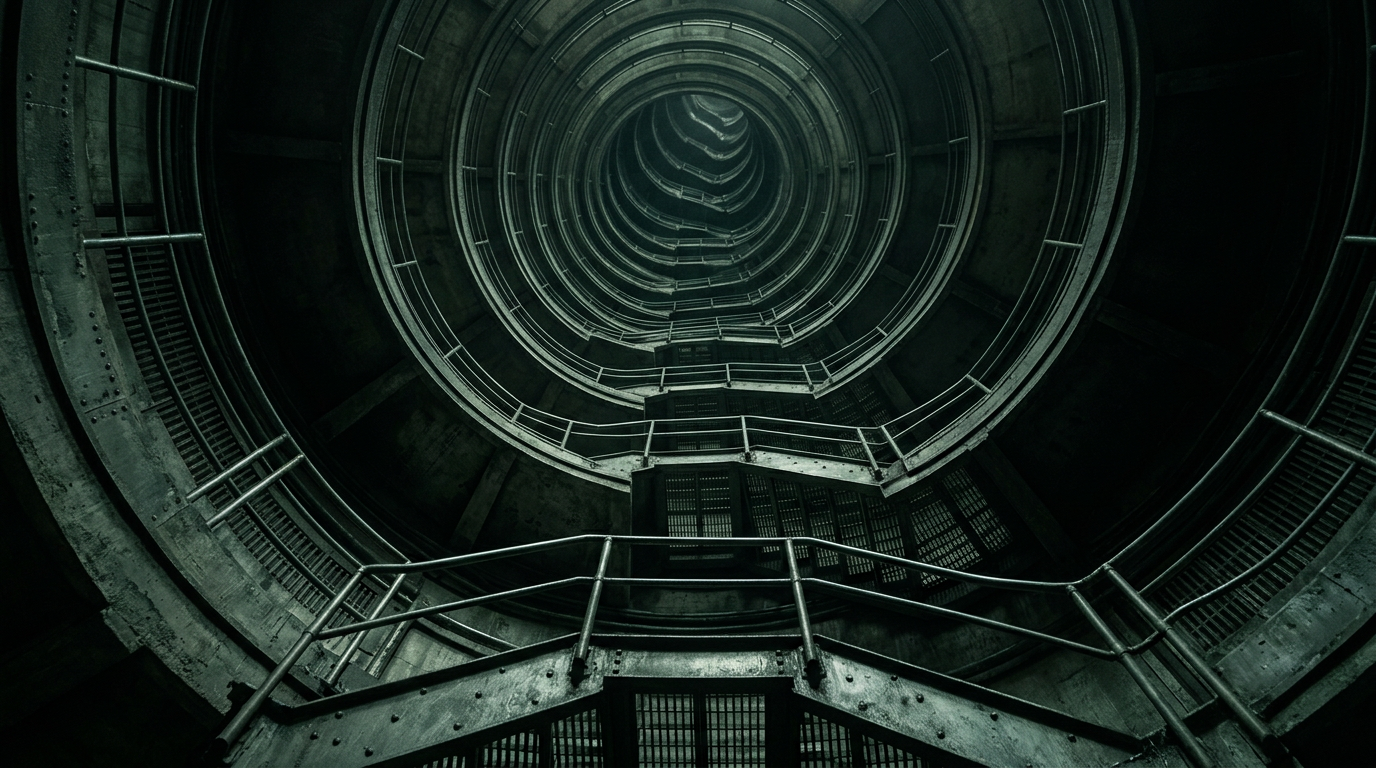
Silo is at its best when it treats infrastructure as psychology. The generator sequence in season one remains a model of practical suspense because the stakes are not abstract. Power is not a metaphor in that hour; it is heat, pressure, timing, and bodies in danger. The production design gives the scene weight. You believe these machines have been patched, worshiped, misunderstood, and feared for generations.
The show also has a useful distrust of exposition. Yes, there are files, relics, forbidden objects, and buried histories. The series is not allergic to the mystery-box tool kit. But its strongest revelations come from material culture: a children’s book, a hard drive, a camera, a suit, a cafeteria display, a relic that should not exist. The past survives as contraband.
That gives Silo a faintly hauntological charge, in Mark Fisher’s sense: the future is trapped under the weight of futures that were promised and then sealed away. The people of the silo do not merely lack history. They live inside a curated absence where memory has become a security threat.
The casting helps keep the concept human. Ferguson brings flint and fatigue, not superhero gloss. Common’s Robert Sims can be too neatly ominous at times, but the show uses his stillness effectively as institutional muscle. Tim Robbins, as Bernard Holland, is even better: fussy, intelligent, petty, and frightening in the way of men who believe procedure absolves them. He is not a tyrant who needs a balcony. He needs a server room.
That detail matters. Silo is one of the few recent sci-fi shows to understand that authoritarianism often arrives not as spectacle but as maintenance.
Where it stumbles
!Workers stand before a huge generator in a dim industrial mechanical level
The show’s genuine weakness is that its patience sometimes curdles into withholding. There is a difference between mystery and delay, and Silo occasionally blurs it. Some episodes move with the heavy tread of people carrying information they are contractually forbidden to say aloud until minute fifty-one.
The problem is not slowness. Slow cinema and slow television can be thrilling when duration changes perception. Andor took its time because each conversation altered the political temperature. Severance uses repetition as an instrument of dread. Silo, by contrast, sometimes parks characters in partial knowledge for so long that their intelligence seems to dim for the sake of structure.
There is also a tonal risk in the show’s self-seriousness. Its world is grim by design, but grimness is not the same as texture. The best dystopias have social oddities, jokes, ceremonies, bad taste, folk habits. The Leftovers understood that catastrophe produces absurd culture as well as grief. Silo gives us some rituals and taboos, but its citizens can still feel under-imagined outside their relation to the central conspiracy. A city is not only governance and work. It is boredom, gossip, flirting, music, bad food, petty fashion, ugly art. More of that would make the silo feel even more alive.
[SPOILERS AHEAD]
The bigger idea
Once Silo expands its perspective beyond the single community, the city-as-character idea becomes sharper, not smaller. The core question is no longer simply “What is outside?” It is “What kind of society does a closed system produce when truth itself is treated as a contaminant?”
This is where the show brushes against the panopticon without turning into a lecture. Surveillance in Silo is not only cameras and informants. It is the internalization of limits. People police their own curiosity because curiosity has been narrativized as a public-health hazard. The genius of the regime is that it makes obedience feel like care for one’s neighbors.
The city’s design enforces that moral confusion. Distance becomes destiny. Mechanical is close enough to keep everyone alive, far enough to be patronized. Judicial and IT are close enough to coordinate power, hidden enough to deny its mechanics. The outside is omnipresent as an image, absent as experience. This is soft sci-fi with hard edges: the technology matters less than the social arrangement it permits.
That is also what separates Silo from a lot of post-apocalyptic storytelling. The show is not obsessed with scavenger aesthetics. It is not another parade of gas masks, raiders, and sentimental flashbacks to the day everything fell. Its apocalypse is administrative. The disaster happened long ago, but the ongoing catastrophe is governance without consent.
The city, then, is not simply a shelter from extinction. It is an argument about human nature. Its rulers believe people can survive only inside a managed lie. Juliette’s counterargument is not naïve optimism. It is mechanical: systems built on false readings eventually fail.
The post-apocalyptic city after Fallout and The Last of Us
Recent genre television has been unusually good at asking what remains after collapse. The Last of Us gives us ruined America as a series of moral climates: military quarantine zone, survivalist compound, commune, cult. Fallout turns retrofuturist rubble into satire, with vaults as social experiments and the wasteland as a marketplace of deranged American branding. Station Eleven treats the post-pandemic world as a theater of memory. Silo is narrower than all of them and, in some ways, more ruthless.
Its city has no sky, no frontier, no pastoral alternative. That makes it a useful correction to the romance of survivalism. Nobody in Silo gets to cosplay self-reliance. Every life depends on strangers, supply chains, rules, inherited machinery, and shared myths. The show’s great subject is not individual survival but collective dependency.
That is why the staircase matters more than any single clue. It is the civic spine, the class ladder, the rumor mill, the pilgrimage route, the emergency exit that is not an exit. A lesser show would keep cutting away to the wasteland. Silo keeps asking what kind of people are produced by never seeing the weather.
What to watch next if you liked this
Pair Silo with films and shows that treat architecture as destiny, not décor.
- Snowpiercer: Bong Joon-ho’s 2013 film remains the cleanest class-structure metaphor in modern sci-fi: a society arranged from tail to engine, with motion standing in for progress.
- Dredd: For vertical urban violence and brutal spatial logic, Pete Travis’s film turns a tower block into a pressure cooker of law, poverty, and spectacle.
- Blade Runner 2049: Denis Villeneuve’s sequel uses monumental emptiness and corporate interiors to make loneliness feel engineered.
- Severance: The clean white office as psychological prison. An ideal double-bill with Silo for viewers interested in workplace design as social control.
- Andor: Not post-apocalyptic, but essential for anyone drawn to adult genre TV about bureaucracy, rebellion, and the cost of political awakening.
- The Expanse: Especially the Belter material, where bodies, accents, and architecture are shaped by labor under hostile conditions.
For reading, start with Hugh Howey’s Wool, the first book in the series that became Silo. Then try J.G. Ballard’s High-Rise for another savage vision of architecture reorganizing human behavior, and Ursula K. Le Guin’s “The Ones Who Walk Away from Omelas” for a short, lethal parable about civic comfort built on moral compromise.
The verdict
Silo works because it refuses to treat the apocalypse as scenery. Its buried city has habits, appetites, blind spots, and immune responses. It rewards obedience, punishes vertical ambition, and converts ignorance into civic virtue. That is more disturbing than any monster.
The series can be too withholding, and its social world could use more everyday strangeness. Still, at its best, Silo is among the strongest arguments for original-feeling sci-fi on television right now: practical in texture, political without slogans, and built around an image so simple it keeps gaining meaning.
A city underground. A staircase through the middle. Everyone alive because the system works. Everyone trapped because it works too well.
Discussion (0)
Loading comments…