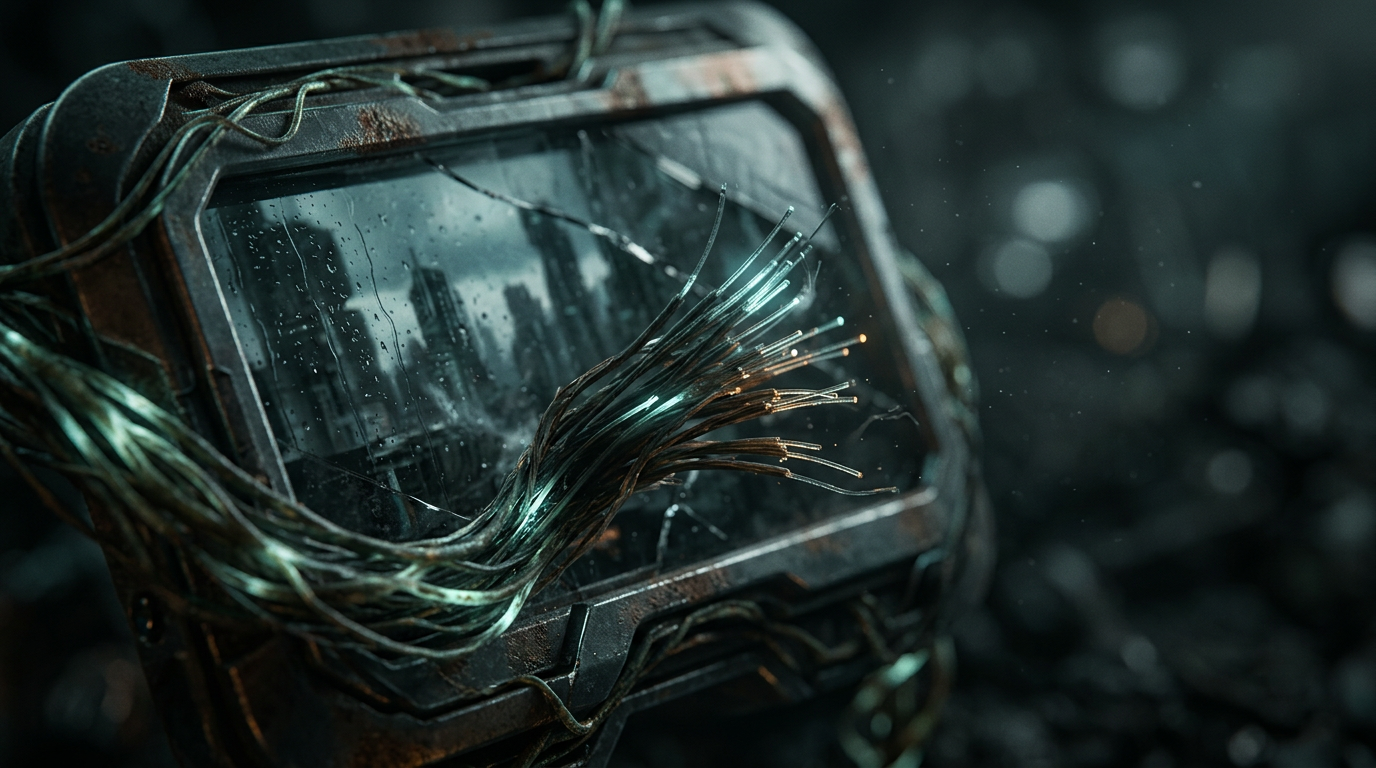
The future keeps arriving already haunted
The most convincing image of the future right now is a beige computer blinking in a room that looks designed by someone who never escaped 1978.
That is not laziness. Not always. Across 2020s film and TV, from Severance and Silo to Andor, After Yang, I Saw the TV Glow, Station Eleven, Tales from the Loop, and even the carefully sanded myth-machinery of Dune, the future has stopped looking like an arrow. It looks like a return. A memory with better lighting. A tomorrow built from obsolete interfaces, corporate folklore, dead media, mothballed utopias, and childhood screens that refuse to stay dead.
Call it hauntology if you like, and Mark Fisher made that word hard to avoid for a reason. The point is not that these films and shows are nostalgic. Nostalgia is usually simpler, more flattering, and more commercial. Hauntology is stranger: the sense that abandoned futures still press against the present, that the world we got is being stalked by the worlds we were once promised.
The best 2020s sci-fi understands this. The worst merely decorates with it.
Why it matters now
By 2026, science fiction has become one of the few places where prestige TV, theatrical spectacle, streamer churn, and art-house dread still talk to each other. Apple TV+ has built a brand out of coolly expensive speculative architecture with Severance, Silo, and Foundation. Netflix keeps feeding global-scale anxiety through Black Mirror and 3 Body Problem. Max gave us Station Eleven and Scavengers Reign before the usual platform instability made even availability feel precarious. Amazon MGM found a blunt, funny, radioactive franchise engine in Fallout. A24 and Neon have kept the stranger edges alive with films that treat technology less as gadgetry than as atmosphere.
At the same time, theaters have become newly fetishized sanctuaries. IMAX 70mm after Oppenheimer, Dolby Cinema for the blockbuster faithful, repertory houses selling out 35mm prints: the medium itself now carries a ghost charge. We do not just watch images. We watch formats returning from the dead.
That is why hauntology fits the decade. The 2020s did not inherit a confident future. They inherited supply-chain dread, climate fatigue, platform consolidation, AI panic, remote-work alienation, IP recycling, and the sour knowledge that every shiny device is also a tracking device. The old cyberpunk bargain was that technology would be dangerous but thrilling. The current bargain is smaller and more humiliating: technology will be boring, mandatory, and impossible to opt out of.
So the mise-en-scène has changed. The future is no longer chrome. It is laminated badges, brutalist corridors, analog switches, old children’s television, bunker cafeterias, corporate wellness rooms, archival tapes, and spaceships that look ancient the moment they appear.
What it gets right
!A retro corporate maze lit by obsolete green computer monitors
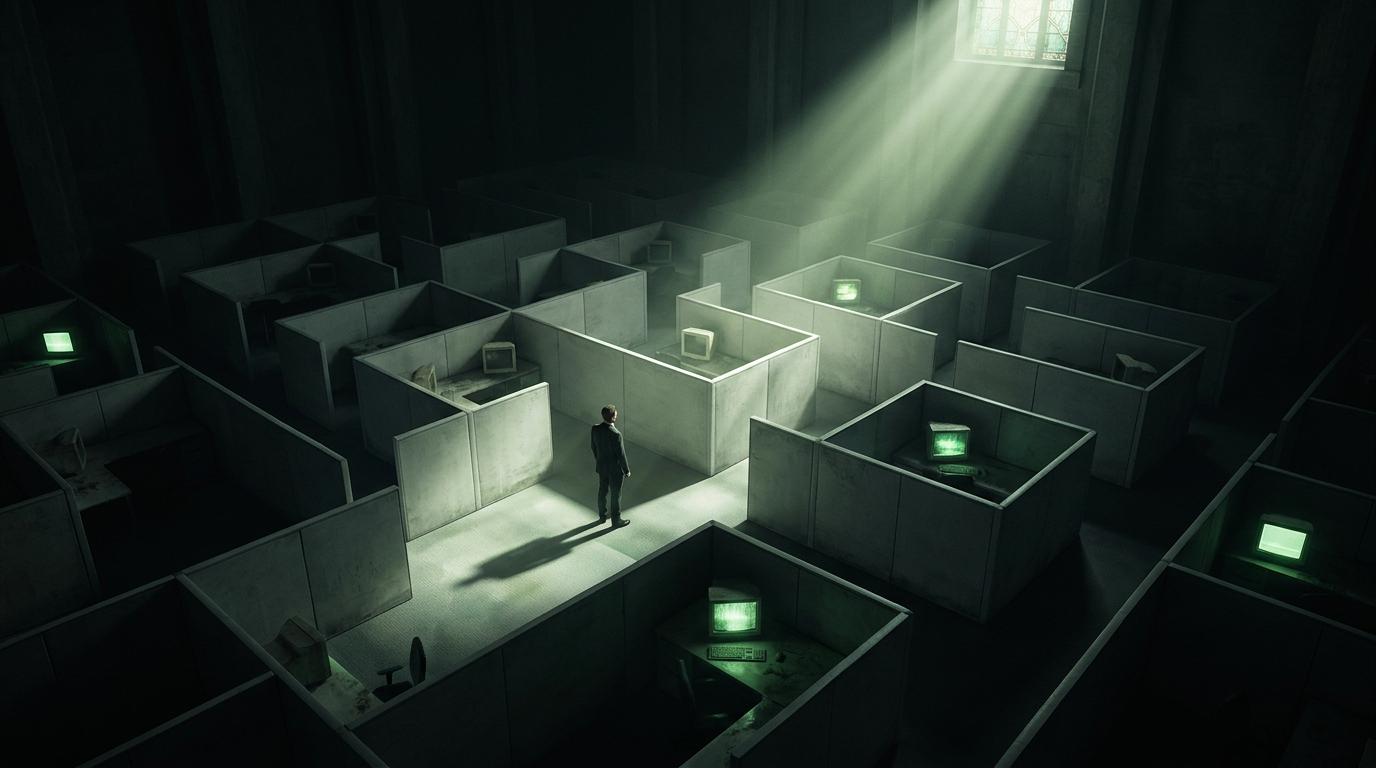
The strongest hauntological sci-fi of the 2020s uses retro design not as a mood board but as an argument.
Severance remains the key text because its office is not just creepy. It is ideologically precise. The computers look obsolete, the lighting feels medicinal, the blocking traps bodies in symmetrical corporate dead zones. The show imagines work as a place where history has been stripped out and then replaced by fake history: rituals, founders, perks, slogans, wellness language. Its retrofuturism is not cute. It says the modern workplace did not transcend the twentieth century. It preserved its cruelties under softer vocabulary.
Silo, on Apple TV+, does something similar with vertical space. Its society is a machine that has forgotten whether it was built for survival or obedience. The production design matters: rust, concrete, generators, worn stairwells, institutional rooms. This is not a sleek post-human civilization. It is a future with maintenance issues. The show’s best idea is that technological regression can be political. If citizens do not understand the system, the system becomes myth.
Andor is the rare franchise entry that turns hauntology into moral pressure rather than brand incense. Star Wars has always been retrofuturist, but Andor strips away the toyetic glow. Its control rooms, prisons, apartments, and factories feel lived-in and historically burdened. The Empire is terrifying because it resembles bureaucracy before it resembles fantasy. Old buttons. Old uniforms. Old methods. Fascism as administrative design.
Then there is I Saw the TV Glow, Jane Schoenbrun’s devastating 2024 film about television as a haunted house you can carry inside your body. It understands that dead media are not dead for the people formed by them. The glow of the screen is not just memory; it is a portal that may have closed too early. The film’s horror comes from the suspicion that a life can be misfiled, that the self you were supposed to become is still somewhere behind the static.
After Yang, from Kogonada, is quieter but just as haunted. Its near future is soft sci-fi: domestic, tasteful, barely futuristic. The android is not a killer or a messiah. He is an archive. The film asks what remains of a person when memory becomes collectible, editable, and aesthetically curated. It is one of the decade’s most elegant uses of technological melancholy.
What it gets wrong / where it stumbles
Hauntology has become dangerously easy to fake.
A dim hallway, a CRT monitor, a synth pad, a corporate logo with no visible product, a child staring at dead broadcast snow: these are now prestige sci-fi shortcuts. They can produce instant seriousness without much thought. The result is not mystery but branding. A mood, vacuum-sealed.
The problem is especially visible in the streamer economy. Platforms love hauntology because it flatters their business model. They sell the future while strip-mining the past. They want new subscribers and old IP, fresh discourse and familiar iconography. The lost future becomes another tile in the interface.
Fallout works better than it has any right to because it understands its own fossil record: 1950s American optimism curdled into nuclear farce. But plenty of franchise television treats retrofuturism as a museum exhibit. Here is the old prop shape. Here is the legacy sound. Here is the fan-service silhouette. Recognition gets mistaken for meaning.
Even serious projects can confuse slowness with depth. Long silences, symmetrical frames, and withheld explanations are not automatically profound. Slow cinema has discipline; prestige TV often has episode-padding. A haunted future needs pressure. Without it, the work becomes a showroom for tasteful decay.
The genuine criticism, then, is this: 2020s sci-fi is sometimes too comfortable with paralysis. It knows how to mourn lost futures, but not always how to imagine new ones. Melancholy can sharpen a story. It can also become an alibi.
The bigger idea
!A dark living room haunted by the glow of an old television
Hauntology is useful because it names a cultural injury without turning it into a tidy diagnosis. These films and shows are not saying the future ended. They are saying our ability to picture the future has been colonized by unresolved pasts.
That is why so many 2020s futures feel archival. In Devs, Alex Garland turns quantum determinism into a cathedral of surveillance and grief. In Tales from the Loop, Simon Stålenhag’s retrofuturist imagery becomes rural elegy: impossible machines sitting in snowy fields as if progress wandered off and left its equipment behind. In Station Eleven, the post-apocalypse is not only about survival. It is about performance, memory, and whether art can outlive the systems that once packaged it.
The strongest works avoid the trap of treating technology as destiny. They treat it as sediment. Every device contains labor, ideology, taste, class, and fantasy. Every futuristic room is built on yesterday’s dream of control.
This is where Denis Villeneuve’s Dune films matter, even though they are adapting a midcentury novel rather than inventing a 2020s future. Their genius is to make space opera feel ancient. The ships do not gleam; they loom. The costumes, sound design, and monumental blocking push sci-fi away from innovation rhetoric and toward empire, ritual, ecology, and inheritance. Dune’s future is so old it has become geological.
That may be the decade’s dominant sci-fi insight: the future is not ahead of us. It is underneath us.
The craft of being haunted
Hauntological screen storytelling lives or dies in craft. It is not just theme. It is texture.
Look at the recurring tools:
- Anachronistic interfaces: Severance and Loki use analog-feeling bureaucracy to make power seem eternal rather than advanced.
- Institutional blocking: Characters are placed in grids, corridors, and surveillance-friendly rooms. The frame becomes a panopticon without needing to announce itself.
- Diegetic media: Tapes, broadcasts, training videos, children’s shows, and corporate films become ghosts inside the story world.
- Practical weight: Dune, Andor, and Silo benefit from sets, miniatures, tactile costumes, and worn surfaces. Even when digital effects are everywhere, the world feels pre-haunted by use.
- Temporal dislocation: The future borrows from the 1970s, 1980s, and 1990s because those decades still carry unfinished promises: space exploration, public infrastructure, video culture, networked life before platform capture.
The uncanny valley is not only about almost-human faces. It is also about almost-familiar worlds. A hallway that looks like your dentist’s office but belongs to a sinister corporation. A spaceship cockpit with switches your grandfather might understand. A TV show from childhood that seems to remember you back.
That almost is where the dread lives.
What to watch next if you liked this
If you want to understand the haunted future of 2020s sci-fi, do not watch randomly. Pair works that argue with each other.
- Severance + Office Space: one is surreal corporate metaphysics, the other a cubicle comedy, but both understand that work steals more than time.
- Silo + Snowpiercer: vertical class structure meets horizontal class structure. Two machines, two societies pretending necessity is the same thing as justice.
- Andor + THX 1138: bureaucratic dystopia before and after franchise mythology hardened around it.
- After Yang + A.I. Artificial Intelligence: artificial beings as emotional archives, with Kogonada’s restraint set against Spielberg’s grand ache.
- I Saw the TV Glow + Videodrome: media does not influence the body from outside; it gets in and starts rearranging the furniture.
- Station Eleven + Children of Men: collapse stories that care less about spectacle than continuity, ritual, and the fragile logistics of hope.
- Tales from the Loop + Stalker: machines, zones, and landscapes where science fiction slows down until it becomes spiritual weather.
- Dune: Part Two + Lawrence of Arabia: desert mythmaking, imperial gaze, and the danger of confusing scale with clarity.
For follow-up reading, start with Mark Fisher’s Ghosts of My Life. Then try Ursula K. Le Guin’s essays in The Language of the Night, not because she is hauntological in the fashionable sense, but because she reminds us that speculative fiction is a moral technology: a way of testing what a society can still imagine.
The verdict
The lost futures of 2020s film and TV are not a failure of imagination. They are evidence of a bruised one.
The decade’s best sci-fi is suspicious of clean futurism because clean futurism now feels like advertising. It knows that the smart home is also a listening device, the platform is also a landlord, the archive is also a trap, and nostalgia is rarely innocent. These works are not asking whether the future will be bright or bleak. They are asking why it keeps arriving in the clothes of the past.
That question has produced some of the richest screen storytelling of the streaming age. Not all of it escapes the boutique gloom of prestige aesthetics. Some of it mistakes analog dust for profundity. But when it works, it gives us something sharper than prediction.
It gives us a way to see the ghosts in the interface.
Discussion (0)
Loading comments…