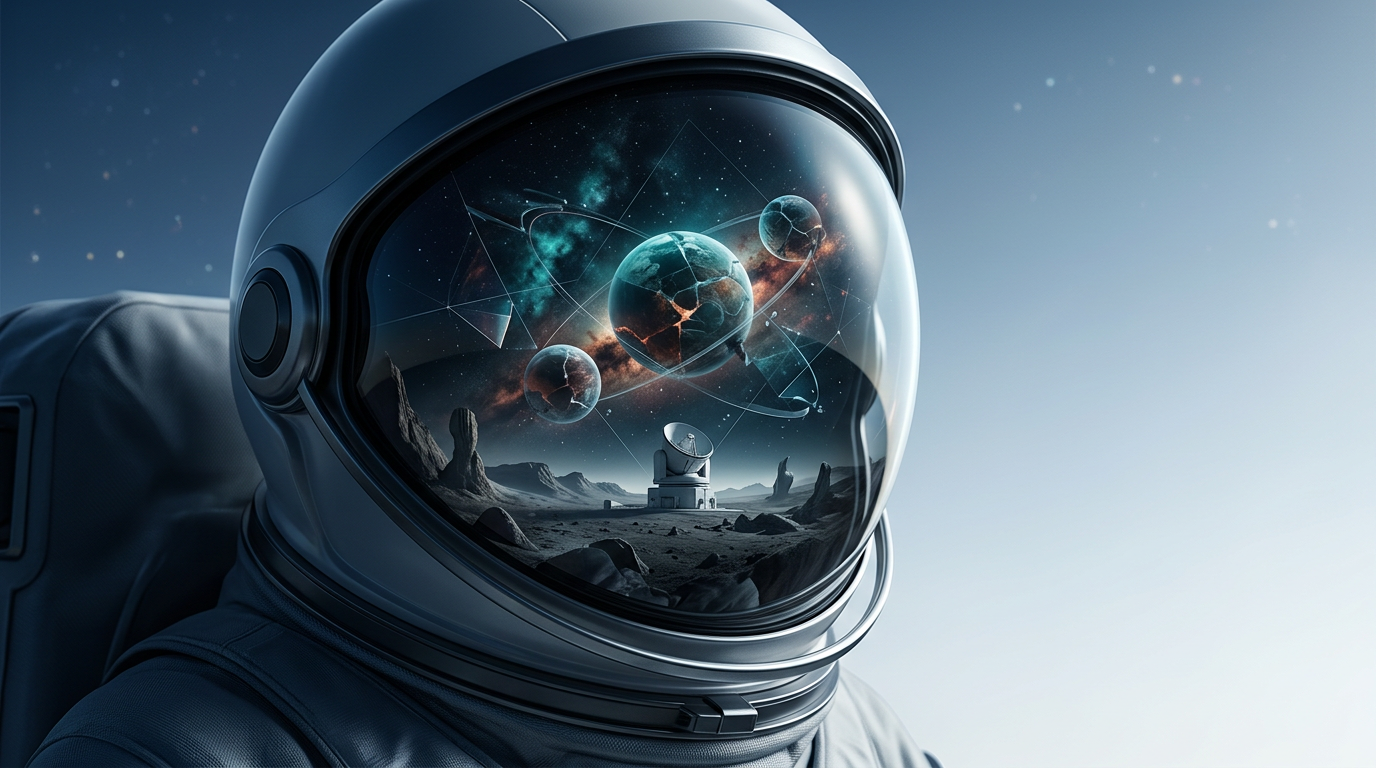
Three-Body is too strange for one adaptation
A scientist stares at a countdown no one else can see, and the universe suddenly feels less like a mystery than a threat with paperwork.
That is the cleanest image shared by Liu Cixin’s The Three-Body Problem, Netflix’s 3 Body Problem, and Tencent’s Chinese series Three-Body: rational people confronted by evidence that reality is not on their side. Everything else changes. Tone. Pacing. Character emphasis. Political texture. Even the basic temperature of fear.
The question is not which adaptation is “faithful,” because fidelity is a smaller virtue than people pretend. The real question is what each version thinks the story is for. Liu’s novel is an engine of ideas with human beings caught in its gears. Tencent treats it as a procedural of scientific dread, almost stubbornly literal in its devotion to sequence and atmosphere. Netflix turns it into a prestige ensemble drama, faster, glossier, more emotionally legible, and unmistakably designed for a global audience that may have Dune, Severance, and Black Mirror in the same recommendation row.
All three versions are valuable. None is definitive. The best one depends on what kind of fear you want.
Why it matters now
By 2026, science fiction on screen is no longer begging for respectability. Denis Villeneuve’s Dune films proved that dense speculative world-building can fill premium formats. Apple TV+ has made expensive, cerebral genre TV part of its brand with Severance, Foundation, and Silo. Netflix, after years of algorithmic genre churn, wants 3 Body Problem to be the kind of big intellectual property that says: yes, we can still make event television for adults.
That makes Three-Body a useful stress test. Liu’s trilogy, Remembrance of Earth’s Past, is not cozy franchise material. It is hard-ish sci-fi with philosophical teeth, built around astrophysics, game theory, political trauma, and the terrifying possibility that contact with alien intelligence may not redeem humanity. It has spectacle, but its spectacle is often conceptual: a civilization breaking, a signal traveling, a decision echoing for centuries.
The Fermi paradox hangs over the whole enterprise: if the universe is so vast, where is everybody? Liu’s answer, especially as the trilogy develops, is not comforting. The cosmos is not empty because it is lonely. It may be quiet because noise is dangerous.
That is why the adaptation question matters. Netflix and Tencent are not merely choosing what to cut. They are choosing what sort of silence to preserve.
The novel is colder than most TV dares to be
!Empty conference room with monitors glowing in a tense sci-fi atmosphere
Liu Cixin’s novel, translated into English by Ken Liu, is not beloved because it offers warm character psychology. It is beloved because it has the nerve to think at species scale. Its prose can be blunt, its people sometimes schematic, but its ideas arrive with the force of weather.
The book’s great strength is escalation. It begins with institutional distrust and scientific impossibility, then keeps widening the aperture until individual lives look both precious and absurdly small. The structure is investigative, but the sensation is metaphysical. You read not to find out who did it, but to learn whether “who” still matters.
This is where the novel has an advantage over television. On the page, exposition can become architecture. A lecture, a memory, a theoretical model: Liu can turn them into suspense because the reader is participating in the construction. Screen drama has a harder time with that. If actors stand around explaining orbital mechanics for too long, the mise-en-scène starts to sweat.
The novel is also more Chinese in its bones than the Netflix series allows itself to be. Its historical wounds are not decorative backstory; they shape the moral logic of the entire work. The Cultural Revolution material is not just trauma branding. It is the story’s first lesson in systems: ideology, science, loyalty, and fear grinding against one another until private conscience becomes almost impossible.
Tencent preserves the dread, and the homework
Tencent’s Three-Body, released in China in 2023, is the adaptation for viewers who want the first novel treated less like raw material than like scripture with production design. It is long, methodical, and at times magnificently unhurried. That is both its virtue and its tax.
The series understands that the early power of The Three-Body Problem lies in process. Scientists compare notes. Investigators follow leads. Rooms are fluorescent, conversations are patient, and dread accumulates through repetition. The blocking is often simple, sometimes stiff, but the cumulative effect matters: a world of competent adults slowly discovering that competence may be irrelevant.
Yu Hewei’s Shi Qiang is a particular asset. The character, a rough-edged cop whose apparent crudeness masks a flexible intelligence, gives the series a human counterweight to its abstractions. The Tencent version lets him breathe. It also gives the scientific community a density Netflix often compresses. You feel institutions, not just protagonists.
But reverence has a cost. Tencent sometimes mistakes duration for gravity. Thirty episodes allow for texture; they also allow for drag. Scenes that should tighten the noose occasionally explain the rope. The show is best when it trusts atmosphere, worst when it behaves as if every viewer has a notepad and an exam coming.
Still, it has something Netflix frequently lacks: patience with strangeness. It lets the story feel alien before the aliens even fully enter the room.
[SPOILERS AHEAD]
Netflix makes it move, then pays the price
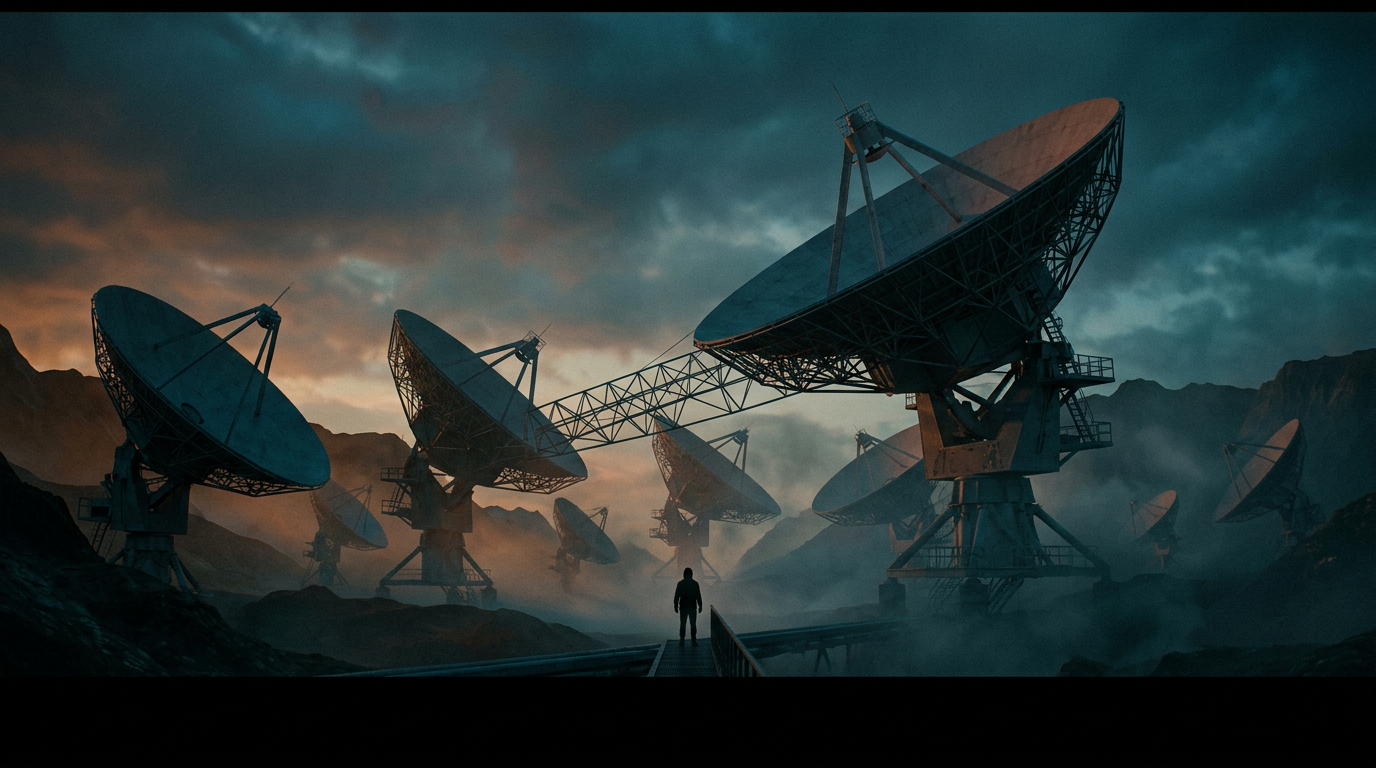
!Radio telescope array at dawn with a lone figure dwarfed by machinery
Netflix’s 3 Body Problem, created by David Benioff, D.B. Weiss, and Alexander Woo, makes a clear wager: the novel’s ideas need a more intimate character machine. So the story is redistributed across the so-called Oxford Five, with Benedict Wong’s Da Shi anchoring the investigation and performers like Jess Hong, Jovan Adepo, Eiza González, John Bradley, and Alex Sharp carrying the emotional crosscurrents.
This is not an irrational choice. Prestige TV runs on attachment. Viewers return for faces, wounds, rivalries, guilt. Netflix knows that a multi-season adaptation of Liu’s trilogy cannot survive on conceptual awe alone. It needs people audiences can track through catastrophe.
The strongest Netflix material often comes when the show accepts its own pulp velocity. The headset sequences have an eerie, expensive clarity. The mystery has snap. The cutting is more propulsive than Tencent’s, and the production understands contemporary streaming grammar: cliffhangers, ensemble friction, clean visual hooks. Rosalind Chao and Zine Tseng, as older and younger Ye Wenjie, give the series its most haunted line of continuity. In their hands, the decision at the story’s center is not villainy. It is despair given a transmitter.
But Netflix also domesticates the material. Moving much of the contemporary action to the UK and reshaping the cast into a friend-group drama gives the show accessibility, yet it softens the novel’s institutional and ideological specificity. At times, the series feels afraid that Liu’s architecture is too severe unless cushioned by romantic history, witty banter, and grief rendered in familiar prestige-TV close-up.
The result is efficient, sometimes gripping, and occasionally smaller than its own premise. When the universe threatens humanity, Netflix still wants to know who used to date whom.
What each version gets right
The novel gets scale right. It has the courage to be impersonal, which is exactly why it lingers. Liu writes as if civilization itself were the protagonist and human psychology were one variable among many. That can feel harsh. It can also feel liberating. Few modern sci-fi novels are so willing to make humanity look provincial.
Tencent gets atmosphere right. Its best stretches make scientific collapse feel procedural and communal. The series has a strong grasp of diegetic unease: news reports, academic meetings, surveillance, rumors, and private panic all feeding the same invisible fire. It is less interested in making the story sleek than in making it plausible moment by moment.
Netflix gets momentum right. It understands that adaptation is transformation, not transcription. The show’s first season has a muscular rhythm, and it makes smart use of actors who can carry exposition without turning into furniture. Benedict Wong, in particular, gives Da Shi a weary warmth without sanding away his bluntness.
All three versions also understand the central horror of the San-Ti/Trisolaran crisis: humanity is not facing an invasion tomorrow. It is facing a verdict. The delay is the nightmare. Four centuries should be comforting; instead, it becomes a cosmic deadline that corrodes politics, religion, science, and the imagination.
Where they stumble
The novel’s weakness is character depth. Liu’s people can be memorable as positions, less so as contradictory human beings. Ye Wenjie is the major exception, and even she is powerful partly because she stands at the crossing of history and cosmic consequence. Readers looking for the interior richness of Ursula K. Le Guin or the emotional precision of Ted Chiang may find Liu austere.
Tencent’s weakness is dramatic elasticity. It honors the book so dutifully that the adaptation sometimes forgets to become television. Not every beat needs oxygen. Not every explanation needs a scene. There are stretches where the anamorphic gloom and sober pacing promise dread, only for the writing to circle a point already made.
Netflix’s weakness is cultural flattening. The series is not careless; it is often intelligent. But its globalized structure sometimes turns a brutally specific Chinese story into a transnational content object with better lighting. That choice may help the show travel. It also changes the moral weather. The book’s argument about historical trauma and civilizational disappointment becomes, in Netflix’s hands, more generalized and more digestible.
There is also the problem of beauty. Netflix’s clean surfaces and expensive VFX can make terror look branded. Tencent’s rougher edges sometimes serve the material better. Cosmic dread should not always arrive in Dolby-polished packaging.
The bigger idea
The deepest subject of Three-Body is not aliens. It is trust under impossible conditions.
Can scientists trust evidence when the laws of physics appear sabotaged? Can citizens trust institutions when institutions have lied before? Can humanity trust itself with knowledge that might doom it? The trilogy’s famous Dark Forest theory sharpens that anxiety into a cosmic principle: in a universe of unknown civilizations, survival may depend on concealment, suspicion, and preemptive violence.
That idea is ugly because it takes a familiar geopolitical logic and scales it to the stars. It is not that space turns us into monsters. It is that space reveals how much of our morality assumes neighbors, witnesses, and consequences close enough to matter.
This is where Netflix’s accessibility, Tencent’s patience, and Liu’s severity all become useful. Taken together, they form a kind of parallax view. The same object seen from three angles: story as spectacle, story as procedure, story as philosophical ambush.
For American viewers, the best approach may be triangulation. Watch Netflix first if you need narrative propulsion. Watch Tencent if you want the full procedural dread of the first novel. Read Liu if you want to feel the floor drop away beneath both.
What to watch next if you liked this
Pairings matter with Three-Body, because the work sits at a crossroads of hard sci-fi, political allegory, and existential horror.
- Arrival: Denis Villeneuve’s film is the humane counterpoint, a first-contact story where language opens possibility rather than merely exposing danger.
- The Expanse: Still one of television’s best arguments for political sci-fi with working-class texture, orbital mechanics, and consequences.
- Devs: Alex Garland’s FX limited series pairs well with the countdown material: determinism, grief, and tech-bro metaphysics in a chilly glass box.
- Annihilation: Garland again, but more biological and uncanny; a useful companion for viewers drawn to zones where nature stops obeying human categories.
- Silo: Apple TV+ offers a cleaner dystopian mystery, but its obsession with knowledge control rhymes nicely with Liu’s institutional paranoia.
- Dune: Part Two: Not similar in plot, but valuable as a comparison in adapting dense speculative material without apologizing for scale.
For reading after Liu, go to Ted Chiang’s Stories of Your Life and Others for philosophical precision, Stanisław Lem’s Solaris for the limits of contact, and Peter Watts’s Blindsight if you want first contact stripped of sentiment almost to the bone.
Verdict
The novel remains the essential version because it is the least eager to comfort you. Tencent is the best screen version for viewers who want the book’s slow dread and Chinese context preserved, even with the drag that comes from devotion. Netflix is the best on-ramp: handsome, brisk, well-cast, and sometimes too eager to translate cosmic terror into familiar ensemble drama.
That sounds like a compromise. It is actually the point.
The Three-Body Problem cannot be reduced to one ideal form because its subject is reduction itself: human beings trying to simplify a universe that refuses to be made human-sized. Every version fails somewhere. Every version reveals something. The smartest way to watch is not to pick a winner, but to notice what each adaptation is afraid to lose.
Netflix fears losing the audience. Tencent fears losing the book. Liu fears, more radically, that humanity may lose the argument with the universe.
Discussion (0)
Loading comments…