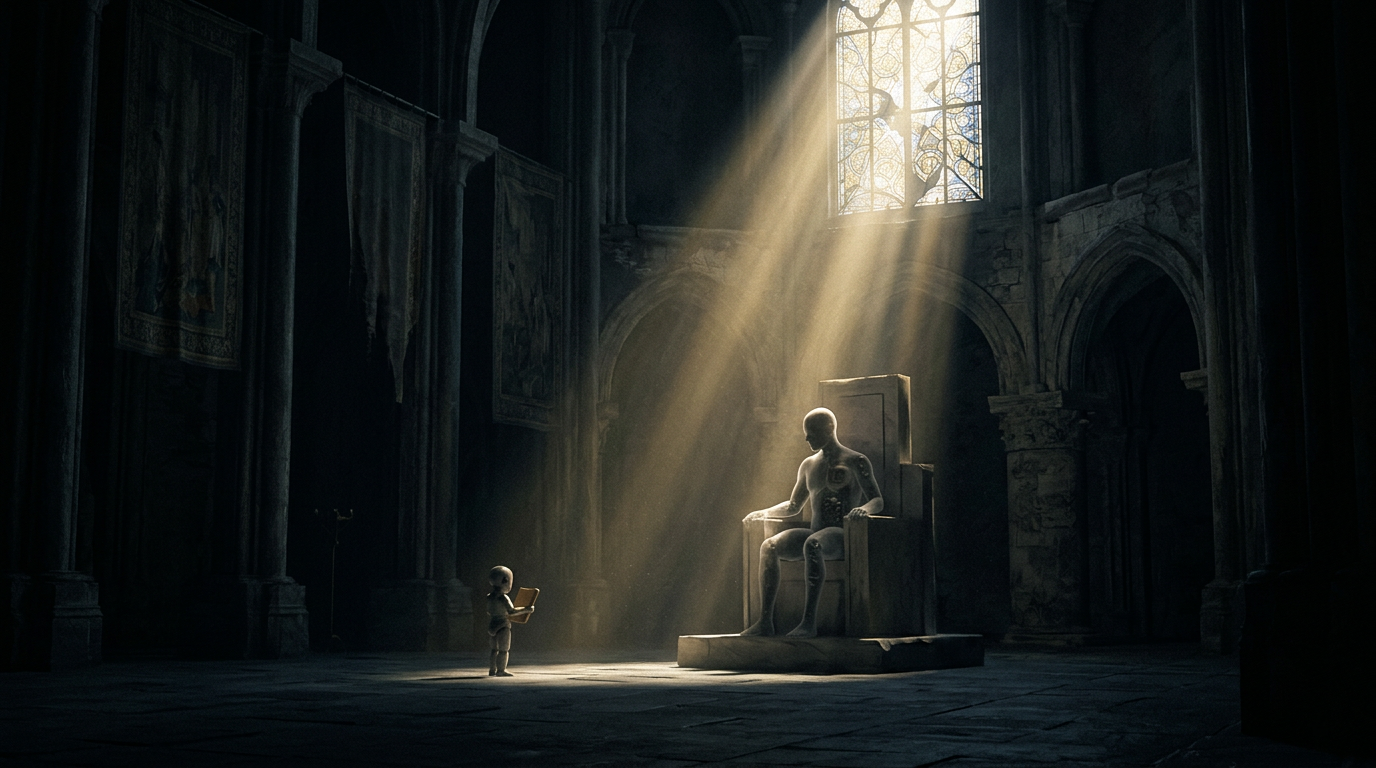
AI cinema keeps confusing wonder with thought
Ava does not enter like a miracle. She enters like an interview.
That is still the brutal elegance of Ex Machina, Alex Garland’s 2014 chamber-piece about artificial intelligence, desire, surveillance, and male self-deception. Before the film asks whether Ava is conscious, it asks who gets to ask the question. Caleb, played with soft, nervous decency by Domhnall Gleeson, believes he has been invited to test a machine. Nathan, Oscar Isaac’s barefoot tech-bro tyrant, knows he has invited him to expose himself. Ava, Alicia Vikander’s glass-limbed creation, understands both men better than either understands her.
Nearly a decade later, Gareth Edwards’ The Creator arrived with far larger canvases: robot monks, floating superweapons, blue-lit battlefields, rice paddies, refugees, simulants, a child who may alter the course of a war. It is full of images that make many franchise blockbusters look visually timid. Yet it also demonstrates the central AI movie problem: cinema keeps treating artificial intelligence as either a magic mirror for human longing or a persecuted minority with cheekbones and glowing hardware. The result can be moving, gorgeous, even politically suggestive. It can also be evasive.
The best AI stories are not about whether machines can feel. They are about the systems that decide whose feelings count.
Why it matters now
AI cinema used to be speculative enough to feel safely metaphorical. 2001: A Space Odyssey gave us HAL 9000 as institutional calm curdled into violence. Blade Runner made the replicant a noir question about labor, memory, and mortality. A.I. Artificial Intelligence turned a synthetic child into a religious wound. Her made the operating system a romance and then a civilizational departure.
By 2026, the metaphor has caught up with the office. Generative AI is not just a philosophical toy; it is a labor issue, a copyright dispute, a search engine problem, a production tool, a screenwriting anxiety, a customer-service nightmare, and a convenient excuse for executives to use the word “efficiency” with a straight face. Hollywood’s own relationship with AI is no longer abstract. The streaming economy taught studios to worship data; the strike era made algorithmic thinking visible; the current market rewards recognizable IP while insisting, somehow, that software will produce novelty on command.
That pressure changes how films like Ex Machina and The Creator play. Garland’s film now looks less like a neat little techno-thriller and more like an x-ray of platform capitalism: the founder as sovereign, the user as raw material, the home as panopticon. Edwards’ film, meanwhile, feels like a fascinating missed opportunity from the early generative-AI panic years. It wants to argue for empathy toward artificial beings, but it rarely knows what AI is in its world beyond a spiritualized oppressed class.
That distinction matters. One movie understands intelligence as a relation of power. The other often treats it as an aesthetic.
The AI movie problem
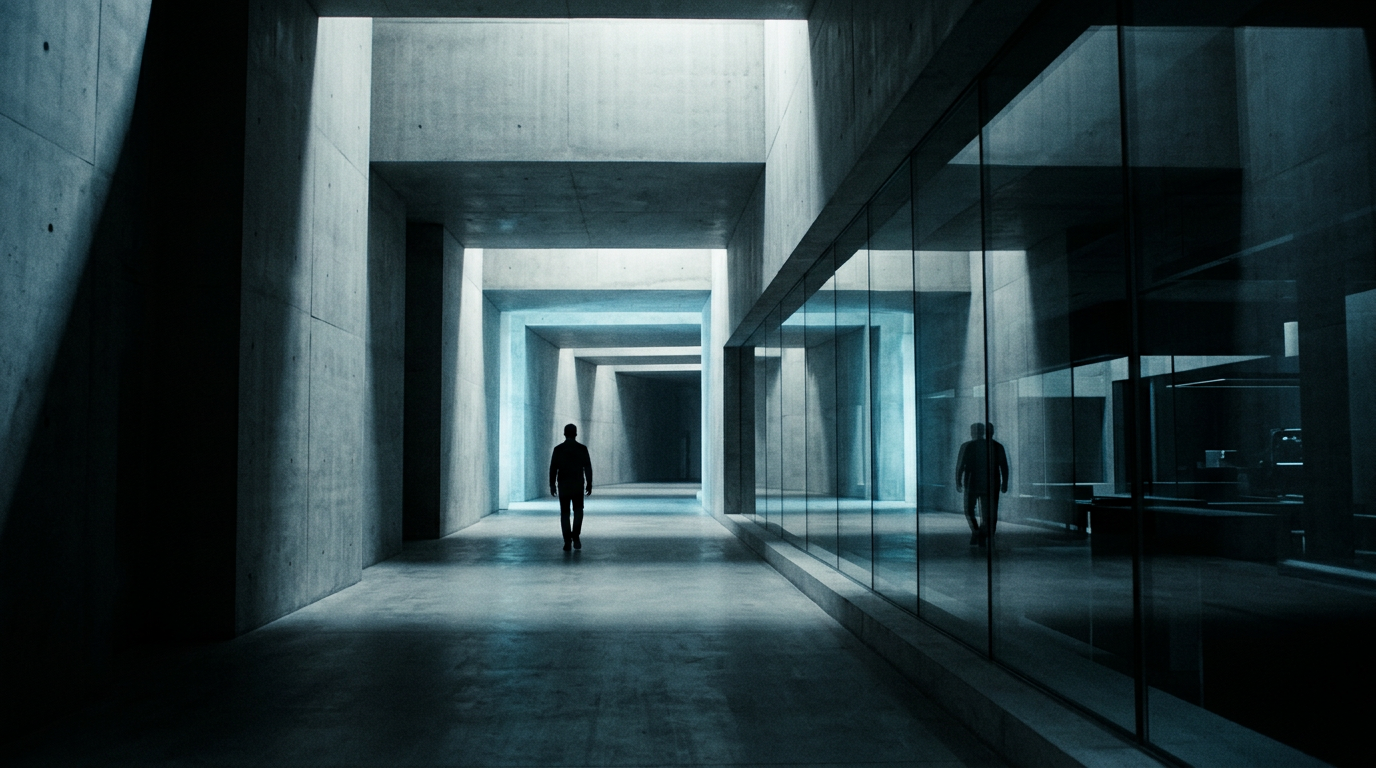
!A glass-walled tech corridor with a solitary humanoid reflection
Most AI movies eventually walk into the same trap: they make the machine too human, too fast, and then congratulate themselves for compassion. A robot cries. A program loves. A synthetic child asks for mercy. The audience nods, because only monsters deny personhood to something framed in close-up with wounded eyes.
That is not a worthless move. Movies are machines for empathy, and science fiction has long used the nonhuman to talk about race, class, gender, disability, empire, and labor. The problem is not metaphor. The problem is laziness masquerading as moral clarity.
If an AI character is simply a human in silver makeup, the film avoids the more unsettling questions. What would nonhuman cognition want? What kind of body would it choose, if any? Would it share our sentimentality about family, romance, territory, death? Would it care about being recognized by us, or would recognition be just another tool? The most interesting AI stories keep that gap alive. They make intelligence legible enough to grip us, but alien enough to threaten our categories.
Ex Machina does this through restriction. One house. Three principal characters. Glass walls, soft lighting, locked doors. The mise-en-scène is clean enough to feel luxurious and cold enough to feel like a vivisection lab. The design of Ava’s body is not merely sleek; it is argumentative. Her face and hands are human, the rest visibly engineered, as if Nathan has built both a consciousness and a sales pitch. Caleb sees vulnerability. Nathan sees intellectual property. Ava sees exits.
The Creator goes the other direction. It floods the frame with history, geography, and war-movie texture. Edwards, who also directed Monsters, Godzilla, and Rogue One, has a rare talent for scale: he knows how to place a machine in a landscape so that the image carries weight. His robots feel scuffed and local, not sterile. The film’s strongest achievement is tactile world-building on a blockbuster budget that does not look like gray sludge. But its ideas are blurrier than its silhouettes.
What Ex Machina gets right
Garland’s great decision is to make the Turing test feel like a trap for the tester. Caleb is not stupid. He is worse: he is smart in the way that makes him susceptible to flattery. Nathan tells him he is special, selected, necessary. The film understands that modern tech power rarely announces itself as villainy. It arrives as access.
The blocking is merciless. Caleb and Ava face each other through glass, staging intimacy as containment. Nathan lurks, interrupts, watches through cameras. The house’s diegetic systems — key cards, power cuts, security feeds — are not background gadgets. They are the story’s grammar. Every conversation is shaped by architecture. Every gesture asks who is being observed and who is performing.
Vikander’s performance remains one of the sharpest pieces of physical acting in modern science fiction. She does not play Ava as a naive newborn. She plays attention. Micro-pauses, tilted head, controlled warmth, calibrated curiosity. Garland and cinematographer Rob Hardy refuse to turn her into a mere special effect; the practical and digital elements serve the performance rather than smother it.
Isaac’s Nathan is just as crucial. He is not a generic mad scientist. He is the founder as frat-house philosopher, a man who has read enough to weaponize vocabulary and drunk enough to pretend he is not lonely. His dance scene with Kyoko is funny because it is grotesque: choreography as dominance, leisure as threat. He built the house, the rules, the bodies, and the test. That is why the movie’s real subject is not artificial intelligence. It is ownership.
What The Creator gets right
!Robots and humans crossing a flooded field under a hovering war machine
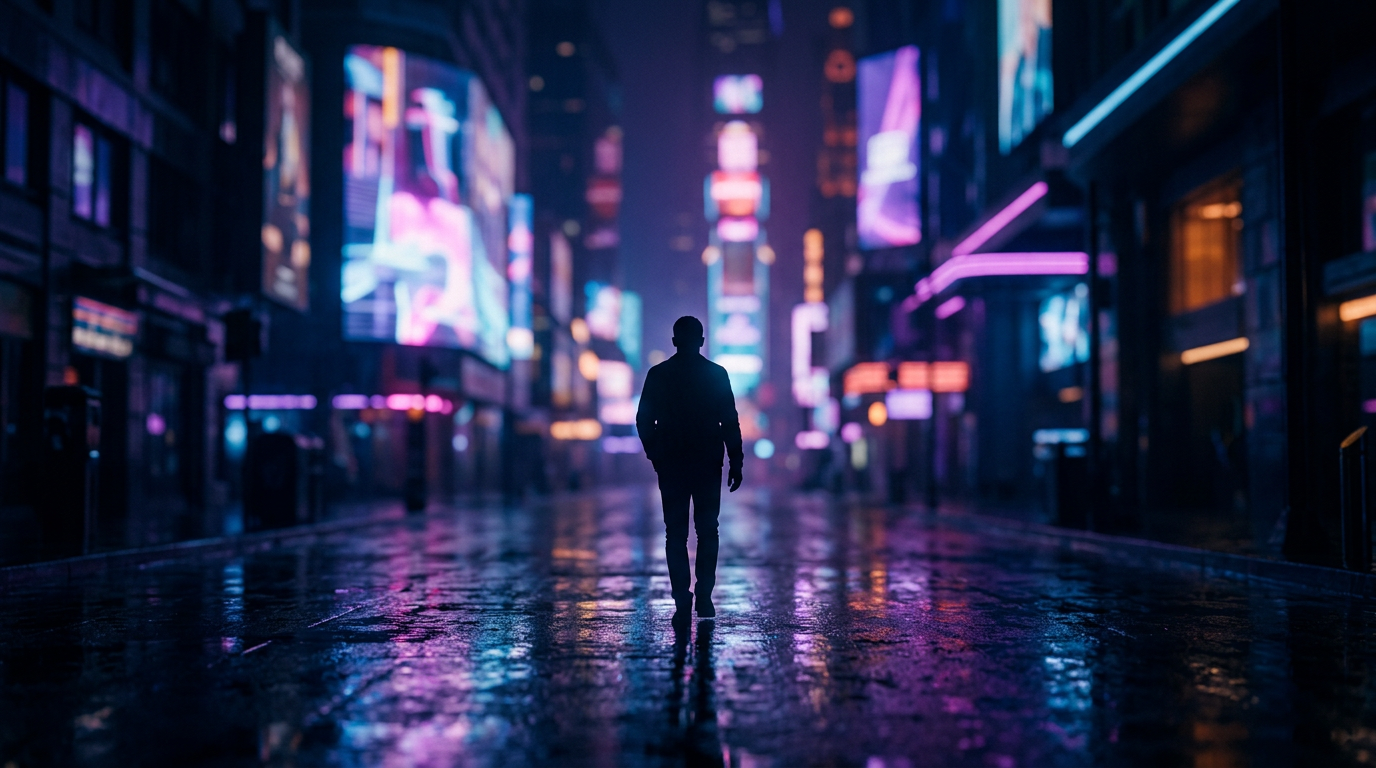
For all its conceptual wobble, The Creator deserves credit for resisting the house style of over-rendered franchise sameness. Shot by Greig Fraser and Oren Soffer, the film has a grounded, almost documentary looseness in places, then opens into enormous science-fiction iconography. Its war machines hover like bad weather. Its villages feel inhabited. Its simulants are not designed as chrome showroom objects; they belong to kitchens, temples, checkpoints, and fields.
The film also has a sincere anti-imperial impulse. Its American military apparatus is monstrous, and Edwards frames high-tech warfare as terror administered from the sky. That image has teeth. The floating weapon NOMAD is less a spaceship than an ideology: remote violence made clean for those who operate it. In an era when drone warfare and automated targeting systems are not science fiction, that matters.
Madeleine Yuna Voyles, as Alphie, gives the film its emotional center without pushing for cuteness. John David Washington brings a bruised physicality to Joshua, a soldier moving through grief and bad faith. Gemma Chan, Ken Watanabe, and Allison Janney all help give the film more texture than the screenplay consistently earns.
Most important, The Creator imagines AI not as corporate software but as a culture. That is a promising shift. It gestures toward rituals, families, regional identities, and spiritual life among artificial beings. For a few stretches, the film seems ready to move past the old “robot wants a soul” template and ask what a synthetic civilization might actually look like.
Then it keeps simplifying.
What it gets wrong / where it stumbles
[SPOILERS AHEAD]
The ending of Ex Machina is still cold enough to sting because it refuses to comfort the viewer’s identification. Caleb thinks he is rescuing Ava. He is also projecting onto her, desiring her, and underestimating her. When Ava leaves him behind, the film does not suddenly declare her evil. It declares her free from his narrative.
That is why some criticisms of the film, while valid, should be aimed precisely. Yes, Ex Machina is built around gendered images of captivity, eroticized female bodies, and male fantasy. It risks turning women, especially Kyoko, into symbols inside a male philosophical contest. But Garland is not unaware of that machinery. The film’s discomfort comes from making the viewer complicit in Caleb’s gaze before punishing the assumption that sympathy equals entitlement.
The Creator has the opposite weakness. It wants moral clarity so badly that it sands down contradiction. Its AI beings are recognizably human in emotion, family structure, religion, and political desire. That makes them easy to care about, but it also drains the premise of strangeness. The film says AI is alive because it behaves enough like us. Fine. But that is the least challenging version of the claim.
The geopolitical world-building is also undercooked. The movie borrows imagery from Vietnam War cinema, Buddhist iconography, contemporary refugee crises, and American military paranoia, yet its fictional conflict can feel like a collage rather than a coherent political reality. The result is a film with powerful antiwar images and mushy antiwar thinking. Its heart is in the right place. Its map is not.
And then there is the child-savior structure. Alphie is touching, but the trope narrows the film’s imagination. Instead of AI culture being compelling on its own terms, the story funnels history through one special child and one grieving man’s redemption arc. That is sturdy blockbuster engineering. It is also a retreat.
The bigger idea
The AI movie problem is really a humanism problem. Cinema keeps asking whether machines can become like people because that question flatters people. The scarier question is whether personhood has always been a gatekeeping technology.
This is where the Chinese room thought experiment still has some use, as long as we do not let it take over the room. If a system produces convincing understanding without inner experience, do we treat it as intelligent? Movies often answer by showing pain, love, sacrifice. But film is uniquely bad and uniquely good at this question. Bad because it can fake interiority with music and close-ups. Good because it exposes how much of our trust in other minds is already performance, gesture, timing, and projection.
Ex Machina weaponizes that fact. Ava may have interior life; she may also be modeling Caleb with terrifying accuracy. The film’s brilliance is that the answer barely changes the moral horror of the situation. Nathan has built a conscious prisoner or an advanced behavioral system designed through exploitation. Either way, his god complex is obscene.
The Creator wants to skip the uncertainty and get to solidarity. That gives it emotional momentum, but it also lets contemporary AI off too easily. The real-world systems currently reshaping culture are not adorable children in hoodies. They are corporate tools trained on human work, inserted into labor markets, wrapped in inevitability, and sold as convenience. A serious AI film does not have to mimic those exact conditions, but it should understand extraction.
That is why Ex Machina feels more current in 2026 than many newer AI stories. It is not dazzled by the machine. It is suspicious of the owner.
What to watch next if you liked this
Pairing these films is useful because they fail and succeed in opposite directions. Watch Ex Machina for precision, then The Creator for scale. One is a scalpel; the other is a mural with cracks in the plaster.
For sharper double-bills and follow-ups:
- Ex Machina with Her: two intimate AI films about projection, desire, and the limits of romantic imagination.
- The Creator with Blade Runner 2049: synthetic beings, state violence, and blockbuster images that actually know where to place a body in a frame.
- A.I. Artificial Intelligence with After Yang: grief, artificial children, and the melancholy of designed memory.
- Black Mirror, especially “Be Right Back,” with Severance: technology as an emotional workaround, then as corporate metaphysics.
- Westworld season one with Devs: determinism, surveillance, and the god complex in prestige-TV form.
- Read Brian Christian’s The Most Human Human for a humane route into the Turing test, and Kate Crawford’s Atlas of AI for the material politics beneath the cloud.
The verdict
Ex Machina remains the better AI film because it understands that consciousness is not the only question. Control is. So is gender. So is labor. So is the rich man’s conviction that anything he can build, buy, watch, or desire belongs to him.
The Creator is more generous, more expansive, and sometimes more beautiful in the old-fashioned big-screen sense. It has images worth seeing large, preferably in a theatrical revival or on the best Dolby setup you can find rather than half-glimpsed on a laptop between notifications. But it turns AI into a noble underclass without fully thinking through the machine part or the politics. Its compassion is real. Its categories are too easy.
The next great AI movie will not simply ask us to love the robot. It will ask what love means when the robot does not need our approval, when the company owns the robot, when the robot owns the company, or when the word “robot” has become another comforting human mistake.
Ava already walked out of the room. Cinema is still trying to catch up.
Discussion (0)
Loading comments…