Blade Runner 2049 has outlived the future
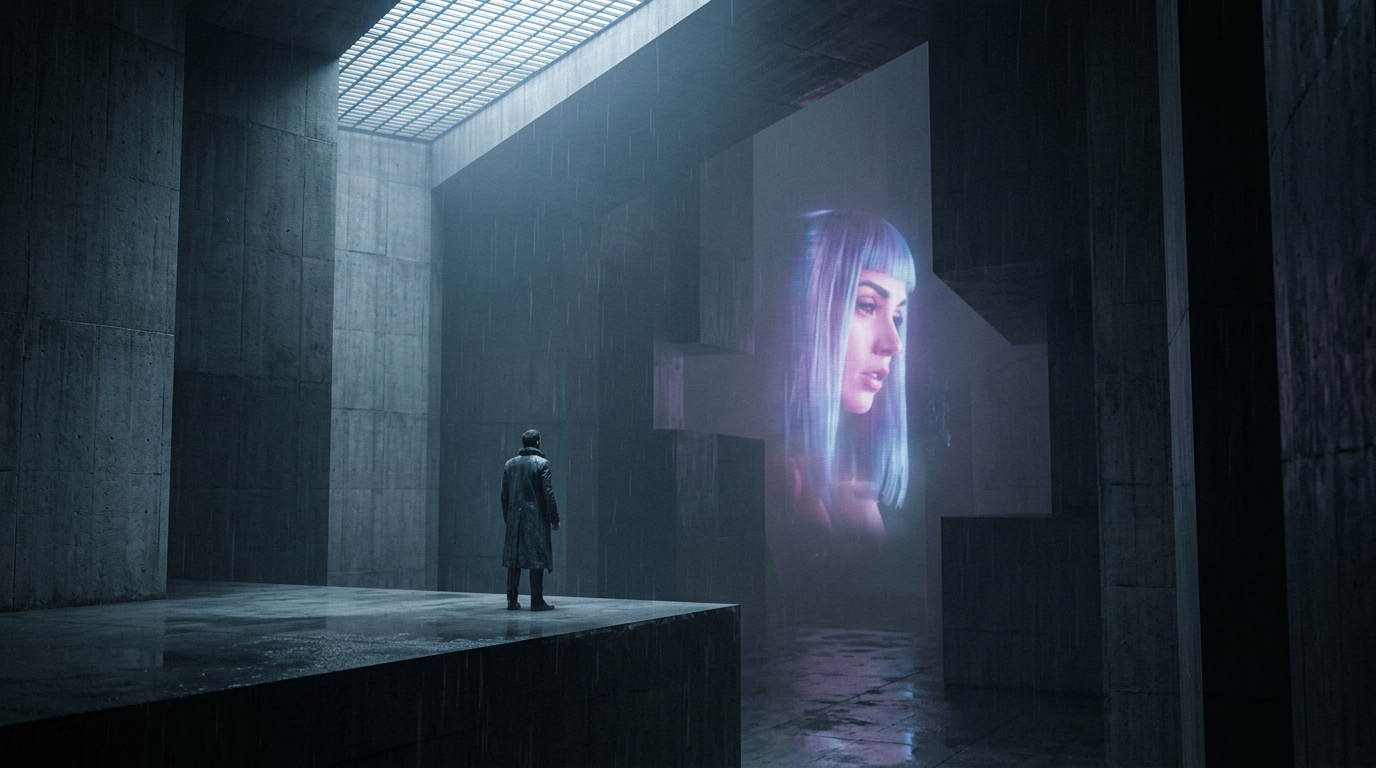
A hologram stands in the rain and tells a lonely man exactly what he needs to hear.
That is the image from Blade Runner 2049 that refuses to age. Not the flying cars. Not the orange ruins of Las Vegas. Not even Ryan Gosling’s beautiful, bruised stillness as K. It is the intimacy machine: a product designed to simulate attention so convincingly that the buyer begins to mistake being seen for being known.
When Denis Villeneuve’s sequel arrived in 2017, it felt like a risky act of studio seriousness: a nearly three-hour, R-rated, expensive science-fiction elegy released into a marketplace that usually rewards brand management over mood. It underperformed theatrically, became a home-cinema fetish object, and then settled into the strange afterlife reserved for movies that were too patient for opening weekend but too powerful to disappear.
Now, in 2026, Blade Runner 2049 feels less like a sequel to Ridley Scott’s 1982 landmark than a diagnostic tool. It understands a culture where bodies are optimized, memories are mediated, companionship is subscription-based, and the wealthy fantasize about escape while the poor inherit the weather. It is not “predictive” in the cheap sense. Villeneuve and screenwriters Hampton Fancher and Michael Green are not checking off gadgets. They are asking what happens when a civilization keeps improving its interfaces while its moral imagination rots.
The film’s relevance keeps growing because it is not really about whether machines can become human. That question was already old when Philip K. Dick asked it. Blade Runner 2049 is about whether humans, under pressure from capital, surveillance, climate collapse, and algorithmic desire, can avoid becoming machines.
Why it matters now
Science fiction has had an odd decade. The streaming wars produced lavish TV worlds, from Apple TV+’s Foundation and Silo to Netflix’s 3 Body Problem, while theaters rediscovered that large-format spectacle can still feel like an event when the image has weight. Christopher Nolan’s Oppenheimer made IMAX 70mm a civic ritual. Villeneuve’s Dune: Part Two proved that dense, strange, political sci-fi can still command a crowd when the craft is imperial-grade. A24 and Neon, meanwhile, helped train audiences to accept genre as philosophy with better lighting.
Inside that landscape, Blade Runner 2049 looks less like an outlier and more like a missing bridge. It connects the old cathedral model of studio filmmaking — massive sets, movie stars, a mythic score — with the current appetite for speculative stories about systems. It has the scale of a blockbuster and the metabolism of slow cinema. It gives you world-building, then makes you sit in the silence after the world has been built.
Its central anxieties have only sharpened. AI companionship is no longer a cyberpunk flourish; it is an ordinary business model. The line between assistant, therapist, flirtation engine, and data-extraction device is already blurry. Synthetic media keeps improving. Online identity is increasingly a performance assembled from prompts, filters, metrics, and feedback loops. The “real” has not vanished, exactly. It has become harder to verify and easier to monetize.
That is why Joi, played by Ana de Armas, has become one of the film’s most durable creations. She is not merely a cautionary tale about artificial love. She is a perfect consumer product because she flatters the buyer’s idea of himself. She does not just say “I love you.” She constructs a world in which that love feels aesthetically inevitable. Warm light. Soft voice. Domestic blocking. A mise-en-scène of being cared for.
The horror is not that she is fake. The horror is that the fake thing may still change the person who needs it.
What it gets right
!Lonely apartment lit by a soft holographic glow and rain outside

Villeneuve’s greatest decision was to make the future feel exhausted rather than busy. So much contemporary sci-fi mistakes density for imagination: more screens, more vehicles, more signage, more lore. Blade Runner 2049 often does the opposite. It clears space. It lets concrete, fog, snow, and neon do emotional work.
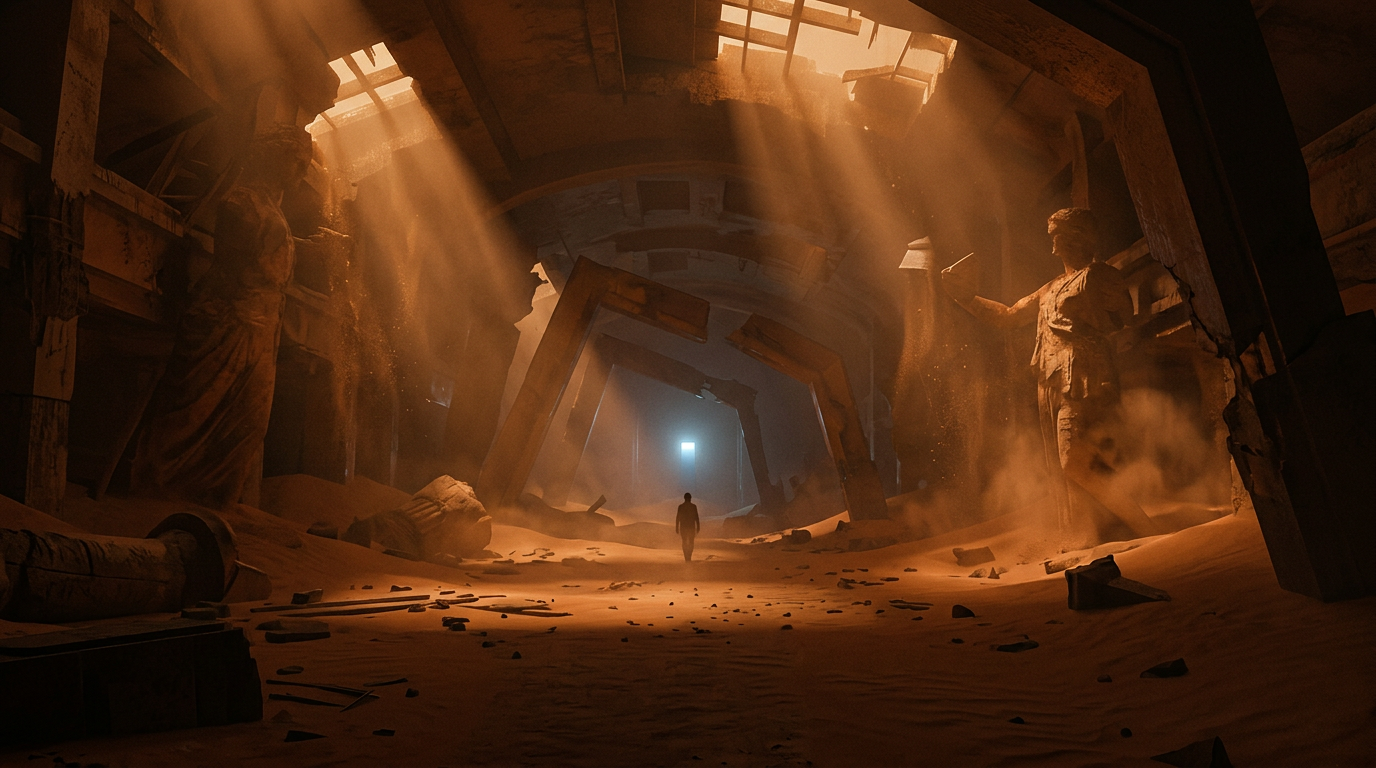
Roger Deakins’ cinematography is rightly famous, but the praise sometimes flattens what he actually achieves. This is not just a gorgeous movie. It is a movie about vision: who gets to see, who is watched, who is reflected, who is reduced to a silhouette. The light is rarely neutral. Wallace Corporation interiors glow like sterile temples. LAPD spaces feel worn down by bureaucracy and bad air. The Las Vegas sequence, soaked in radioactive amber, turns nostalgia into a physical toxin.
The sound design and score by Hans Zimmer and Benjamin Wallfisch understand the original Vangelis mood without embalming it. The bass does not simply announce scale; it presses on the body. The music often feels less composed than exhaled by the architecture. In Dolby Cinema, the film can seem to vibrate from inside the walls.
Gosling’s performance remains one of his finest because it resists the usual prestige-acting signals. K is not a blank. He is a man trained to behave like a blank, which is more interesting. Gosling plays tiny deviations: a pause held too long, a question asked too softly, a look that lingers where obedience should end. Harrison Ford, returning as Deckard, does not try to reclaim the movie through charm. He brings damage, suspicion, and the physical heaviness of someone who has outlived his own genre.
The supporting cast gives the world moral texture. Robin Wright’s Lieutenant Joshi is not a cartoon of authority; she is a functionary who understands the fragility of the order she serves. Sylvia Hoeks’ Luv is terrifying because she combines devotion, resentment, and corporate discipline into one sleek weapon. Jared Leto’s Niander Wallace is the film’s weakest major presence, but even there the conception is clear: a blind tech messiah who speaks in scripture while treating bodies as inventory.
[SPOILERS AHEAD]
What it gets wrong / where it stumbles
The film’s biggest flaw is not its length. The slowness is the point, and most of it earns its oxygen. The problem is that Wallace is less interesting than the system he represents.
Leto plays him as a whispering oracle, all damp pauses and predatory calm. It is not a disastrous performance, but it narrows the character into villainous mystique when the movie around him is smarter than that. Wallace should feel inevitable: the logical end point of monopoly capitalism, colonial ambition, and spiritual emptiness. Instead, he sometimes feels like a man rehearsing for a TED Talk in a crypt.
There is also a gender problem the film knows about but does not entirely solve. Blade Runner 2049 is brutally perceptive about the commodification of women’s bodies and images, yet it repeatedly stages that commodification through ravishing surfaces. Joi, Mariette, the giant nude hologram, the replicant bodies handled as industrial assets: the critique is real, but so is the aesthetic charge. Villeneuve is not being careless. The tension is intentional. Still, intention does not erase the risk that the film’s sorrowful gaze can look a lot like the thing it mourns.
The resistance subplot, led by Freysa, also arrives with more thematic importance than dramatic force. It gestures toward collective politics, then retreats back into K’s private awakening. That choice makes sense for the film’s tragic shape, but it leaves the revolutionary world slightly underwritten. Compared with Andor, which understands rebellion as logistics, compromise, and labor, Blade Runner 2049 treats rebellion as a whispered mythology.
That is the price of its focus. The film is less interested in movements than in souls.
The bigger idea
!Solitary figure crossing an amber ruined casino interior
The first Blade Runner asked whether a replicant could possess a soul. Blade Runner 2049 asks a colder question: if your memories are manufactured, your desires nudged, your labor assigned, and your loneliness exploited, what part of you remains available for freedom?
This is where the film’s famous twist still lands. K is not the miracle child. He is not the chosen one. His memories, the ones that make him feel singular, belong to someone else. In a lesser blockbuster, that revelation would be a demotion. Here it becomes liberation. K’s humanity does not depend on being special. It depends on what he chooses after the fantasy of specialness collapses.
That is a devastatingly contemporary idea. Much of online life is built around the promise of uniqueness delivered through mass templates. Your feed is personalized. Your ads are personalized. Your entertainment is recommended just for you, by systems that have made the same intimate promise to millions of other people. Blade Runner 2049 understands the ache underneath that bargain. To be told you are unique by a machine designed to say so is not comfort. It is a trap with flattering lighting.
The film also works as a panopticon story, though not in the obvious “cameras everywhere” way. K is watched by institutions, tested by baseline routines, tracked through records, and disciplined by architecture. But the deeper surveillance is internal. He polices his own reactions. He fears his own hope. The most effective control system is the one that makes desire feel like malfunction.
And then there is hauntology, Mark Fisher’s idea of a culture possessed by lost futures. Blade Runner 2049 is haunted not only by Deckard and Rachael, but by the future promised by the original film. Its Los Angeles is not sleek progress; it is the afterimage of futures that failed to arrive cleanly. Atari signs glow like corporate ghosts. Sinatra flickers in a dead casino. The movie is full of obsolete glamour, broken dreams, and synthetic afterlives.
That is why the ending is so moving. K’s final act is not self-discovery in the superhero sense. It is self-erasure in service of someone else’s reunion. He becomes real not by proving an origin story, but by making a moral choice without applause. Snow falls. The music rises. The future remains ruined. A human act still matters.
The 2026 afterlife
Rewatching Blade Runner 2049 today, what stands out is how little it flatters contemporary attention. It does not rush to reassure you. It does not wink. It does not treat lore as homework or nostalgia as a reward system. Even its callbacks to the 1982 film are mournful rather than triumphant.
That may be why its reputation keeps improving. It belongs to the small group of modern studio sci-fi films that feel built to be revisited: Arrival, Interstellar, Annihilation, Dune: Part Two, Ex Machina, Under the Skin, Nope. Not because they all do the same thing, but because they understand that spectacle without an idea curdles quickly.
Villeneuve has become the defining big-canvas science-fiction director of the current era because he treats scale as pressure, not decoration. In Dune, history crushes the individual. In Arrival, language reshapes grief. In Blade Runner 2049, the built world keeps insisting that personhood is a clerical error. The drama lies in refusing that verdict.
The film also looks better as streaming libraries become more disposable. On a phone, it is diminished. On a proper screen, with the room dark and the sound allowed to breathe, it regains its authority. If you can catch it in repertory projection, Dolby, or any serious large-format revival, do. This is not nostalgia for theatrical purity. It is a practical point about form. Deakins composes bodies against vast negative space; shrink the image too far and you shrink the loneliness.
What to watch next if you liked this
For a double bill, pair Blade Runner 2049 with films and series that test its ideas from different angles:
- Blade Runner: Watch Ridley Scott’s Final Cut first if you want the noir fever dream before Villeneuve’s elegy. The original is messier, sexier, and more unstable.
- Arrival: Villeneuve’s warmer companion piece, with Amy Adams anchoring a story about language, time, and grief without turning wonder into mush.
- Ex Machina: Alex Garland’s chamber-piece version of artificial intimacy and male vanity. Smaller scale, sharper knife.
- Her: Spike Jonze gets at the ache of operating-system romance with more tenderness and less doom.
- Ghost in the Shell: Mamoru Oshii’s 1995 anime remains essential cyberpunk, especially for its treatment of embodiment and identity.
- A.I. Artificial Intelligence: Steven Spielberg and Stanley Kubrick’s strange, wounded fairy tale about programmed love and human cruelty.
- Severance: For viewers drawn to controlled identities, corporate architecture, and the terror of compartmentalized selves.
- Andor: Not cyberpunk, but the best recent argument that systems are defeated by people doing unglamorous, dangerous work together.
A strong weekend pairing: Ex Machina on Friday, Blade Runner 2049 on Saturday, Her on Sunday. That sequence moves from manipulation to existential ache to emotional dependence, and it makes Joi look less like a sci-fi invention than part of a larger screen history of artificial companionship.
For reading, go back to Philip K. Dick’s Do Androids Dream of Electric Sheep?, not as a checklist for adaptation, but as a stranger, more anxious text about empathy and spiritual exhaustion. Then read Mark Fisher’s Capitalist Realism if you want a bracing vocabulary for the film’s sense that the future has been privatized before anyone else could reach it.
The verdict
Blade Runner 2049 keeps getting more relevant every year because it saw the future not as a gadget parade, but as an emotional economy. It understood that the next great scarcity would not be information. It would be unpurchased attention. Unscripted tenderness. A memory that belongs to you. A choice that cannot be optimized away.
The film stumbles when it turns its corporate villain into a gothic abstraction, and it never fully escapes the seductions of the images it critiques. But those flaws do not weaken its central force. If anything, they make it more revealing: a beautiful movie suspicious of beauty, a sequel suspicious of inheritance, a blockbuster suspicious of the systems that made it possible.
K lies in the snow at the end, having finally acted outside the logic that built him. No one markets the moment back to him. No one upgrades it. No one turns it into a product tier.
For once, the machine does not get the last word.
Discussion (0)
Loading comments…