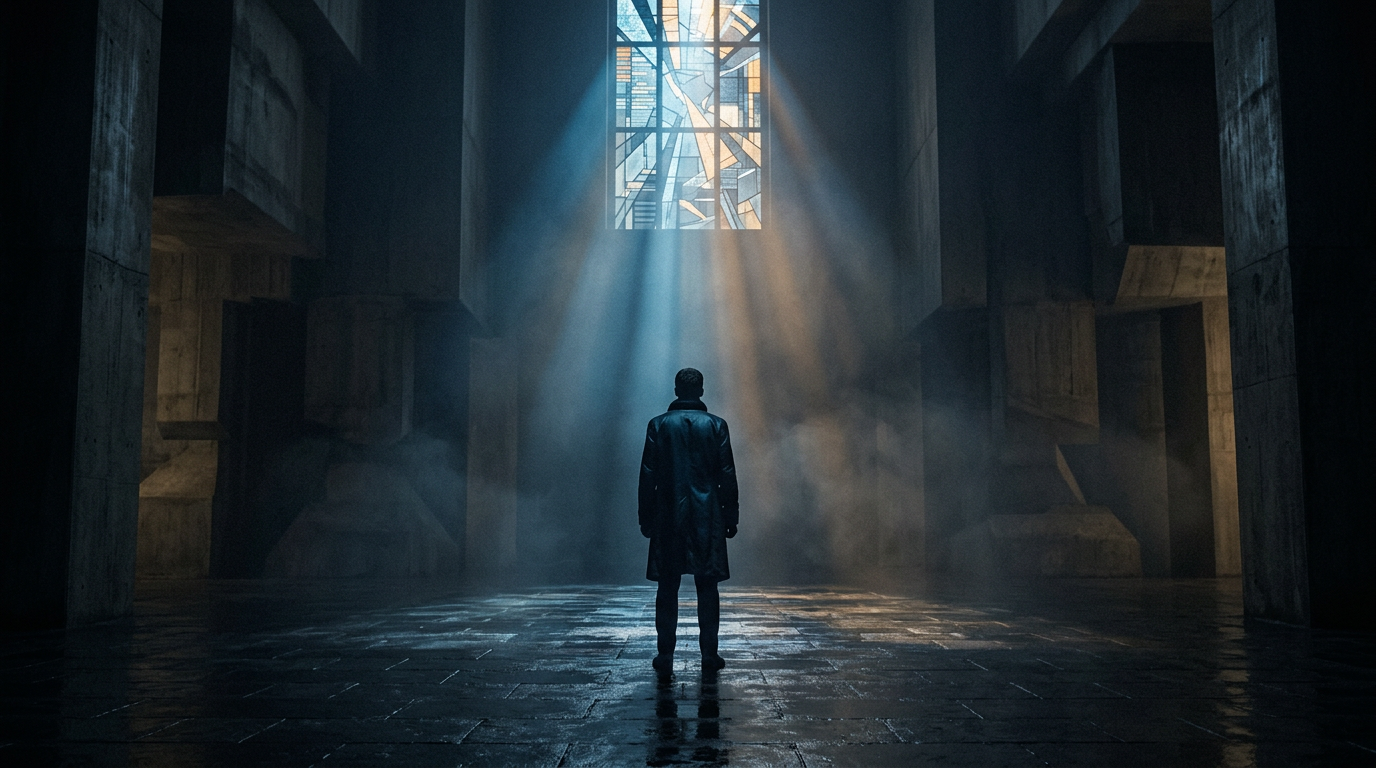
Blade Runner 2049 saw the future getting lonelier
The most frightening thing in Blade Runner 2049 is not a killer android, a dead planet, or a corporate god complex. It is Ryan Gosling standing in a doorway, waiting for an algorithm to tell him he is loved.
Denis Villeneuve’s 2017 sequel arrived with impossible baggage: follow Ridley Scott’s Blade Runner, honor Philip K. Dick’s anxiety about artificial life, satisfy viewers who worship rain-slicked neon, and somehow justify its own existence in a market already addicted to expensive brand resurrection. It underwhelmed commercially. Then it started to grow.
By 2026, Blade Runner 2049 looks less like a handsome legacy sequel and more like one of the key American science-fiction films of the century. Not because it predicted flying cars or off-world colonies. Those are set dressing. Its accuracy is emotional and infrastructural: synthetic companionship, privatized surveillance, engineered labor, collapsing ecosystems, and a culture so saturated with images that reality itself becomes a luxury good.
The film’s future is not fast. That is part of its insult. Villeneuve and cinematographer Roger Deakins do not treat dystopia as a chase montage. They hold on the hangar-like emptiness of police headquarters, the irradiated orange of Las Vegas, the gray protein farms, the glassy sterility of the Wallace Corporation. The mise-en-scène is less “cool future” than “late-capitalist mausoleum with better lighting.” Every room seems designed to make a person feel replaceable.
And that is why it keeps gaining force. The closer our own world moves toward AI girlfriends, workplace monitoring, climate adaptation for the wealthy, and algorithmic identity performance, the less speculative the film feels. Blade Runner 2049 is not asking whether machines can become human. That question was already stale when the first film asked it beautifully. Villeneuve’s movie asks a harsher one: what happens when human beings start accepting machine conditions as normal?
Why it matters now
Science fiction ages in two ways. The gadgets become quaint, or the social diagnosis gets nastier. Blade Runner 2049 belongs to the second category.
The 2026 viewing landscape is crowded with prestige dystopias and expensive IP futures: Apple TV+ has made chilly corporate unease into a house style with Severance and Silo; Netflix keeps feeding the appetite for speculative paranoia with Black Mirror and 3 Body Problem; Amazon’s long-gestating Blade Runner 2099 project exists because studios know this world still has cultural oxygen. Meanwhile theatrical sci-fi has found new life in the wake of Dune: Part Two, Oppenheimer proving that adult spectacle can still command a room, and a renewed hunger for large-format cinema where scale actually means something.
But Blade Runner 2049 is not merely “big.” It is patient. That makes it feel almost radical now. In a streaming economy that treats attention as a resource to be strip-mined, Villeneuve gives us pauses, negative space, brutal architecture, and silence heavy enough to bruise. The film asks you to look at a face after the system has finished talking.
Its most contemporary element is Joi, played by Ana de Armas: a purchased holographic companion whose tenderness may be sincere, programmed, or commercially optimized beyond distinction. In 2017, she registered as a clever update to cyberpunk’s old erotic circuitry. In 2026, she looks uncomfortably close to a business model. The question is no longer whether an AI companion can simulate affection. The question is whether lonely people will care if it is simulation.
That is where the film earns its relevance. It understands that the future will not only oppress us through police drones and corporate violence. It will soothe us. It will compliment us. It will learn our preferences. It will call us special.
What it gets right
!A lone figure dwarfed by a golden futuristic corporate atrium
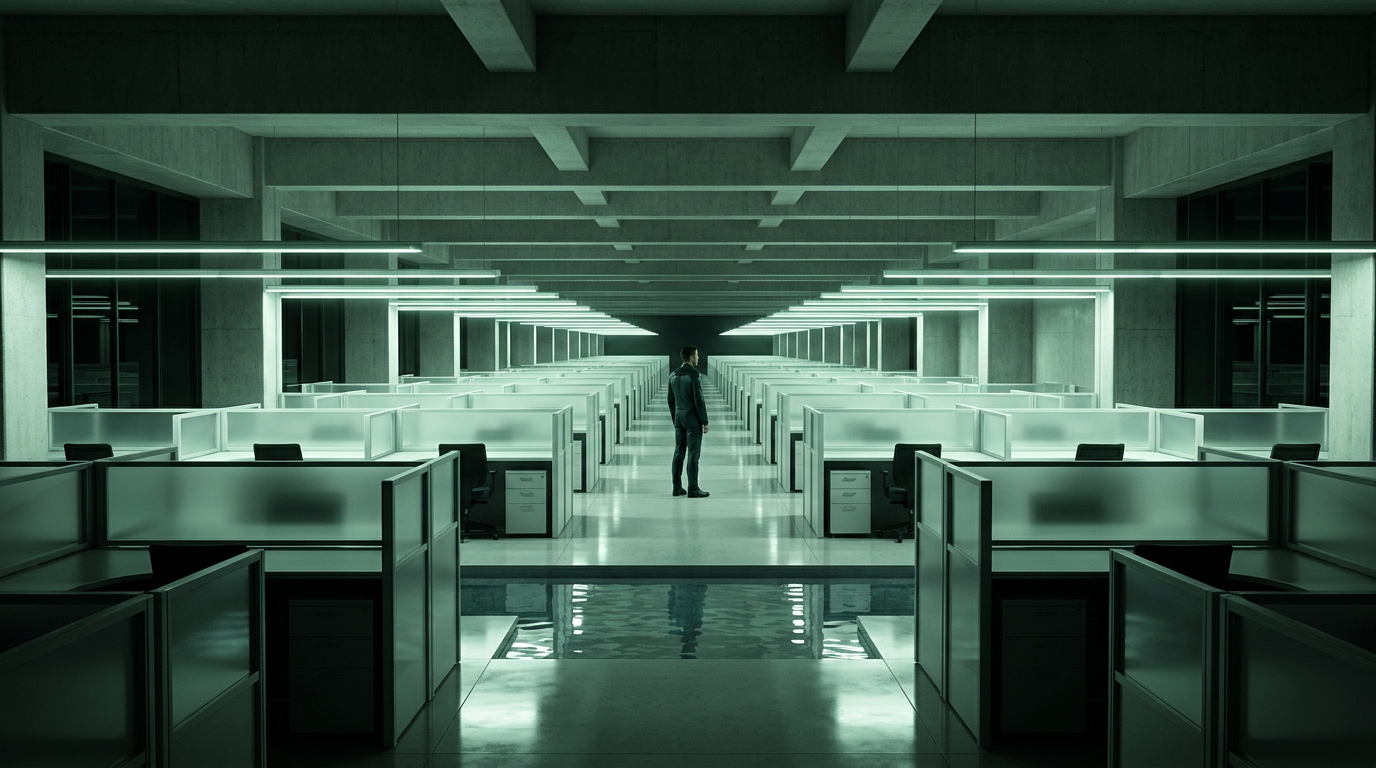
The original Blade Runner gave cinema one of its great haunted cities: noir Los Angeles remade as globalized ruin, all smoke, signage, wet asphalt, and existential fatigue. Blade Runner 2049 wisely refuses to out-neon it. Villeneuve expands the world horizontally and emotionally. His Los Angeles is less crowded than Scott’s, more depleted, more lonely. The future has not exploded. It has hollowed out.
Deakins’ cinematography, which won him his first Academy Award, is not just beautiful; it is moral. The lighting tells you who owns the world. Wallace’s headquarters glow with monastic gold, as if capital has learned to impersonate divinity. Police interiors are brutal slabs of institutional gray. The wastelands have the texture of exhausted matter. This is world-building through atmosphere rather than exposition.
The blocking is equally severe. Gosling’s K is often framed as a small figure inside enormous systems: doorways, corridors, basins of light, rooms that seem to swallow him before he speaks. His performance is built from micro-delays. He is not blank; he is managed. Every pause suggests a person trying to determine whether his next feeling is permitted.
The sound design helps. Hans Zimmer and Benjamin Wallfisch do not imitate Vangelis so much as exhume him. Their score groans, pulses, and occasionally blooms into melancholy, as if the old romantic synthesizer dream is trapped under industrial machinery. The result is not nostalgia. It is hauntology in the Mark Fisher sense: a future possessed by futures that failed to arrive.
The film also understands labor. Replicants are not just metaphysical puzzles; they are workers. Disposable workers. Built for obedience, punished for memory, retired when inconvenient. K’s job is grotesque because it makes him both tool and enforcer, the exploited employee sent to erase evidence of exploitation. That double bind gives the movie its political bite.
What it gets wrong and where it stumbles
For all its intelligence, Blade Runner 2049 is not untouchable. Its biggest weakness is Niander Wallace, played by Jared Leto as a blind tech messiah whispering in riddles. The film needs Wallace as a corporate theologian, a man who sees reproduction, slavery, and expansion as parts of the same imperial equation. But the performance sometimes turns menace into scented-candle villainy. He is less frightening when he speaks than when his architecture speaks for him.
There is also the familiar Blade Runner problem of women as projections: muse, memory, assistant, mother, target, advertisement. Villeneuve complicates this more than some critics allowed, especially through Joi and Luv, but the film still leans hard on female bodies as symbolic territory. Sylvia Hoeks gives Luv a terrifying precision, a killer with the posture of an executive assistant and the grief of an unwanted child. Still, the movie’s emotional architecture remains overwhelmingly organized around K’s awakening.
Its slowness, too, is a virtue until it becomes a mannerism. At 164 minutes, Blade Runner 2049 earns much of its sprawl, particularly in IMAX or on a serious home setup with disciplined lighting and sound. On a distracted couch, chopped into two nights between phone checks, it can feel embalmed. That is partly a viewer problem, partly a pacing problem. Villeneuve’s solemnity is powerful, but it occasionally mistakes duration for depth.
None of these flaws break the film. They keep it human. Or at least human-adjacent.
The bigger idea
!A quiet snowy rooftop under distant neon light

[SPOILERS AHEAD]
The genius of Blade Runner 2049 is its cruel inversion of chosen-one mythology. K believes he may be miraculous: a replicant born rather than manufactured, a being whose existence would rupture the boundary between product and person. In another franchise, this would be destiny. Here, it is misdirection.
K is not the child. He is the decoy. The revelation does not shrink him; it liberates the film from narcissism. His life matters not because he is singular, but because he chooses meaning without cosmic confirmation. That is a braver idea than “you were special all along.”
The film’s central philosophical pressure is not simply the old Ship of Theseus question of what makes a person continuous over time. Memories can be implanted. Bodies can be manufactured. Desire can be purchased. What remains? Blade Runner 2049 answers with action, not essence. A person is not proven by origin. A person is revealed in what they protect when no reward is coming.
This is why K’s final movement lands with such force. His sacrifice is not a plot coupon redeemed for franchise closure. It is an ethical act in a universe built to deny ethics. He helps Deckard reach his daughter, Dr. Ana Stelline, and then lies down in the snow. The image is quiet, almost perversely so. No speech. No coronation. Just breath, weather, and the possibility that dying for someone else may be the only form of authorship left to him.
The snow matters. The first film’s tears vanished in rain; this one gives us snowflakes, delicate and indifferent. Nature, or what remains of it, does not validate K. It simply receives him.
That ending is why the movie has aged better than many cleaner, tidier science-fiction spectacles. It refuses the algorithmic comfort of identity as branding. K does not need to be the secret prince, the lost heir, the franchise key. He becomes real by doing something no system asked him to do.
A sequel that actually argues with its predecessor
Most legacy sequels are taxidermy. They pose beloved images under new lighting and hope recognition will pass for feeling. Blade Runner 2049 does something rarer: it disagrees with the mythos it inherits.
Ridley Scott’s Blade Runner is obsessed with the erotic and existential instability of the artificial human. Villeneuve’s sequel shifts the emphasis to systems: policing, data control, bioengineering, memory production, environmental collapse. Deckard, played again by Harrison Ford, is not treated as a triumphant returning icon. He is a relic hiding in the ruins of a dead entertainment capital, surrounded by holographic Elvis and Frank Sinatra performances that flicker like cultural ghosts.
That Las Vegas sequence is among the best in recent studio sci-fi because it stages nostalgia as malfunction. The past does not return cleanly. It stutters, glitches, performs to an empty room. Ford, often asked in late-career roles to carry the burden of audience affection, is used more intelligently here. Deckard is tired, guarded, and morally weathered. The movie does not ask us to applaud him for existing.
Villeneuve also strips away some of the macho detective glamour. K’s investigation is less a noir case than a spiritual audit. Each clue makes him less certain, not more powerful. The unreliable narrator is not a voice-over this time; it is identity itself.
What to watch next if you liked this
If Blade Runner 2049 hits you harder now than it did in 2017, build a small viewing chain around its concerns rather than its surface.
- Blade Runner: Watch Ridley Scott’s 1982 film in a final-cut version if available. Pair it with 2049 as a study in how cyberpunk shifted from crowded urban paranoia to corporate loneliness.
- Her: Spike Jonze’s 2013 film is the gentler, more wounded cousin of the Joi storyline. Together, they make a sharp double-bill about intimacy under software capitalism.
- Ex Machina: Alex Garland’s chamber piece is colder and more argumentative, with Alicia Vikander’s Ava turning the Turing-test setup into a study of gendered control and tech-bro vanity.
- A.I. Artificial Intelligence: Steven Spielberg’s misunderstood 2001 film shares 2049’s ache for artificial beings who inherit human cruelty and human longing.
- Ghost in the Shell: Mamoru Oshii’s 1995 anime remains essential for anyone interested in cybernetics, embodiment, and identity beyond flesh.
- Severance: For a TV pairing, Apple TV+’s corporate nightmare makes an excellent companion piece about divided selves and institutional ownership of consciousness.
- Andor: Not cyberpunk, but spiritually aligned. Tony Gilroy’s series understands systems, labor, sacrifice, and rebellion without flattering the viewer.
For reading, return to Philip K. Dick’s Do Androids Dream of Electric Sheep?, not because the films are faithful in a literal sense, but because Dick’s spiritual panic still hums beneath them. Then try Mark Fisher’s Capitalist Realism for a brisk, bleak framework on why futures in popular culture often feel pre-defeated.
The final verdict
Blade Runner 2049 keeps getting more relevant because it was never mainly about whether androids have souls. It was about a civilization outsourcing tenderness, memory, labor, and belief until the difference between authentic and artificial becomes less important than who profits from the confusion.
That is a grim thesis. The film’s surprise is that it finds grace anyway. Not hopepunk, exactly; Villeneuve is too severe for that. But not nihilism either. K’s journey suggests that meaning can survive even when origin stories collapse, even when love might be code, even when the city is a machine for processing loneliness.
The movie’s scale still deserves the biggest screen you can manage: Dolby Cinema if it returns, a 4K disc if you care about shadow detail, a dark room and real speakers if you are watching at home. But its true size is not visual. It is existential.
Every year, the billboards get smarter. The assistants get warmer. The bosses get more abstract. The climate gets less forgiving. And Blade Runner 2049, once accused of being too slow and too sad for blockbuster culture, looks more and more like it was simply paying attention.
Discussion (0)
Loading comments…