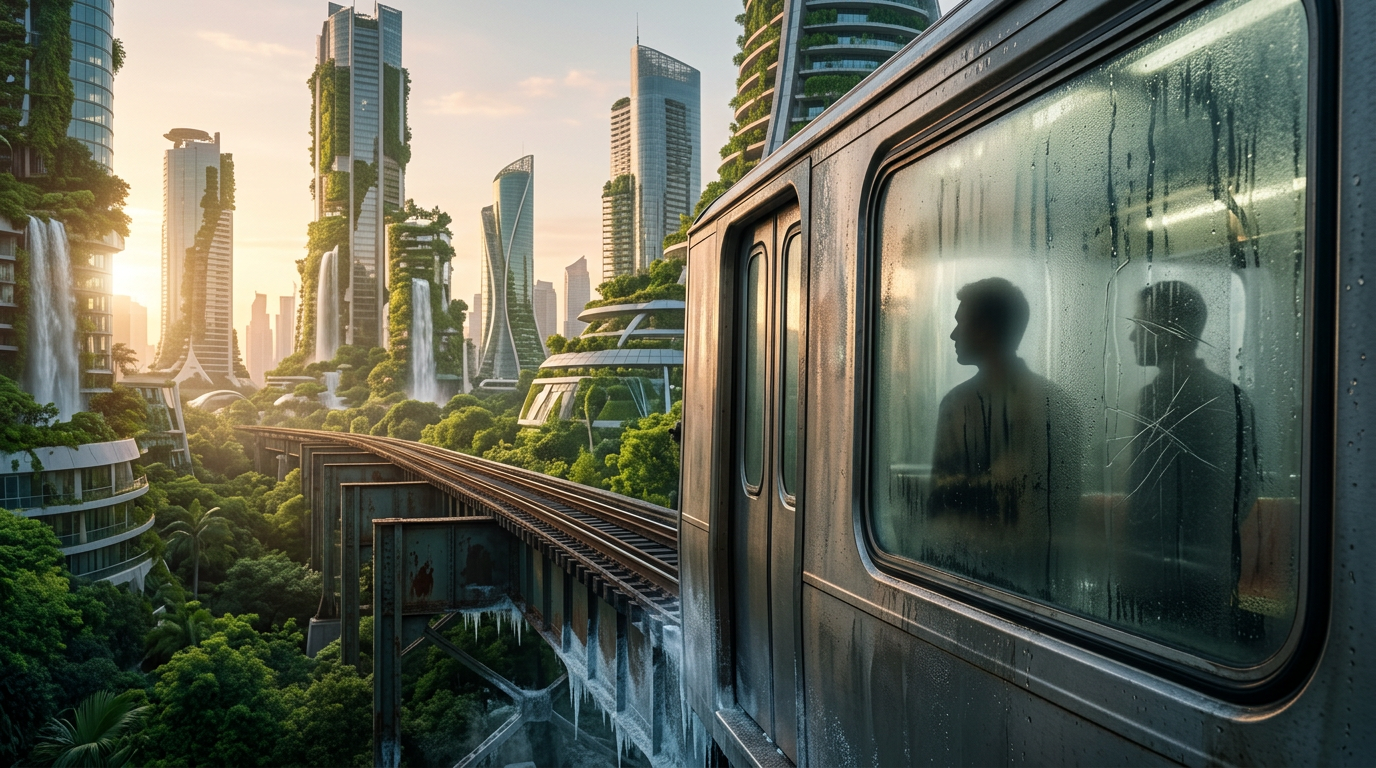
Bong Joon-ho makes the future sweat
A man slips on blood and propaganda in Bong Joon-ho’s future, and the gag lands before the metaphor does.
That has always been Bong’s trick. His science fiction is never content to admire the machinery. The train, the lab, the slaughterhouse, the cloned body, the sealed ecosystem: each arrives with a price tag, a smell, and a manager explaining why cruelty is simply logistics. Bong’s futures do not shimmer. They perspire.
With Mickey 17, Bong returned to English-language sci-fi after Snowpiercer, bringing Robert Pattinson into a story about expendability, replication, and the fantasy that capitalism can make even death a renewable resource. The film is not an isolated eccentricity in his career. It is the latest panel in a mural that runs through The Host, Snowpiercer, Okja, and even the non-sci-fi architecture of Parasite: class is not a theme pasted onto genre. It is the operating system.
The job of a Bong Joon-ho sci-fi film is not to predict the future. It is to make the present confess under pressure.
Why it matters now
Sci-fi is having one of its periodic identity crises, which is usually when it gets interesting. Prestige television has stretched the genre into corporate paranoia and metaphysical HR nightmares with Severance. Apple TV+ keeps betting on scale with Foundation and Silo. Netflix and international streamers chase the intellectual cachet of 3 Body Problem. Theatrical sci-fi, meanwhile, has clawed back cultural space through the IMAX heft of Dune, the chilly precision of Blade Runner 2049, and the renewed appetite for original speculative stories that do not arrive pre-chewed by franchise lore.
Bong sits oddly and productively inside that landscape. He is not a hard-sci-fi engineer like Christopher Nolan in Interstellar, nor a mythic world-builder like Denis Villeneuve in Dune. He is closer to a social entomologist with a taste for slapstick. He watches systems through bodies: hungry bodies, sick bodies, animal bodies, duplicated bodies, bodies shoved into the wrong compartment.
That emphasis feels especially sharp in 2026. Climate anxiety has become less like a subject and more like the weather in which all subjects now live. Automation is no longer abstract. AI panic, biotech speculation, supply-chain fragility, and billionaire bunker fantasies have made old dystopian furniture look depressingly ergonomic. Bong’s sci-fi matters because it refuses the clean futurism of tasteful screens and antiseptic corridors. His mise-en-scène insists that the future will be administered by petty men with clipboards, shareholders, and security badges.
In Snowpiercer, climate catastrophe has already happened, and civilization survives as a violently stratified train. In Okja, ecological language is absorbed by corporate branding until ethical consumption becomes another marketing department. In Mickey 17, cloning is not transcendence. It is workplace policy.
Bong’s sci-fi is class warfare with jokes
!A worker faces translucent cloning pods in a cold industrial lab
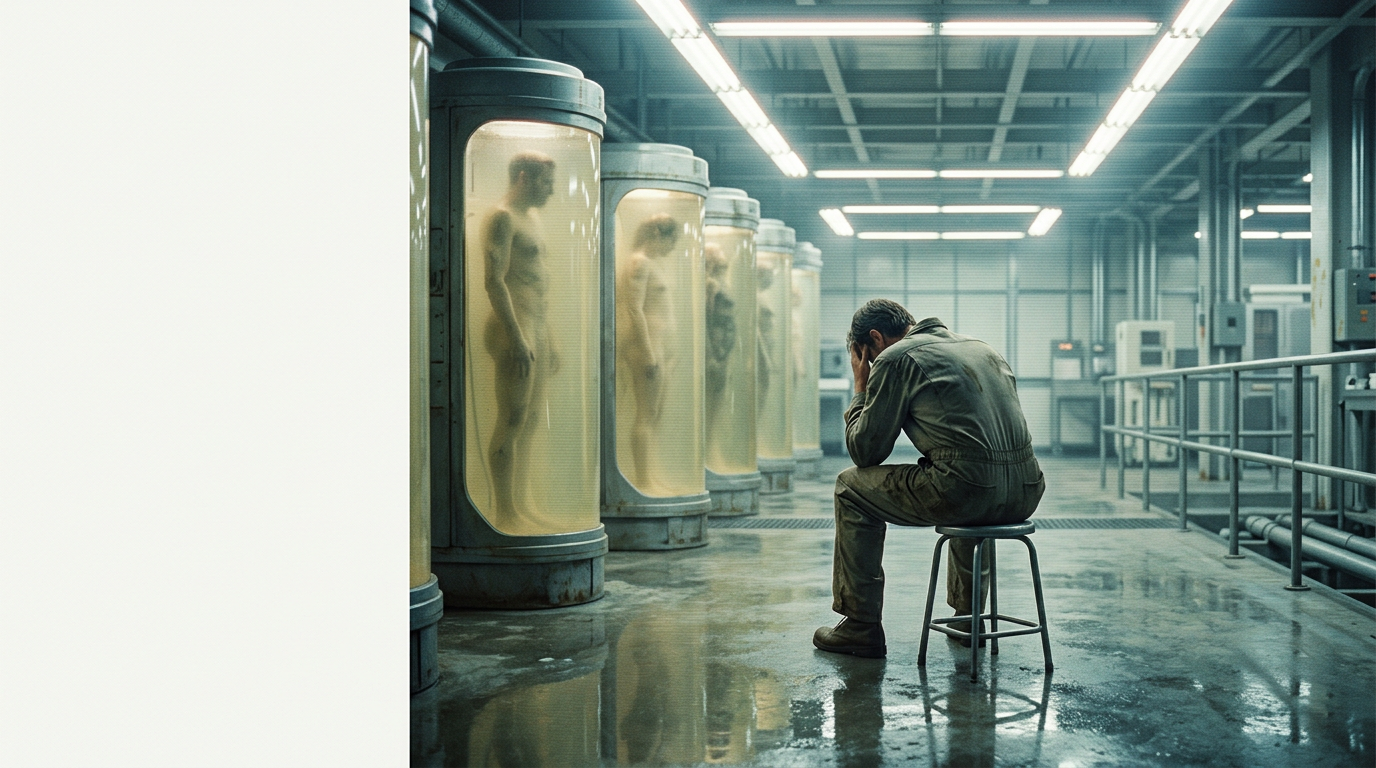
The standard dystopian film often imagines oppression as solemn architecture: monoliths, surveillance grids, gray uniforms. Bong prefers something nastier and funnier. He gives power bad taste.
That is why Snowpiercer remains one of the great class allegories of the 21st century, not because the metaphor is subtle but because the filmmaking is so tactile. The train’s horizontal blocking turns inequality into geography. The tail section is crowded, greasy, handheld. The elite cars become progressively more absurd: aquariums, classrooms, nightclubs, cultivated leisure. The film’s structure is practically diagrammatic, yet Bong keeps it from becoming a civics lecture by making each carriage a new genre mutation. Prison revolt becomes body horror, then satire, then action cinema, then religious pageant.
He understands that class is not merely who has money. It is who gets space, silence, calories, medical care, fresh air, and the right to be bored.
That same instinct powers Parasite, even though it is not sci-fi. The house functions like speculative architecture: levels, sightlines, hidden rooms, invisible labor. Its production design is so exact that the staircase becomes a moral instrument. Bong’s science fiction borrows from that same grammar. He builds worlds vertically, horizontally, metabolically. Someone always eats better because someone else eats worse.
In Mickey 17, expendability becomes literal. A disposable worker can die, be reprinted, and return to the job. It is a bleak comic escalation of the gig economy, where the worker is not merely replaceable in theory but replaceable by design. The clone premise lets Bong sharpen an old question: what does a system do to people once it no longer has to pretend they are unique?
What it gets right
Bong’s great strength is that he never treats science fiction as a showroom for ideas. He treats it as a collision between ideas and appetite.
First, his world-building has friction. The best Bong settings feel used before the plot begins. The train in Snowpiercer is not just a metaphor; it is a machine with labor needs, religious myths, food production, educational propaganda, and security protocols. Okja understands the corporate spectacle around biotechnology: the soft colors, the scripted sincerity, the way a monstrous business model can wear a wholesome mascot grin.
Second, he casts for contradiction. Tilda Swinton’s grotesque bureaucratic performance in Snowpiercer turns management into vaudeville. Chris Evans plays against superhero cleanliness, letting exhaustion and shame sit on his face. In Mickey 17, Pattinson’s screen persona is useful precisely because it can bend from tremulous comedy to existential panic. Bong likes actors who can make humiliation legible.
Third, his violence is moral without being tidy. Bong is not a scold. He knows revolt is messy, compromised, sometimes absurd. His action sequences are often staged as ethical pileups rather than triumphal release. In Snowpiercer, the famous axe fight is brutal not because it is choreographed chaos, but because Bong interrupts rhythm with ritual, darkness, and exhaustion. Bodies do not glide through his set pieces. They crash, pant, and make mistakes.
Fourth, the comedy matters. Bong’s tonal shifts can still startle viewers raised on American genre films that sort jokes and trauma into separate drawers. But his humor is not decoration. It is diagnostic. People do ridiculous things inside terrible systems because systems train them to be ridiculous. Corporate language becomes funny because it is obscene. Bureaucracy becomes funny because it is murder wearing a polite face.
What it gets wrong / where it stumbles
!Luxury greenhouse dining space above frozen ruins and hidden labor
Bong’s boldness has a cost. His English-language sci-fi can occasionally over-articulate what his Korean-language films allow to fester.
Snowpiercer is powerful partly because it is blunt, but the final stretches lean hard into exposition. The film’s allegory is already written into every corridor, costume, and meal; when characters stop to explain the machine, the movie risks flattening its own mystery. Bong usually recovers through performance and visual pressure, but the gears show.
Okja has similar problems in miniature. Its best passages are devastatingly clear: a child, an animal, a corporation, a marketplace. Its weaker moments push the satire toward caricature so broad that the emotional stakes briefly wobble. Jake Gyllenhaal’s gonzo performance is intentionally abrasive, but intentional abrasion is still abrasion.
With Mickey 17, the danger is built into the premise. Cloning stories naturally invite metaphysical talk: identity, memory, continuity, the Ship of Theseus problem in human form. Bong is too earthy a filmmaker to get lost in philosophy for long, which is mostly a virtue. Still, there are moments where the social satire and the existential panic compete for oxygen. Is the film angrier about labor exploitation, colonial fantasy, bodily identity, or political demagoguery? The answer can be all of the above, but all of the above is not always a dramatic shape.
That is the genuine criticism: Bong’s sci-fi sometimes wants the velocity of pulp, the bite of satire, and the density of political theory in the same breath. When it works, nobody else sounds like him. When it stumbles, the film can feel like three brilliant arguments trying to exit through one door.
The bigger idea
Bong’s central subject is not technology. It is permission.
Who is permitted to survive? Who is permitted to waste? Who is permitted to define a life as disposable, an animal as product, a worker as replaceable, a lower class as necessary ballast? His science fiction returns to these questions with the persistence of a guilty conscience.
The climate ticking clock in Bong is rarely abstract. Snowpiercer begins after a geoengineering catastrophe, a reminder that technological fixes can preserve hierarchy rather than cure it. The train is sold as salvation, but it is really a moving panopticon: every compartment watched, sorted, narrated, and disciplined. Survival becomes an excuse for permanent inequality.
Okja pushes the logic backward into the supply chain. Its speculative creature is not the point by itself. The point is the sentimental machinery around it. A corporation does not need to deny cruelty if it can rebrand cruelty as care. That may be Bong’s most contemporary insight. The future will not necessarily arrive with jackboots. It may arrive with wellness language, sustainability metrics, influencer-ready sincerity, and a premium subscription tier.
Mickey 17 extends the argument to the self. If a person can be copied, can labor finally escape death, or has death simply been privatized? The cloning premise makes literal what many workers already understand metaphorically: the system does not need you, but it needs someone shaped like you to keep showing up.
This is where Bong’s work brushes against the Ship of Theseus without turning into a dorm-room puzzle. If the body is replaced, printed, restored, or duplicated, what remains politically vulnerable? Not the soul in some abstract sense. The contract. The hierarchy. The person standing in front of a superior who has decided that continuity is less important than productivity.
The craft behind the panic
Bong’s filmmaking is often praised for tonal control, but that phrase can undersell the muscularity of his craft. His camera is not just agile; it is argumentative.
In Snowpiercer, the anamorphic frame emphasizes lateral movement and social compression. The train moves forward, the rebels move forward, history supposedly moves forward, yet the system is circular. The track loops. Progress is revealed as maintenance.
His blocking tends to expose status instantly. Who stands? Who kneels? Who eats while others watch? Who occupies the center of the frame and who is shoved to its edge? Bong’s class politics are legible before anyone speaks. That is why his films travel so well across languages and markets. The subtitles carry the dialogue, but the mise-en-scène carries the insult.
He is also one of the few major genre filmmakers who understands that practical texture still matters in a digital age. Even when visual effects are central, Bong wants surfaces that feel touchable: fur, metal, meat, snow, grime, fluorescent institutional light. His futures resist the plastic weightlessness that plagues so much streamer-era sci-fi. You can feel the budget, but more importantly, you can feel the floor.
That matters because class is physical. It is sore knees, bad air, cheap food, cramped rooms, and the constant humiliation of being seen only when useful.
What to watch next if you liked this
If Bong’s sci-fi clicks for you, do not stop at the obvious titles. Build a small syllabus around bodies under systems.
- Snowpiercer paired with Children of Men: two visions of social collapse where production design does as much political work as dialogue.
- Mickey 17 paired with Moon: cloning, labor, loneliness, and the corporate theft of personhood, with very different temperatures.
- Okja paired with Sorry to Bother You: anti-capitalist satire that uses absurdity to reach truths realism might politely avoid.
- The Host paired with Godzilla Minus One: monster cinema as national trauma, family melodrama, and public failure.
- Parasite paired with High-Rise: architecture as class system, with Bong’s precision set against Ben Wheatley’s nastier social decay.
- Severance as a television follow-up: not Bongian in tone, but deeply aligned in its suspicion of corporate language and partitioned selves.
For reading, start with Edward Ashton’s Mickey7, the novel that inspired Mickey 17, then move to Mark Fisher’s Capitalist Realism if you want a sharper vocabulary for the trap Bong keeps filming: the sense that the system is absurd, brutal, and somehow treated as the only available reality.
Final verdict
Bong Joon-ho’s science fiction works because it distrusts clean futures. His films know that technology does not abolish class; it often gives class better tools. A climate refuge can become a prison. A miracle food source can become a slaughterhouse with branding. A cloned body can become the final fantasy of management: a worker who can die without interrupting the schedule.
That sounds grim, and it is. But Bong is not a nihilist. His movies are too alive for that. They are full of bad jokes, sudden tenderness, incompetent authority, grotesque meals, and people who keep stumbling toward dignity even when the system has priced dignity out of the market.
The future, in Bong’s hands, is not sleek prophecy. It is a workplace accident, a family crisis, a climate bill, and a moral test arriving all at once. The machine keeps moving. Someone should really pull the emergency brake.
Discussion (0)
Loading comments…