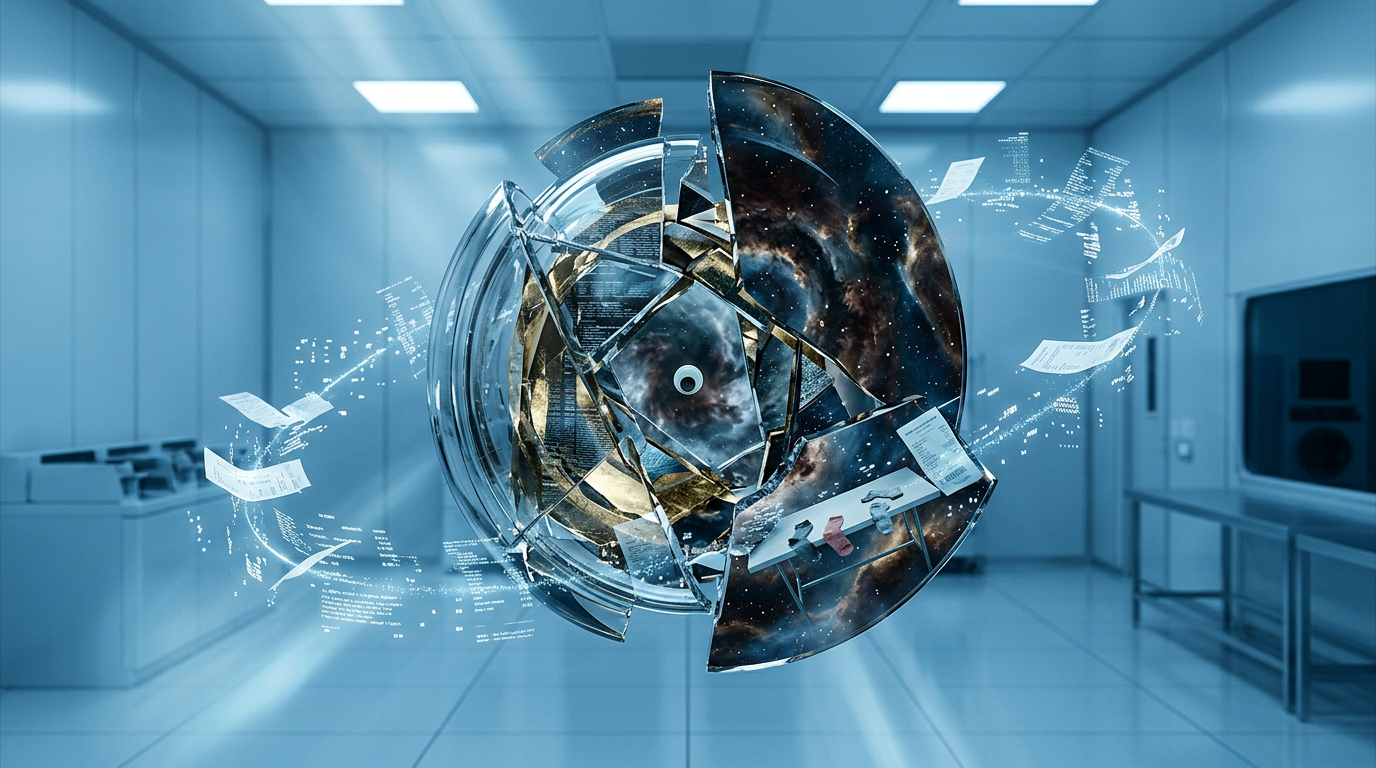
Everything Everywhere gave the multiverse a pulse
The most convincing portal in modern sci-fi is a tax-office cubicle.
Everything Everywhere All at Once begins not with a star gate, a quantum lab, or a superhero stepping through a branded tear in reality, but with Evelyn Wang surrounded by receipts. Fluorescent light. Paperwork. Family tension compressed into bad posture. The mise-en-scène is deliberately unglamorous: a laundromat, an apartment, an IRS desk where a life can be reduced to deductions and missed deadlines. Then the universe cracks open.
That is the film’s secret. The Daniels, Daniel Kwan and Daniel Scheinert, do not treat the multiverse as a bigger map. They treat it as a more honest close-up. Every alternate life Evelyn glimpses is not just a gimmick, not merely a costume change or a comic bit. It is a possible indictment. A possible mercy. A possible version of the self that got better lighting, made bolder choices, loved differently, failed more elegantly.
By 2026, the multiverse has been strip-mined by franchises, meta-comedies, animated spectacles, prestige genre shows, and every IP machine looking for a way to sell nostalgia without admitting defeat. Everything Everywhere All at Once still stands apart because it understands a basic dramatic rule that too much recent multiverse storytelling forgets: infinity only matters if one ordinary life matters first.
Why it matters now
The film arrived in 2022 and looked, at first glance, like another entrant in a crowded conceptual arms race. Marvel had already made the multiverse a franchise strategy. Rick and Morty had turned alternate realities into deadpan existential wallpaper. Spider-Man: Into the Spider-Verse had proved that comic-book plurality could be formally exhilarating. Christopher Nolan’s Interstellar and Denis Villeneuve’s Arrival had already given mainstream audiences permission to cry at high-concept science fiction.
But Everything Everywhere All at Once landed differently. It was an A24 release that became an unlikely box-office event, then an Oscar juggernaut, winning seven Academy Awards including Best Picture, Best Director, Best Actress for Michelle Yeoh, Best Supporting Actor for Ke Huy Quan, and Best Supporting Actress for Jamie Lee Curtis. That institutional success matters less than the reason it happened: people recognized themselves in its maximalism.
That recognition feels even sharper now. The streaming era has trained viewers to keep several tabs open in their heads: one eye on the show, one on the phone, one on the recap ecosystem, one on the next subscription purge. Multiverse stories mirror that fractured attention. They flatter our exhaustion by turning choice overload into cosmology.
Everything Everywhere All at Once does something more bruising. It says the problem is not that there are too many worlds. The problem is that you can lose the one you are standing in.
That makes it one of the defining sci-fi films of the 2020s, even if its science is gleefully soft. Its quantum mechanics are nonsense in the best possible way: less textbook than emotional operating system. The film is not hard sci-fi. It is domestic sci-fi, immigrant-family melodrama, absurdist action cinema, and metaphysical slapstick welded together with a frightening amount of editorial nerve.
What it gets right
!A tax office corridor bends into mirrored multiverse reflections
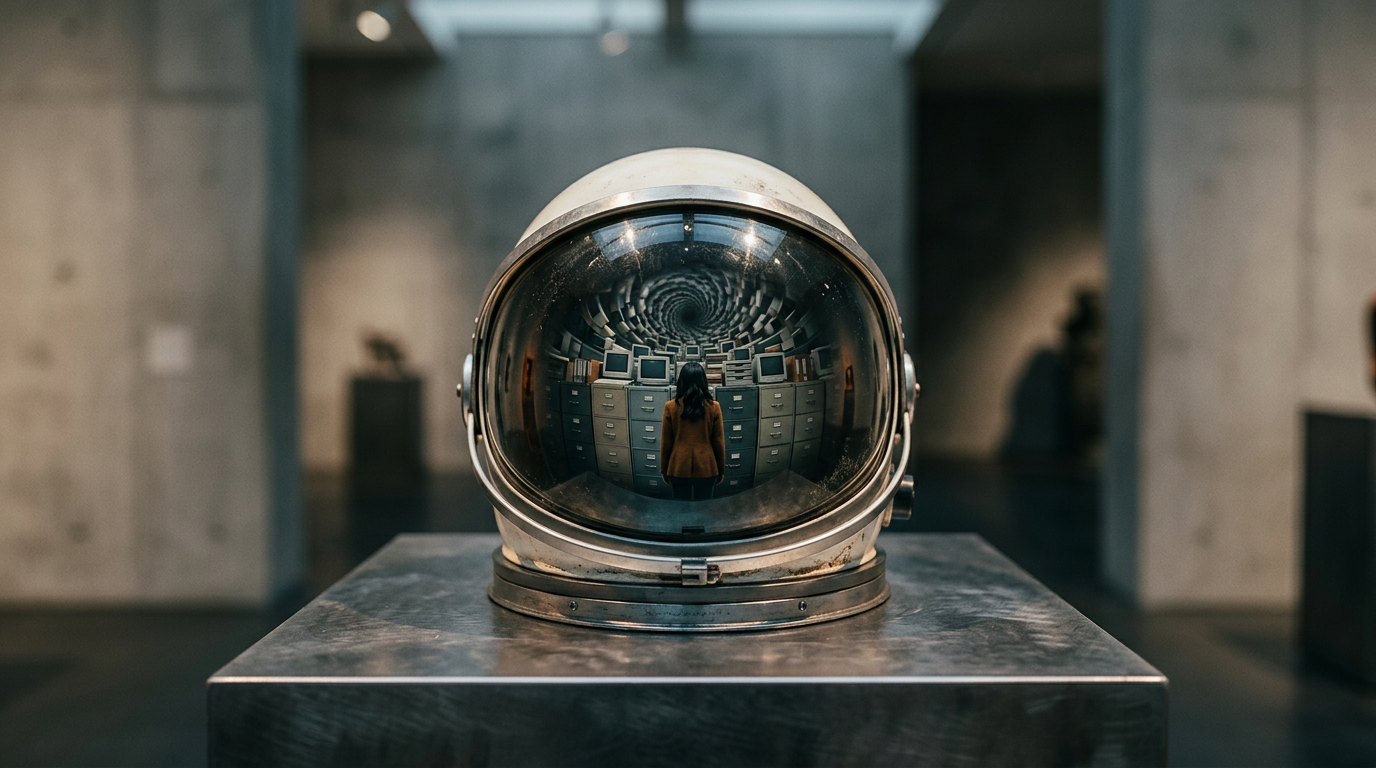
The multiverse works here because it is character design, not set dressing.
Evelyn is introduced as a woman who has been split long before verse-jumping enters the picture. She is a wife, mother, daughter, business owner, translator, caretaker, scold, disappointment, and exhausted administrator of everyone else’s needs. Michelle Yeoh plays her without vanity. Evelyn is not secretly noble in every scene. She is impatient, ungenerous, distracted, often cruel in the banal way tired people become cruel. Yeoh lets the glamour of her movie-star presence fight against the drag of Evelyn’s daily life, which gives the alternate selves real charge.
Ke Huy Quan’s Waymond is just as crucial. In a lesser film, he would be the sweet husband who exists to soften the heroine. Here, his gentleness is an ethic. The blocking often places him at the edge of Evelyn’s attention, waving papers, offering food, absorbing blows. Then the film reveals that his softness is not weakness but strategy. Quan’s performance keeps changing temperature: comic fussiness, action-movie precision, romantic melancholy. He gives the film its moral center without sanding off its weirdness.
The Daniels also understand that a multiverse movie needs rhythm more than lore. The editing by Paul Rogers is astonishingly aggressive, but it rarely becomes noise. Images recur, mutate, rhyme. A martial-arts beat can turn into a domestic accusation. A gag can become a wound. A cutaway that looks disposable can come back with emotional interest. The film’s world-building is not a wiki. It is a nervous system.
Practical effects and scrappy visual invention help too. Everything Everywhere All at Once never looks like the most expensive film in the room, which is part of its charm. The seams show. The absurd props, handmade textures, and elastic production design give the movie a tactile quality many franchise multiverses lack. Too many contemporary blockbusters render infinity as weightless digital soup. The Daniels make infinity feel sticky, cheap, funny, and sad. Like life.
Most important, the movie commits to tonal whiplash as form. Hot-dog fingers, kung fu, tax anxiety, Wong Kar-wai pastiche, googly eyes, and family trauma should not occupy the same dramatic grammar. Yet they do because the film’s governing principle is associative rather than linear. It moves the way an anxious mind moves. Catastrophic thought. Memory. Joke. Shame. Fantasy. Back to the receipt.
[SPOILERS AHEAD]
The rest of this essay discusses major emotional and plot turns, including Jobu Tupaki and the film’s ending.
What the multiverse is really about
!Two stones sit on a quiet cliff beneath a vast sky

Jobu Tupaki could have been a quip machine with couture and cosmic powers. Stephanie Hsu turns her into something far more dangerous: a person who has seen every option and found them all insufficient. Her nihilism is not cool-girl decoration. It is depression rendered as ontology.
The everything bagel is a perfect joke because it is also a perfect metaphor. Put everything on it and the center disappears. The film’s most famous image is funny, stupid, and devastating. It literalizes a culture of total access: every identity, every timeline, every aesthetic, every possible self available at once. The result is not liberation. It is collapse.
This is where Everything Everywhere All at Once surpasses many multiverse stories. The Marvel model often uses alternate selves to escalate stakes or generate applause. A familiar face walks through a portal, and recognition does the work. The Daniels use alternate selves to ask a meaner question: if every version of you exists somewhere, what makes this version worth saving?
That question brushes against the Ship of Theseus problem without turning the movie into a lecture. If Evelyn can borrow skills, memories, and selves from countless lives, what remains Evelyn? The answer is not essence in some clean philosophical sense. It is attention. It is the choice to stay with a person in the room, even after you have seen the glamorous lives where you did not.
The rock scene is the film’s bravest formal gamble. Two silent stones in a barren landscape, subtitled like a deadpan art film, should destroy momentum. Instead it slows the movie down enough for feeling to catch up. After so much cutting, noise, and spectacle, the absence of movement becomes radical. Slow cinema sneaks into a maximalist comedy and, for a few minutes, wins.
The ending works because it does not solve Evelyn’s life. The laundromat is still financially precarious. The family remains prickly. Joy is not cured by a speech. Waymond’s kindness does not magically erase years of being overlooked. What changes is Evelyn’s orientation toward the ordinary. The multiverse has not given her escape. It has returned her to responsibility.
What it gets wrong / where it stumbles
The film’s messiness is mostly productive, but not entirely.
At 139 minutes, Everything Everywhere All at Once occasionally mistakes repetition for escalation. Some late-film beats hammer the same emotional chord after the audience has already heard it clearly. The Daniels’ maximalism can become a kind of insurance policy: if one joke does not land, three more are already sprinting toward you. That abundance is part of the film’s identity, but it sometimes crowds out the quieter ache underneath.
The comedy is also more uneven than its reputation suggests. The juvenile gags have a purpose; they break prestige solemnity and keep the movie from becoming tasteful therapy. Still, a few bits feel overly pleased with their own outrageousness. The film’s best absurdism reveals character. Its weaker absurdism waves its arms.
There is also a fair criticism that the film’s emotional reconciliation arrives with a speed real family wounds rarely allow. The mother-daughter relationship is sharply observed, especially in the tension between love and control, but the movie’s final movement compresses years of pain into an operatic confrontation. That is not a fatal flaw. Melodrama has its rights. But viewers who have lived through similar fractures may find the catharsis more aspirational than persuasive.
Even so, the film earns more than it fumbles. Its excess is not empty spectacle. It is the aesthetic of a woman, a family, and a century of screen culture trying to process too much at once.
The bigger idea
Everything Everywhere All at Once is often described as a multiverse movie, but its deeper genre is regret cinema.
Every major alternate timeline offers Evelyn a fantasy of competence. Movie star. Martial artist. Chef. Lover. Celebrity. The lives she did not live are staged with different visual grammars, including the lush romantic melancholy associated with Wong Kar-wai and the crisp physical clarity of Hong Kong action cinema. The film becomes a museum of cinematic possibility, but it refuses to let style become escape.
That refusal is what makes it so durable. The movie understands capitalist realism, Mark Fisher’s useful phrase for the feeling that the present system is the only imaginable one, at the level of a laundromat ledger. Evelyn’s crisis is cosmic, but her trap is material: debt, immigration pressure, generational obligation, customer service, audit culture. The multiverse does not float above capitalism. It erupts from inside its paperwork.
The googly eye is the film’s counter-symbol to the everything bagel. One is total negation, a black circle that swallows meaning. The other is cheap, ridiculous, and adhesive. A tiny act of chosen attention. The film’s philosophy is not that nothing matters, or that everything matters equally. It argues for selective devotion. Be kind here. Pay attention here. Repair what you can here.
That is why the film’s influence is tricky. Copying its chaos is easy. Copying its discipline is hard. You can fill a frame with variants, portals, costume changes, and meta jokes, but without a specific emotional wound at the center, the multiverse becomes a filing system for fan service.
What to watch next if you liked this
Pair Everything Everywhere All at Once with films and shows that treat speculative form as emotional pressure, not decoration.
- Arrival: Denis Villeneuve’s alien-contact drama is the clean, mournful double-bill. Where the Daniels explode time into slapstick and action, Arrival folds it into grief, language, and maternal choice.
- Spider-Man: Into the Spider-Verse and Spider-Man: Across the Spider-Verse: The best franchise cousins. Their animation uses style as identity, and their multiverse has genuine visual grammar rather than generic portal sludge.
- Being John Malkovich: Spike Jonze and Charlie Kaufman’s body-hopping absurdism remains a key ancestor. Smaller scale, sharper teeth, same discomfort with the self as a stable address.
- The Matrix: The Wachowskis’ cyberpunk landmark is still the essential double-bill for reality-as-system cinema, especially beside the Daniels’ more domestic form of liberation.
- Russian Doll: Natasha Lyonne’s series turns repetition and alternate pathways into a bruised comedy about trauma, memory, and self-sabotage.
- Severance: For a colder companion piece, Apple TV+’s workplace nightmare splits identity through corporate architecture rather than cosmic possibility.
For reading, try Jorge Luis Borges’ short story The Garden of Forking Paths, still one of the great compact visions of branching reality. David Deutsch’s The Fabric of Reality is useful if you want a more serious doorway into many-worlds thinking, though the Daniels’ film is happier treating physics as a trampoline.
The verdict
Everything Everywhere All at Once remains the rare cultural phenomenon whose bigness did not flatten its strangeness. It won the awards, entered the meme bloodstream, boosted A24 from boutique tastemaker to Oscar heavyweight, and gave Michelle Yeoh a role worthy of her full screen history. None of that explains why it still plays.
It plays because the multiverse is not the point. The point is the person doing laundry while wondering whether every major choice has already gone wrong. The point is a husband whose kindness looks foolish until it looks heroic. The point is a daughter asking to be seen without being converted into a parental project. The point is that infinity, properly used, can make a single hand held across a parking lot feel enormous.
That is the multiverse done right: not bigger lore, but sharper love.
Discussion (0)
Loading comments…