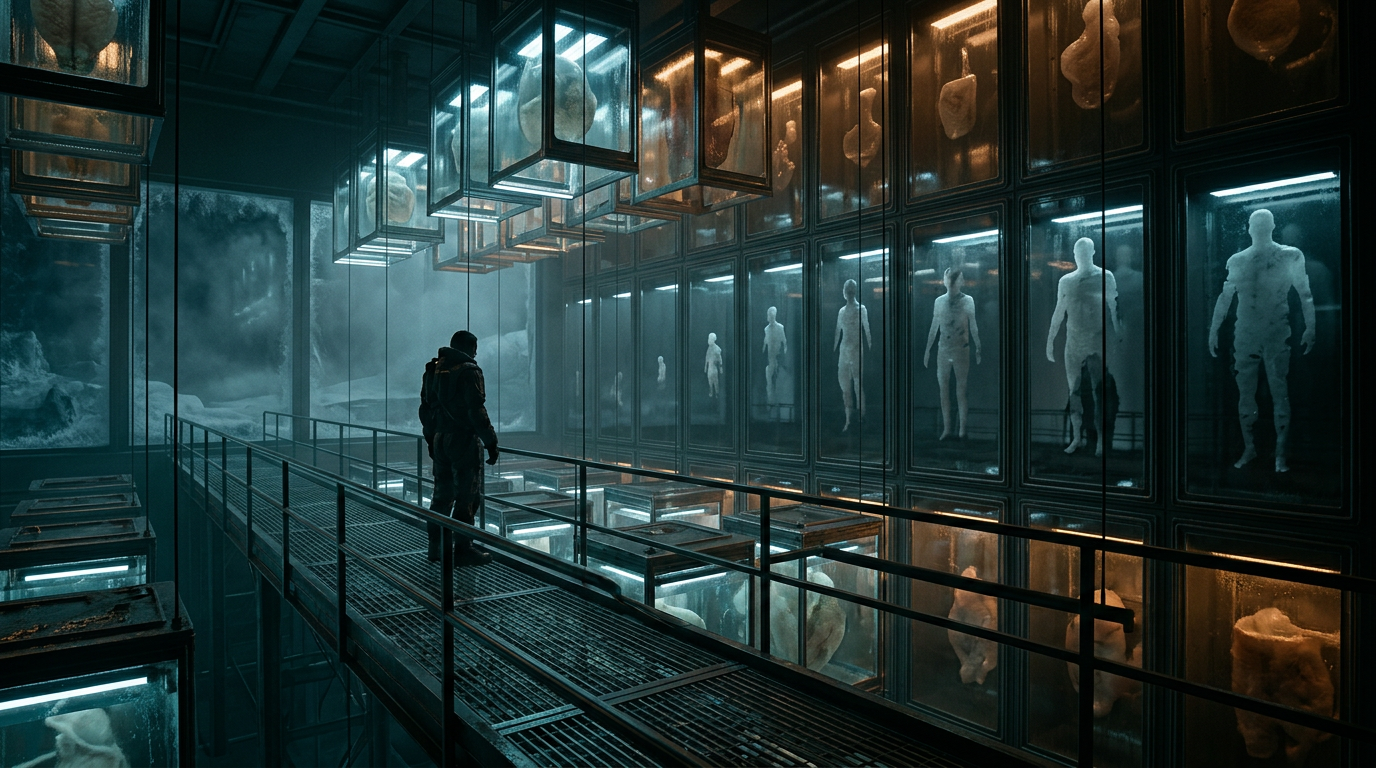
Mickey 17 makes immortality look like factory work
Robert Pattinson dies like a temp worker clocking out.
That is the cruel joke at the center of Mickey 17, Bong Joon Ho’s bruising, absurd, frequently disgusting sci-fi comedy about a man whose body has become a renewable corporate resource. The film, adapted from Edward Ashton’s novel Mickey7, is not really about immortality. Immortality sounds luxurious. This is about replacement. It is about a system that looks at death, sees overhead, and builds a workflow around it.
Bong has always understood that genre works best when it has a stomach. The Host made the monster movie into a family tragedy and a state failure. Snowpiercer turned class struggle into a moving diagram of violence. Parasite found horror in architecture. Mickey 17 extends that logic into biopunk: not cyberpunk’s rain-slick neon and corrupted data, but meat, memory, digestion, reproduction, exposure. The body is not sacred here. It is inventory.
The result is one of the more interesting studio sci-fi swings of the decade: messy, political, funny in the wrong places, and more emotionally coherent than its carnival tone first suggests. It is also proof that the current body horror revival is not a retro fad. It is the genre catching up to how modern life already feels.
The body is the workplace
Mickey Barnes, played by Pattinson with a jittery mix of panic, sweetness, and self-erasure, signs up to be an expendable on a colonizing mission. When a task is too lethal, too contaminated, too experimental, Mickey does it. When he dies, the company prints another version of him with most of his memories restored. The sci-fi premise is clean. The implications are filthy.
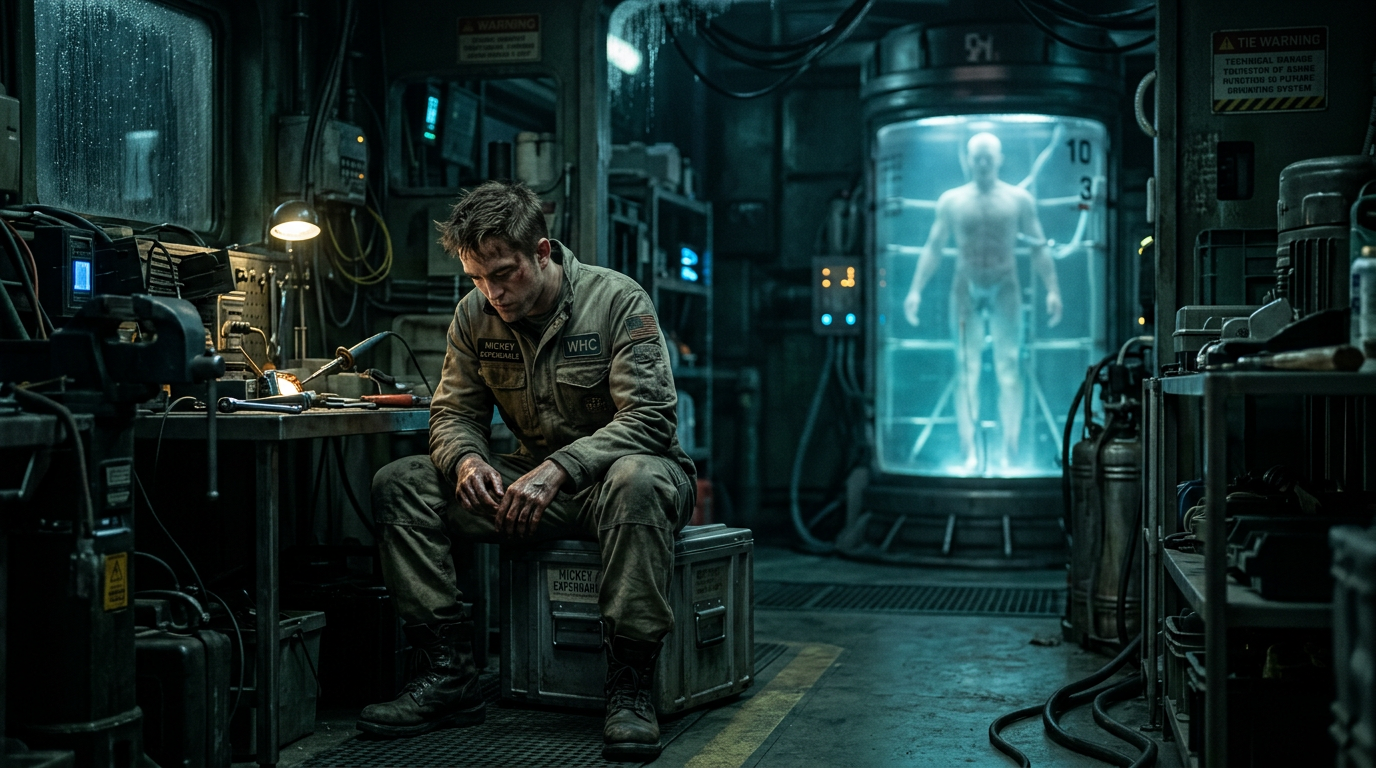
What makes Mickey 17 sting is the banality of its nightmare. Bong does not frame cloning as a sleek miracle. The mise-en-scène is bureaucratic, cramped, and grimy. The machines that remake Mickey have less in common with divine technology than with industrial kitchen equipment. The miracle of resurrection has the vibe of a maintenance request.
That is where the film earns its place in biopunk. Biopunk is not simply sci-fi with viscera. It is sci-fi that treats biology as a system to be hacked, patented, rationed, and exploited. In Mickey 17, the human body becomes the final frontier of labor optimization. You can hear echoes of warehouse management, military risk calculus, gig work, medical debt, and colonial logistics. If one worker can be killed repeatedly, management no longer has to pretend safety matters.
Pattinson is crucial. He has spent the post-Twilight years building a career out of damage: Good Time, High Life, The Lighthouse, The Batman. Here, he gives Mickey a body that seems to apologize for occupying space. His voice choices will irritate some viewers; they are nasal, tremulous, almost cartoonishly submissive. But the performance has a sick logic. Mickey is a man trained by circumstance to make himself smaller than his own suffering.
Why it matters now
!A cold cloning chamber with human reflections and organic machinery
Body horror is having a serious cultural moment because the body has stopped feeling like private property.
Look at the recent evidence. Coralie Fargeat’s The Substance turned beauty culture into a splatterhouse of self-division. David Cronenberg’s Crimes of the Future imagined art, surgery, and ecological mutation collapsing into one another. Brandon Cronenberg’s Possessor and Infinity Pool pushed identity into invasive technology and elite cruelty. Julia Ducournau’s Titane made flesh, metal, gender, and family feel unstable in the same frame. Even mainstream franchise work like Alien: Romulus understood that audiences still respond to practical slime, teeth, birth imagery, and the terror of being used as an incubator.
This is not nostalgia for VHS-era gross-outs. The new body horror is about consent under systems that call themselves efficient. It belongs to a viewing landscape where prestige TV has made alienation stylish, streamers have trained audiences to consume dystopia by the season, and theatrical sci-fi has rediscovered scale through Dune: Part Two, Oppenheimer in IMAX 70mm, and the continuing appetite for large-format spectacle. Against that backdrop, Mickey 17 feels pointedly anti-sleek. It is not selling transcendence. It is asking who gets ground up to make transcendence possible.
The film also arrives after years of tech rhetoric promising that the self can be uploaded, optimized, extended, backed up. Bong’s answer is a raspberry blown through a wound. If your consciousness can be copied, the corporation will not treat you like a soul freed from mortality. It will treat you like a subscription plan.
What it gets right
Bong’s great strength remains tonal violence. He does not transition politely between comedy and horror. He slams them together and lets the bruise show. A scene can begin as workplace farce, veer into slapstick, and end with the queasy recognition that Mickey’s pain has been administratively pre-approved.
The blocking often reinforces the joke. Mickey is frequently positioned as a thing being handled: strapped down, shoved aside, observed, processed. Around him, authority figures occupy space with grotesque confidence. Mark Ruffalo and Toni Collette play power as performance, all appetite and theater. Their broadness is not subtle, but subtlety is not always the correct weapon against political vanity. Bong shoots leadership as a kind of bad television broadcast: loud, flattering to itself, spiritually hollow.
The film’s world-building is at its best when it is tactile. The off-world colony has the expected sci-fi machinery, but Bong is more interested in the mess around the machinery: food, bodily fluids, cheap surfaces, uniforms that never quite disguise hierarchy. The production design favors systems that look half-improvised and fully cruel. This is not the clean futurism of Apple Store modernity. It is a workplace where the future has already been value-engineered.
Pattinson’s doubling is also more than a gimmick. The film understands that a copy is not just a plot device; it is an acting problem. What changes in posture when one version of a man has endured more than another? What happens when self-preservation becomes rivalry? Pattinson plays the differences without turning them into a party trick. One Mickey may be more frightened, another more defiant, but both carry the same original wound: the knowledge that nobody important thinks he counts.
What it gets wrong and where it stumbles
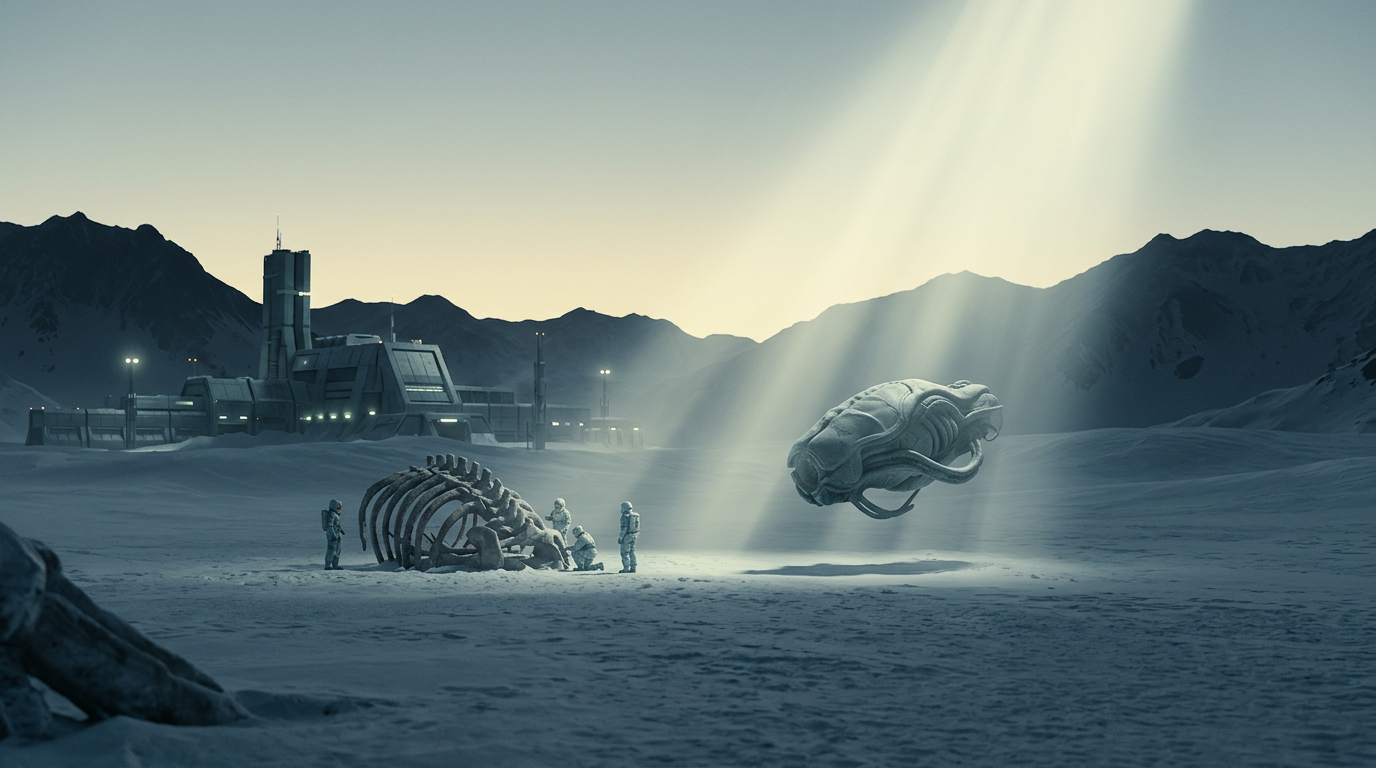
!Workers crossing a frozen alien colony beside strange biological structures
The film’s weakest instinct is its eagerness to underline. Bong’s satire has always been legible, but Mickey 17 sometimes mistakes volume for force. The ruling-class grotesques are funny until they become too easy to dismiss. When villainy is played as nonstop buffoonery, the system behind it can start to feel less frightening than it should.
There is also a crowding problem. Naomi Ackie brings steel and warmth to Nasha, and the film is strongest when it lets her relationship with Mickey complicate the ethics of replacement. But the broader ensemble occasionally pulls oxygen away from that intimacy. Steven Yeun, as part of Mickey’s orbit, gives the film a useful note of opportunism and resentment, yet some character turns feel compressed by the machinery of the plot.
The third act, without spoiling specifics here, has Bong’s familiar appetite for escalation. That can be exhilarating. It can also flatten the more disturbing questions raised earlier. Mickey 17 is at its best when it sits with the horror of policy. It is less original when it becomes a louder uprising movie, even a well-staged one.
Still, an uneven Bong film is not a minor object. Its flaws are connected to its ambitions. The movie wants to be a clone comedy, a colonial satire, a romance, a creature feature, a labor parable, and a theological insult. No wonder it wobbles.
The bigger idea
[SPOILERS AHEAD]
The most interesting question in Mickey 17 is not whether Mickey is the same person after each printing. It is who benefits from making that question unsolvable.
The Ship of Theseus problem hangs over the film: if every plank is replaced, is it still the same ship? Bong gives that old philosophical puzzle a nasty labor twist. If every cell can be replaced and every memory restored, is Mickey still Mickey? The corporation’s answer is practical: close enough to work, disposable enough to kill.
That is the film’s sharpest biopunk insight. Identity is not treated as a mystery to be honored. It is treated as a legal and managerial category. A person becomes a continuity claim attached to a job function. The horror is not that the copy might be fake. The horror is that authenticity no longer protects anyone.
This is where Mickey 17 separates itself from cleaner hard sci-fi. It is not especially interested in the engineering details of cloning or memory transfer. It is soft sci-fi with teeth, using speculative technology to expose a moral arrangement already in place. The future is not scary because it invents new cruelties. It is scary because it gives old cruelties better tools.
Bong’s colonial setting matters, too. The mission’s rhetoric promises survival, destiny, a new world. The reality is extraction wrapped in pioneer myth. Bodies are spent, local ecologies are misunderstood, and leadership converts ignorance into policy. The film’s creatures are not just obstacles; they are a rebuke to human entitlement. In that sense, Mickey 17 is less interested in conquering the alien than in showing how alien humans become when they organize society around disposability.
What to watch next if you liked this
Use Mickey 17 as the start of a sharper body-horror and biopunk run, not as a standalone curiosity.
- Double-bill it with The Fly: David Cronenberg’s 1986 classic remains the cleanest modern text on transformation, illness, desire, and scientific arrogance. Mickey 17 makes the body replaceable; The Fly makes it tragically irreversible.
- Pair it with The Substance: Both films turn self-optimization into bodily civil war. Fargeat is more savage about beauty and gender; Bong is more focused on labor and class.
- Watch Snowpiercer afterward: Bong’s earlier English-language sci-fi makes a useful companion piece. One train, one colony, the same brutal question: who gets sacrificed so the system can keep moving?
- Add Moon: Duncan Jones’s 2009 film is quieter and lonelier, but it shares Mickey 17’s interest in cloning as corporate theft of the self.
- Queue Severance: Apple TV+’s workplace nightmare is not body horror in the splattery sense, but its split consciousness premise rhymes beautifully with Mickey’s divided personhood.
- Try Annihilation: Alex Garland’s film pushes biopunk toward ecological awe and terror. It is less satirical, more uncanny, and still one of the essential recent films about bodies losing their borders.
- Read Edward Ashton’s Mickey7: The novel is leaner and more interior than Bong’s film. Reading it after the movie clarifies how much Bong amplifies the satire and grotesquerie.
- Read Jeff VanderMeer’s Annihilation: For a stranger, more hypnotic account of biology rewriting human certainty, VanderMeer remains indispensable.
Verdict
Mickey 17 is not Bong Joon Ho at his most elegant. It is too busy, too blunt in places, and occasionally too pleased with its political caricature. But it has something many contemporary sci-fi films lack: a real thesis about the body.
The movie understands that the future will not arrive only through screens, algorithms, and artificial intelligence. It will arrive through organs, waste, hunger, reproduction, injury, and the paperwork that decides which bodies are worth protecting. That is why its grossness matters. The slime is not decoration. The deaths are not just gags. The repeated body of Mickey Barnes is a punchline, a resource, a crime scene.
Bong turns resurrection into a labor dispute and cloning into slapstick despair. In a decade crowded with sleek dystopias and prestige melancholy, Mickey 17 has the decency to be ugly. More sci-fi should risk that.
Discussion (0)
Loading comments…