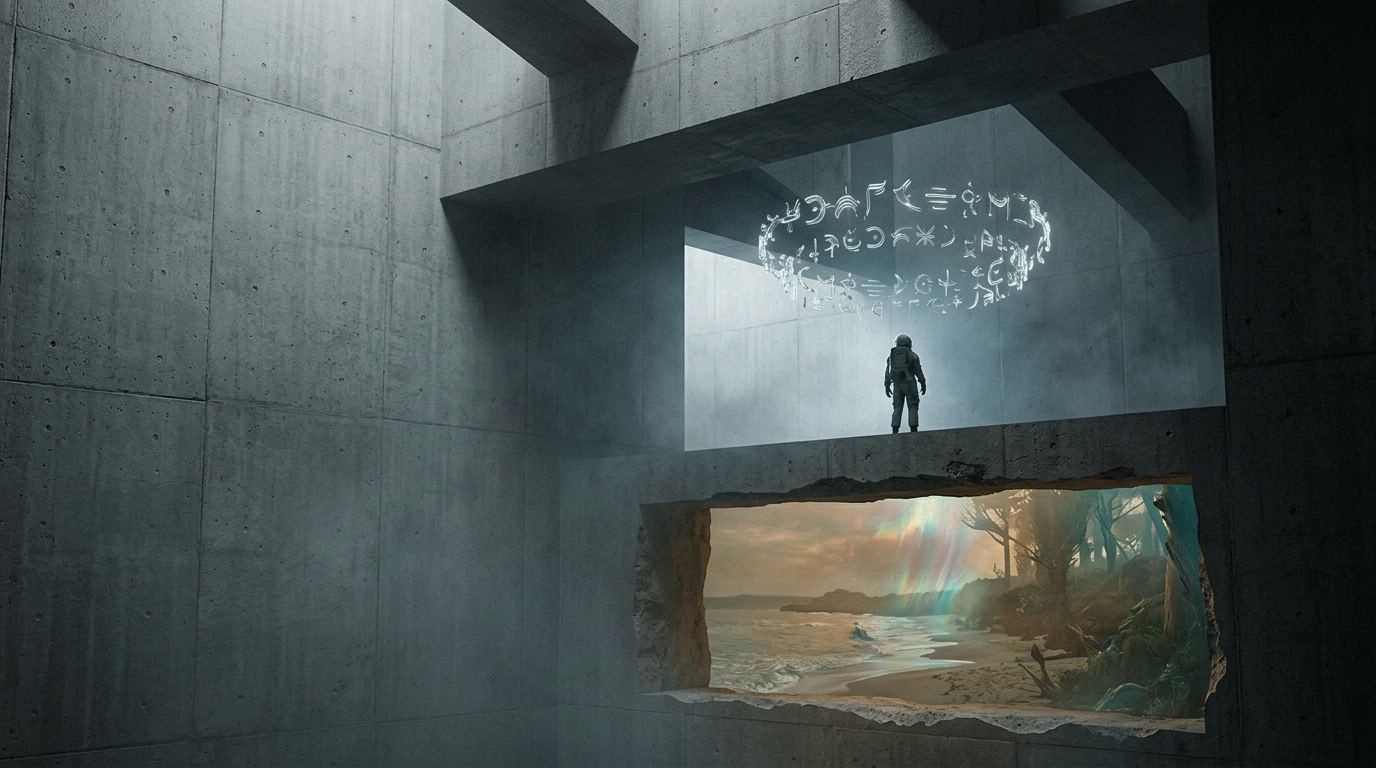
Soft sci-fi learned to whisper
The alien in Arrival never fires a shot.
That sounds like a small thing until you remember how often modern science fiction treats first contact as a zoning dispute with missiles. Denis Villeneuve's Arrival and Alex Garland's Annihilation belong to a different tradition: soft sci-fi that is less interested in engineering diagrams than in perception, memory, grief, mutation, and the terrifying possibility that the universe is not hostile so much as indifferent to our categories.
Both films arrived before the streaming glut fully trained audiences to expect an algorithmic season finale every eight hours. Arrival opened in 2016, adapted from Ted Chiang's novella Story of Your Life. Annihilation followed in 2018, drawn from Jeff VanderMeer's Southern Reach trilogy. Neither is obscure, exactly. One was an Oscar player; the other became a cult object after Paramount sold much of its international distribution to Netflix. But in 2026, with Apple TV+ still investing in glossy speculative prestige, Netflix carrying the weight of 3 Body Problem, and theatrical sci-fi trying to survive between Dune-sized events and A24-scaled oddities, these two films look less like isolated successes than like a hinge.
They helped prove that science fiction did not need to get louder to feel enormous. It needed to get more intimate.
Why it matters now
The current sci-fi field is split between maximalism and interiority. On one side: sandworms, orbital battles, multiverse mechanics, franchise lore, IMAX spectacle, Dolby thunder. On the other: Severance turning office architecture into a metaphysical prison, Silo making bureaucracy feel apocalyptic, Scavengers Reign treating alien ecology as both biology and nightmare. The best contemporary work often borrows from both camps, but Arrival and Annihilation remain crucial because they clarified the value of softness.
Soft sci-fi is a slippery label. It does not mean unscientific, unserious, or sentimental. It means the film's primary engine is not hardware, propulsion, or orbital math. The emphasis falls on anthropology, linguistics, psychology, sociology, desire. Hard sci-fi asks whether the spacecraft can plausibly work. Soft sci-fi asks what the spacecraft does to the person inside it.
Arrival and Annihilation are not anti-science. They are anti-certainty. Their laboratories are emotionally contaminated. Their data sets are incomplete. Their protagonists are highly trained women who discover that expertise is necessary but not sufficient. Amy Adams's Louise Banks and Natalie Portman's Lena are not action heroines with PhDs slapped on as décor. Their intelligence shapes the mise-en-scène: quiet rooms, careful observation, hesitation, the discipline of looking again.
That discipline feels newly valuable in 2026. The streamer wars trained the industry to weaponize pace. Hook fast, reveal faster, tease the next installment before the current one can breathe. These films refuse that metabolism. They ask you to sit with the unknown until it stops behaving like a puzzle and starts behaving like a wound.
What Arrival and Annihilation changed
!A human figure studies alien shadows behind fogged glass

Arrival made alien contact feel like translation rather than conquest. Its great formal trick is not the heptapods' circular written language, though that remains one of the most elegant bits of diegetic design in modern sci-fi. It is the way Villeneuve and editor Joe Walker structure the film around comprehension as an emotional event. Language is not a tool Louise picks up. It is an environment she enters.
Annihilation pushed in a more fungal, feverish direction. Garland's film is less serene than Arrival, more abrasive and less tidy. It imagines the alien not as visitor but as process: refraction, mutation, duplication. The Shimmer is not a spaceship with diplomatic intentions. It is a zone where DNA, memory, and identity begin to mishear one another. Rob Hardy's cinematography gives the film a bruised translucence, while Mark Digby's production design makes the natural world look gorgeous in the way mold can be gorgeous if you forget it is eating the wall.
Together, the films revived a mode that had been present in cinema for decades, from Solaris to Close Encounters of the Third Kind to Under the Skin, but had often been crowded out by franchise logic. Their aliens are not villains, mascots, or lore delivery systems. They are epistemological shocks. They change the rules of knowing.
This is where the soft sci-fi renaissance earns the term. Not because every later show or film copied these two. Many did not. But they helped reopen space for speculative cinema in which the climax could be interpretive rather than militarized.
[SPOILERS AHEAD]
What it gets right
Arrival's boldest move is that its story about alien language becomes a story about time, choice, and maternal grief. The film's nonlinear structure is not a gimmick tucked behind a curtain. It is the point. Louise does not simply learn heptapod; she begins to experience reality differently. Villeneuve's restraint matters here. He avoids turning linguistic relativity into a superhero power. The gift is devastating because it expands consciousness without protecting the person who receives it.
Amy Adams gives one of the great modern sci-fi performances because she plays cognition as feeling. Watch her face in the chamber scenes. The blocking places her between military urgency and alien opacity, but Adams refuses both panic and bravado. She listens for a living. That may sound undramatic. It is not. Listening is the film's moral position.
Annihilation gets something equally difficult right: self-destruction rarely feels theatrical from the inside. Lena's expedition into the Shimmer externalizes depression, cancer, infidelity, trauma, and evolutionary change without reducing any of them to a one-to-one symbol. The film's practical effects and digital work are most unsettling when they sit near the uncanny valley but refuse to cross into clean fantasy. The bear sequence is famous for good reason, not just because it is frightening, but because it makes grief diegetic. A scream becomes an afterimage. Death leaves a voice behind.
The final lighthouse sequence remains one of the strongest pieces of sci-fi choreography from the last decade. Lena's double does not attack like a monster. It mirrors, absorbs, presses, learns. The movement is closer to dance than combat, a physical argument about the Ship of Theseus without the film ever naming it. If every cell changes, if every memory is refracted, what exactly returns home?
Both films also understand scale. Arrival's spacecraft are huge, but Villeneuve shoots them with austere reverence rather than trailer-ready triumph. Annihilation's Shimmer covers a coastline, yet Garland makes it feel cellular. The macro and micro keep collapsing into each other. That is the secret grammar of this renaissance: the cosmos is not out there. It is already inside the body.
Where it stumbles
!A suited biologist examines impossible flowers in a shimmering forest
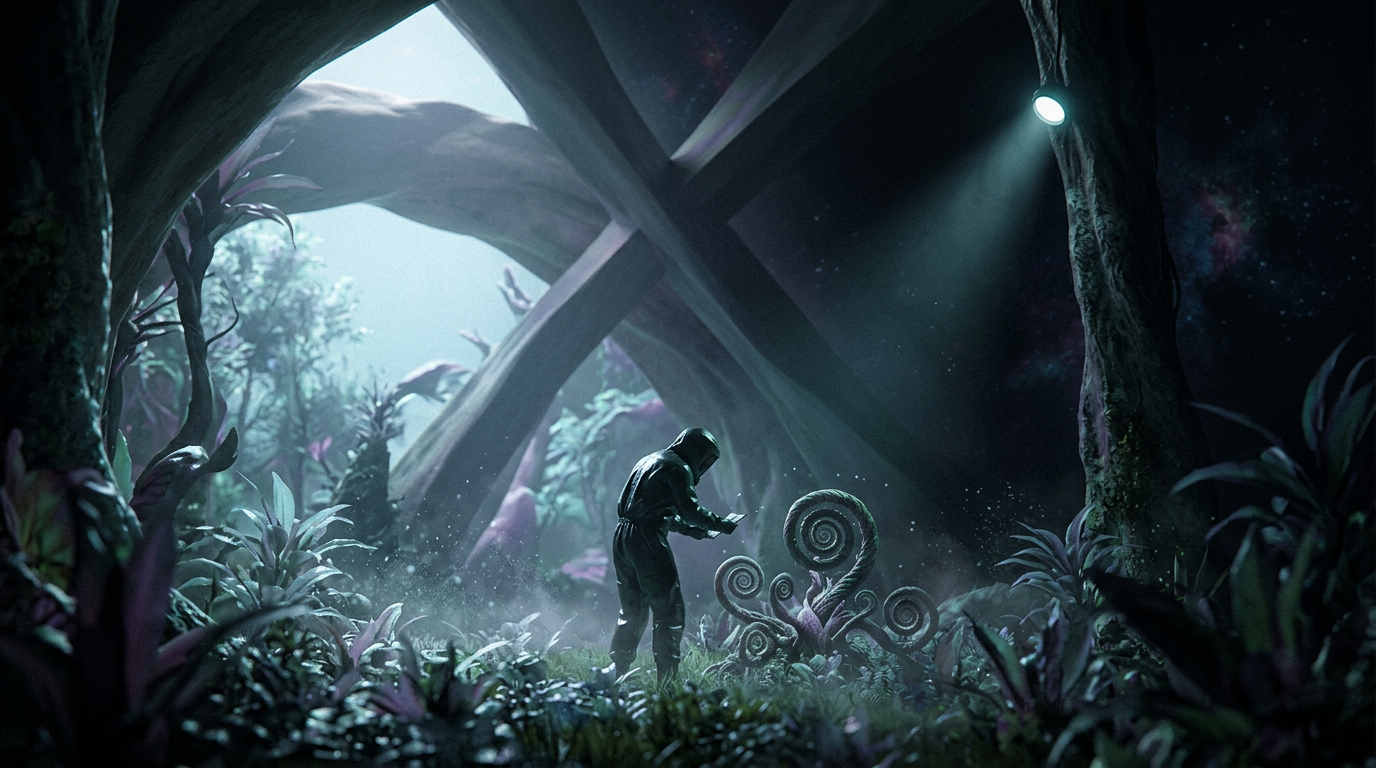
The soft sci-fi boom has its own evasions, and these films are not exempt.
Arrival is so immaculately controlled that its geopolitical material can feel underdeveloped. The film gestures toward global panic, mistranslation, military escalation, and media hysteria, but its most convincing scenes are intimate. That is not a fatal flaw; the intimacy is the design. Still, the world outside Louise's perception sometimes feels like a pressure system rather than a society. The film trusts emotion more than politics.
Annihilation has the opposite problem. It is messier, stranger, more sensorially daring, but its ensemble is unevenly served. Jennifer Jason Leigh, Gina Rodriguez, Tessa Thompson, Tuva Novotny, and Natalie Portman make a compelling unit, yet some character histories arrive with the clipped efficiency of dossier pages. Garland wants archetype and psychology at once. The combination sometimes works beautifully; sometimes you can feel the adaptation compressing VanderMeer's weirder, more bureaucratic dread into a cleaner cinematic descent.
There is also a broader risk in the genre's post-Arrival mood: ambiguity as prestige wallpaper. A slow dolly, a mournful synth, a cryptic final shot, and suddenly thin writing can masquerade as profundity. Soft sci-fi is not automatically deeper because it whispers. Sometimes it is just underwritten. The difference is whether the ambiguity changes the viewer's relationship to the image. Arrival and Annihilation mostly pass that test. Many imitators do not.
The bigger idea
The soft sci-fi renaissance matters because it rejects the most boring version of futurism: the fantasy that technology will finally make human beings legible. In these films, more knowledge does not produce mastery. It produces responsibility.
That is why Arrival still feels so radical. The heptapods do not hand humanity a weapon or a clean warning. They offer a new structure of perception, and the moral burden lands on Louise. Knowledge becomes inseparable from loss. The future is not conquered. It is endured.
Annihilation is harsher. Its alien presence does not communicate in any recognizable ethical register. It refracts. It changes everything because change is what it does. If Arrival is about translation, Annihilation is about contamination. One imagines contact as a grammar problem with spiritual consequences. The other imagines it as biology without consent.
That difference explains why the two films make such a potent double-bill. Arrival is soft sci-fi as communion. Annihilation is soft sci-fi as infection. Both are about the collapse of the boundary between self and other, but they disagree about whether that collapse can be called grace.
In an age when much mainstream sci-fi borrows the Dark Forest theory as a shortcut to cosmic paranoia, these films take a more troubling route. The universe may not be hiding predators behind every star. It may be stranger than predation. It may meet us with a sentence we cannot parse or a mutation we cannot refuse.
What to watch next if you liked this
If Arrival and Annihilation reopened this corridor for you, do not follow them with more plot mechanics. Follow them with films and shows that treat the unknown as a change in texture.
- Pair Arrival with Solaris, preferably Andrei Tarkovsky's 1972 film, for another story about contact that turns into an autopsy of memory and longing.
- Pair Annihilation with Jonathan Glazer's Under the Skin, a colder film that uses alienness to strip human behavior down to appetite, performance, and fear.
- Watch Ex Machina after both, not because it is bigger, but because Garland's earlier film is a chamber piece about consciousness, surveillance, and male vanity disguised as innovation.
- Watch Devs if you want Garland stretching determinism into prestige TV architecture, with all the strengths and stiffness that implies.
- Watch Severance for the cleanest recent proof that speculative television can make production design carry philosophical weight.
- Watch Silo for a more plot-driven but still thoughtful version of institutional sci-fi, where world-building is inseparable from who controls history.
- Watch Scavengers Reign for alien ecology that feels genuinely nonhuman, a rarity even in expensive science fiction.
For reading, start with Ted Chiang's Story of Your Life and Jeff VanderMeer's Annihilation. Chiang gives you precision; VanderMeer gives you spores in the bloodstream. Then try Stanislaw Lem's Solaris, still the key text for anyone suspicious of sci-fi that makes aliens too convenient.
The verdict
Arrival and Annihilation endure because they understand that awe is not the same as scale. Awe can be a sentence diagrammed on glass. A flower growing wrong. A body returning home with the faint suspicion that home no longer has a stable meaning.
The soft sci-fi renaissance did not begin with these films, and it did not end with them. But they gave the 2010s and the streaming era that followed a usable grammar: slower, stranger, more interior, less obedient to the franchise reflex. They reminded filmmakers that the alien is most powerful when it does not explain itself like a villain in the third act.
Science fiction keeps promising new worlds. Arrival and Annihilation offer the more frightening possibility: the world is already new, and we are the ones who have not caught up.
Discussion (0)
Loading comments…