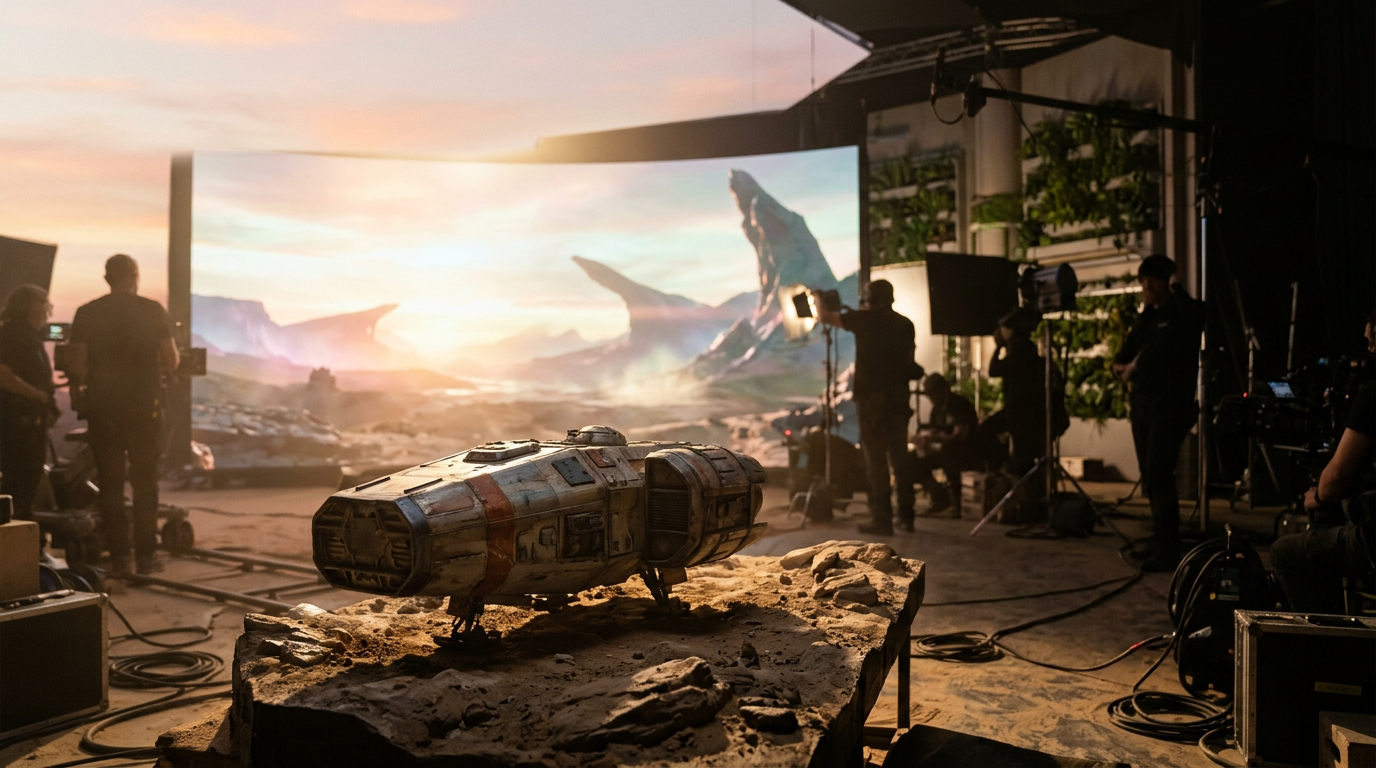
The best sci-fi still leaves fingerprints
A sandworm feels more dangerous when the movie remembers that sand has weight.
That, more than nostalgia, is why the practical-effects-versus-CGI argument refuses to die in modern science fiction. Every few months, another blockbuster or prestige TV series arrives wrapped in the language of innovation: virtual production, volumetric capture, real-time rendering, machine-assisted workflows, LED walls, invisible effects. Fine. Tools evolve. But the audience’s body remains stubbornly analog. We know when light hits an object. We know when an actor is touching a surface instead of miming against tennis balls. We know when a corridor has corners.
So who is winning? Not practical effects, exactly. Not full CGI either. The winning side is the hybrid: movies and shows that build enough of the world for performers, cameras, and light to believe in it, then use digital effects to extend the frame rather than replace the frame. The losing side is not CGI. It is weightlessness.
Why it matters now
The question has new urgency because sci-fi is no longer confined to summer tentpoles and the occasional awards-season provocation. In 2026, the genre is everywhere: theatrical event cinema, Apple TV+ prestige machinery, Netflix’s expensive global bets, Amazon MGM’s game-world adaptations, Max’s franchise stewardship, Mubi’s art-house futurism, Neon and A24’s appetite for strange bodies and broken systems. Sci-fi has become the house language of anxiety.
That spread has changed the look of the genre. The old binary — practical equals real, CGI equals fake — no longer describes what we are actually watching. Denis Villeneuve’s Dune films are not anti-CGI; they are massively dependent on digital work. James Cameron’s Avatar films are not live-action in any ordinary sense; they are some of the most persuasive synthetic environments ever made. Andor is praised for looking tactile, but it also uses modern digital extension and compositing. Alien: Romulus sold itself partly on animatronics and creature suits, yet its cleanest scares depend on digital polish. Silo and Foundation live in the streaming zone where sets, screens, extensions, and simulation have to coexist under tighter episode schedules.
The streamer wars made the issue worse. Television budgets ballooned, then discipline returned with a vengeance. The result is a lot of sci-fi that looks expensive and strangely cheap at the same time: glossy surfaces, shallow blocking, overlit environments, and digital backgrounds that feel like weather reports. Theatrical sci-fi, meanwhile, has leaned into scale: IMAX 70mm for Nolan, Dolby Cinema contrast for space operas, giant-format spectacle as a reason to leave the couch. When the screen gets bigger, bad texture gets louder.
The false war between rubber and render farms
!Actor reaches down a scratched sci-fi corridor toward a creature in steam
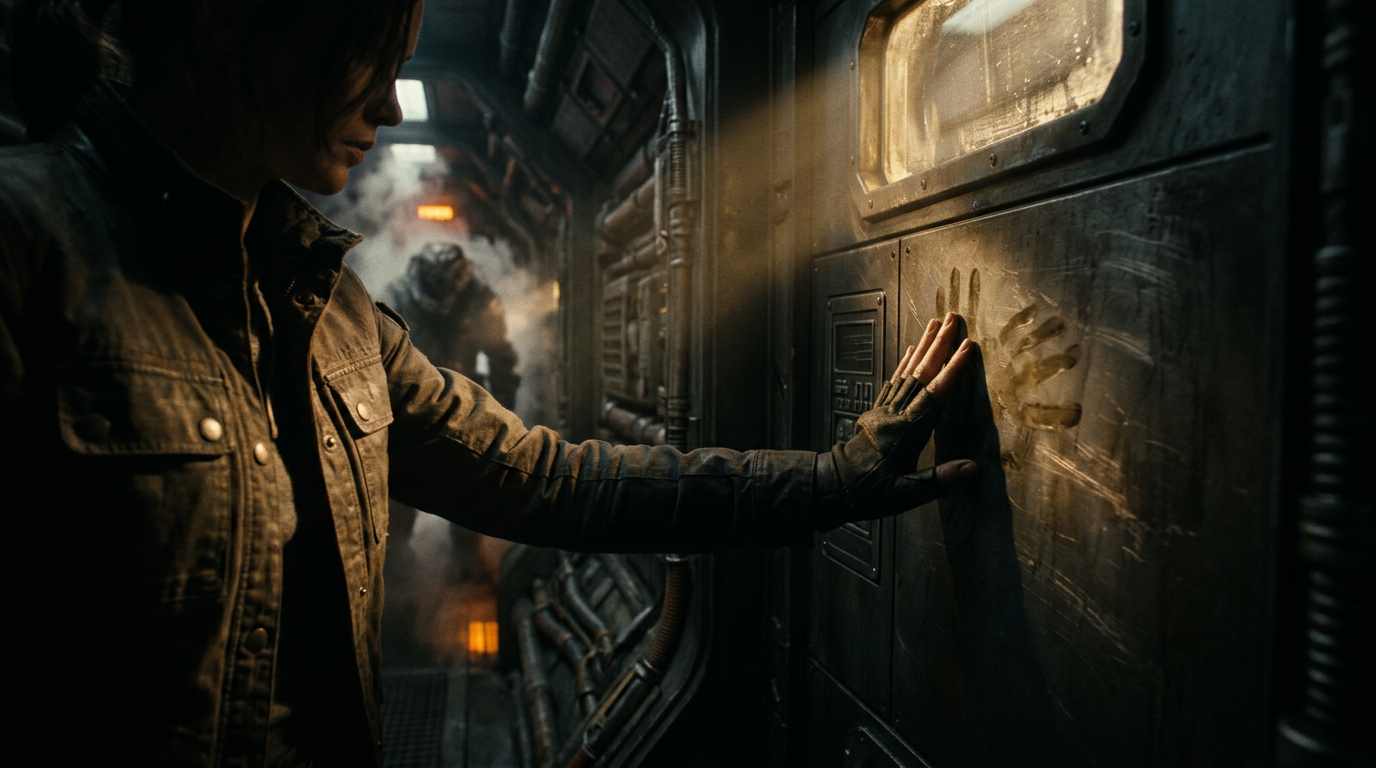
Practical effects have moral authority because they carry evidence. A miniature spaceship, a creature suit, a prosthetic wound, a full-scale cockpit, a wet alley with steam drifting through it — these things give the camera resistance. They produce accidents. They force choices in blocking and mise-en-scène. They create shadows that do not need to be negotiated in a render pipeline.
But practical effects can also be stiff, limited, and obvious. Plenty of beloved pre-digital movies contain rubbery creatures and matte lines. Nostalgia has a generous eye. Full CGI, at its best, can do what physical production cannot: alter gravity, bend anatomy, multiply armies, create impossible skies, and let a camera move through architectures no crane could reach. Cameron’s work in Avatar: The Way of Water is not persuasive because it avoids artifice. It is persuasive because the artifice has a governing physics. Water, skin, breath, and motion obey a coherent world.
The problem is not computer-generated imagery. The problem is computer-generated indifference.
When CGI becomes a production default rather than an aesthetic decision, everything starts to feel equally available and therefore equally unimportant. The city can burn. The moon can crack. The hero can fall through a thousand feet of debris. If the shot has no tactile grammar — no scale cues, no spatial logic, no diegetic light source, no actor reacting to anything with mass — the image becomes content, not cinema.
What practical effects get right
Practical effects win the first five seconds of trust.
Look at Alien, still a benchmark not because the xenomorph is always fully convincing in motion, but because the Nostromo is a workplace before it is a haunted house. Grease, condensation, low ceilings, grubby monitors, bodies squeezed into rooms. The creature enters a world that already has rules. Ridley Scott’s mise-en-scène makes the impossible feel like an intrusion into the possible.
That lesson carries into Alien: Romulus, which understands the franchise’s great secret: production design is suspense. A corridor with a practical ceiling can be scarier than a digital cathedral because it tells the actor where fear can hide. Practical creature work also changes performance. Actors flinch differently when a wet, articulated thing is actually in front of them. Their eyelines sharpen. Their bodies negotiate space.
Christopher Nolan’s Interstellar uses miniatures and large-format photography not as a retro badge but as a way of preserving mass. The spacecraft feel engineered, not merely designed. Villeneuve’s Blade Runner 2049 and Dune films rely on enormous sets, real locations, practical atmospherics, and severe lighting discipline. Even when the frame is digitally extended, the base image has density. Dust hangs in the air. Fabric drags. Armor scratches. The future has a surface.
This is where practical work is still ahead: it gives cinema a material conscience. It prevents the frame from becoming a showroom.
What full CGI gets right
!Motion-capture stage dissolves into a blue alien ocean environment
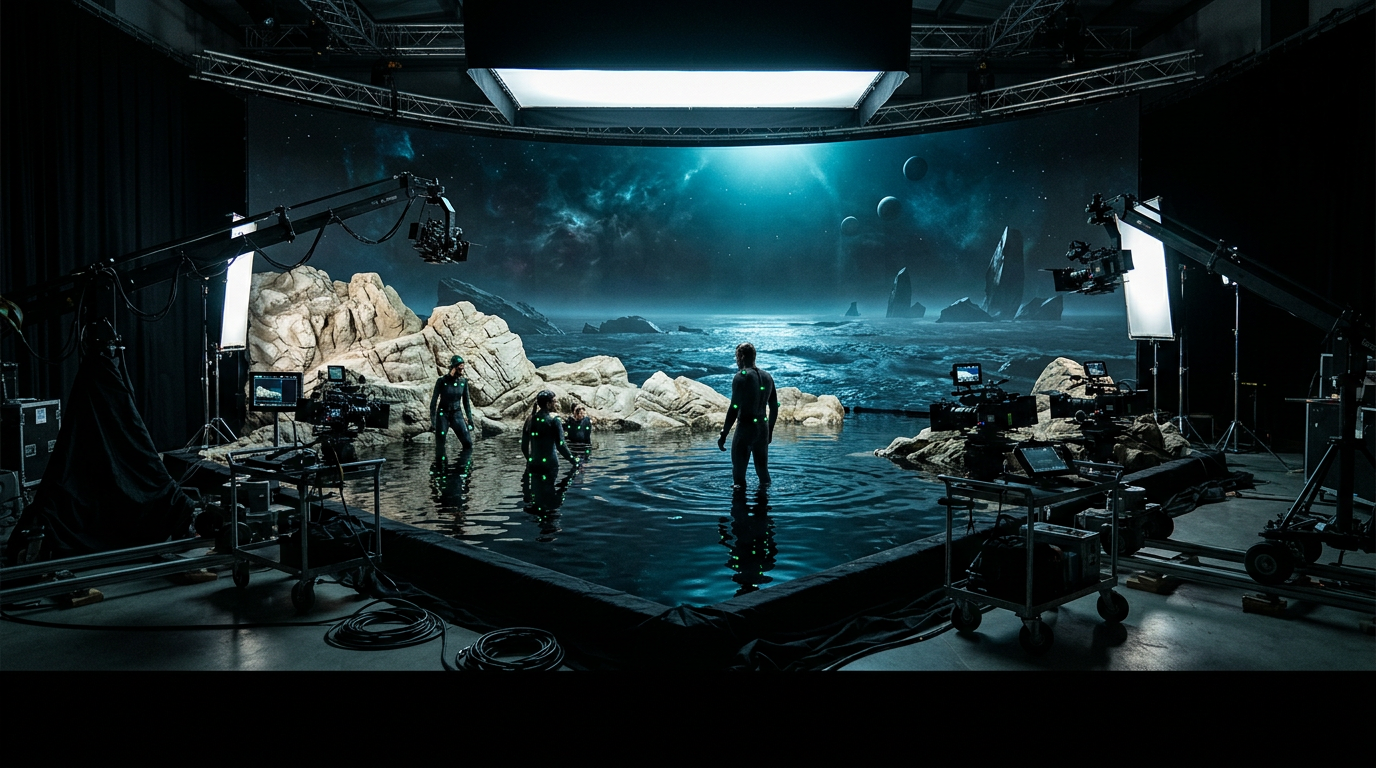
Full CGI wins when the subject is not an object but a system.
The Na’vi in Avatar are not puppets pretending to be alive; they are performance-captured bodies translated into another biology. Pandora works because Cameron is less interested in isolated wow shots than in ecology: how muscles move, how creatures swim, how plants respond, how bodies occupy three-dimensional space. It is soft sci-fi, yes, but its images are disciplined by a hard commitment to cause and effect.
The same is true, in a different register, of Gravity and Alfonso Cuarón’s long-take illusionism. The film’s space is heavily manufactured, but the digital construction supports an experiential idea: disorientation as physics. You do not admire the effect as a trick. You feel the absence of up and down.
Digital effects also allow modern sci-fi to visualize scale beyond the reach of physical fabrication. Foundation would be impossible without digital architecture. The Three-Body Problem needs abstraction, cosmic threat, and technological spectacle that no practical build could fully supply. Godzilla Minus One, made with remarkable resourcefulness, proved that digital effects can feel forceful when they are grounded in perspective, consequence, and human geography. Its destruction lands because the camera seems to know where the ground is.
The best CGI is not invisible because you fail to notice it. It is invisible because you accept its contract.
What it gets wrong / where it stumbles
The practical-effects revival has its own vanity problem. Too many publicity campaigns now treat animatronics, real explosions, and in-camera work as ethical superiority. As if a rubber head automatically has more soul than a render. That is nonsense. A bad puppet is still bad. A practical set can be lit like a furniture catalog. A miniature can be photographed without scale. Craft is not a purity test.
There is also a labor issue hiding under the romance. Digital artists remain some of the most essential and least publicly understood workers in contemporary filmmaking. When studios brag that a movie is practical, they often erase the hundreds of VFX artists who removed rigs, extended sets, fixed reflections, added atmosphere, and made the supposedly real image function. The phrase ‘no CGI’ is usually marketing. At best, it means ‘less CGI than you think.’ At worst, it is a way of flattering audiences who have been trained to blame pixels for every bad creative decision.
Full CGI stumbles most often in two places: overcoverage and poor integration. The camera can go anywhere, so it goes everywhere. The shot can last forever, so it does. Digital creatures are lit with impossible clarity. Virtual cities are designed with no sense of municipal boredom, no trash pickup, no maintenance scars, no ordinary human misuse. The uncanny valley is not just about faces. It is about worlds that have never been touched by weather, labor, or time.
Streaming sci-fi is particularly vulnerable. A show can have a staggering budget and still feel weightless if every room is a volume stage, every horizon a plate, every conversation blocked in the same medium-wide geometry. LED walls are a tool, not a worldview. Used well, as in parts of The Mandalorian and other virtual-production-heavy projects, they can give actors real light and directors immediate environments. Used lazily, they create aquarium cinema: performers sealed in a glowing tank.
The bigger idea
Science fiction is always asking us to believe in an arrangement of the unreal. The effect is not just decorative; it is philosophical. If a movie asks whether a synthetic person is alive, as Blade Runner and Ex Machina do, the image itself becomes part of the argument. If the body looks too smooth, too plastic, too frictionless, the film may be making the uncanny valley worse by accident. If the world looks inhabited, damaged, and specific, the speculative idea gains pressure.
That is why the Ship of Theseus question fits the effects debate so neatly. If a shot begins with a practical set, replaces the sky, extends the building, swaps the creature’s face, paints out the wires, and adds digital weather, is it still practical? If a performance-captured alien preserves the actor’s timing, breath, and emotional rhythm, is it merely CGI? The categories collapse under scrutiny.
What matters is authorship. Villeneuve’s images have a recognizable austerity. Cameron’s have kinetic curiosity. Nolan’s have mechanical seriousness. Alex Garland’s Ex Machina uses restrained effects because the film’s terror depends on proximity and doubt. Jonathan Glazer’s Under the Skin uses alienation through form more than spectacle; its sci-fi charge comes from behavior, framing, and the awful calm of observation.
The future of effects will not be won by one pipeline. It will be won by directors, cinematographers, production designers, creature builders, previs artists, compositors, and editors working toward one perceptual rule: the audience must feel that the image has consequences.
What to watch next if you liked this
- Double-bill Dune: Part Two with Lawrence of Arabia. Not for plot equivalence, but for desert scale, human figures against landscape, and the politics of myth photographed as weather.
- Pair Alien with Alien: Romulus to see how industrial production design, creature work, and digital cleanup have changed without dissolving the franchise’s core grammar.
- Watch Blade Runner 2049 after 2001: A Space Odyssey. One is haunted neon and synthetic memory; the other is clinical awe. Both understand that silence is an effect.
- Pair Avatar: The Way of Water with Gravity for two versions of digital immersion: one ecological, one survivalist.
- Watch Interstellar with First Man, even though the latter is not sci-fi. The shared interest is machinery, vibration, cockpit subjectivity, and the terror of engineered limits.
- For TV, put Andor beside Silo. Both benefit from environments that feel governed by labor, bureaucracy, and architecture rather than lore alone.
- Read Paul M. Sammon’s Future Noir: The Making of Blade Runner for a production history of texture, compromise, and obsession.
- Read J.W. Rinzler’s The Making of Alien for a reminder that great sci-fi worlds are built through arguments, accidents, and materials.
- Browse the Cinefex archives if you can find them. The magazine treated effects work as authorship long before studio marketing caught up.
Verdict
Practical effects are winning the rhetoric. CGI is winning the workload. The movies are won by neither.
The best modern sci-fi treats practical work as the anchor and digital work as expansion. It lets actors touch something. It lets light behave. It gives the editor shots with physical logic. Then it uses CGI for what cinema has always wanted from technology: impossible scale, impossible motion, impossible bodies, impossible dread.
So the answer is blunt: full CGI wins when filmmakers build a world with rules; practical effects win when they give that world scars. The real champion is the hybrid image with fingerprints still visible under the render.
Discussion (0)
Loading comments…