The Matrix was always about prompt engineering
Neo opens his mouth and reality changes. Not because he has better hardware. Because he has learned the grammar of the system.
That is the useful shock of returning to The Matrix at 27, after years of large language models turning the phrase “artificial intelligence” from a movie threat into a tab in the browser. The Wachowskis’ 1999 original is still a sleek cyberpunk action film with leather, rain, bullet time, and one of Keanu Reeves’ great blank-slate performances. But the trilogy now reads less like a prophecy about virtual reality headsets and more like a fable about systems that run on language: commands, names, myths, scripts, prompts, permissions.
The popular memory of The Matrix is oddly reductive. Red pill, blue pill. Humans in pods. Cool sunglasses. A trench-coat shootout that launched a thousand bad commercials. Yet the trilogy’s real obsession is not whether the world is fake. It is how a world convinces you to keep producing it. In 2026, when LLMs can summarize, imitate, flatter, fabricate, and occasionally invent with the confidence of a midlevel consultant, that question feels less dated than the green code.
The first film remains the cleanest object: a near-perfect fusion of Hong Kong action grammar, cyberpunk mise-en-scène, anime influence, religious symbolism, and late-’90s anti-corporate paranoia. The Matrix Reloaded and The Matrix Revolutions are messier, more talkative, more self-serious, and more interesting than their reputation. The trilogy’s flaws are real. So is its ambition. Few American studio franchises have worked this hard to turn blockbuster form into a debate about agency.
Why it matters now
The Matrix arrived when the internet still felt like a frontier and office cubicles looked like spiritual death. Its enemy was a machine order disguised as normal life: commutes, bosses, debt, polite despair. That critique has aged almost too well, but the LLM era shifts the emphasis.
Today’s anxiety is not only that machines will trap us inside a simulation. It is that machines will become fluent in our surfaces. They can write in the style of grief without grieving, mimic expertise without understanding, and generate consensus-shaped prose that sounds plausible enough to pass through exhausted institutions. The old fear was illusion. The newer fear is statistical intimacy.
That is why Agent Smith feels newly contemporary. Hugo Weaving plays him not as a robot but as a bureaucrat with disgust curdling under the skin. He is an enforcement mechanism with personality leakage. He speaks in polished contempt, weaponizing categories: human, virus, anomaly, purpose. He is less a killer app than a moderation policy with a jawline.
The trilogy also understands something our current AI discourse often fumbles: intelligence is never just intelligence. It lives inside ownership, labor, policing, infrastructure, desire. The machines in The Matrix are not merely clever. They control energy, bodies, architecture, memory, and story. That is the difference between a chatbot and a civilization.
The comparison to LLMs should not be flattened into “the Wachowskis predicted ChatGPT.” They did not. What they dramatized is more durable: a world where cognition is mediated by systems most people cannot see, built by powers most people cannot question, and maintained by habits that feel like choice.
What it gets right
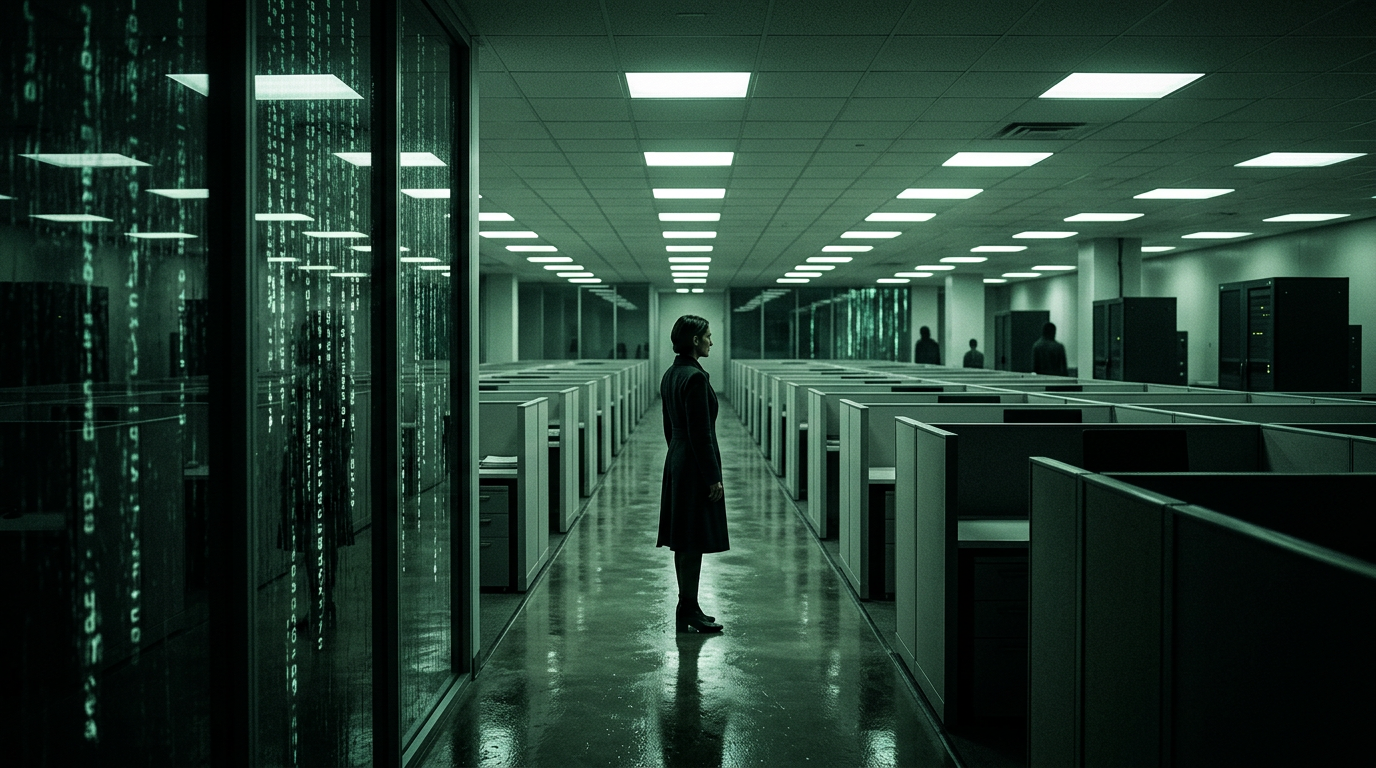
!A green-lit office maze suggesting corporate control and invisible systems
The original film’s genius is that its exposition has muscle. Every idea arrives through blocking, editing, costume, sound, or combat. Morpheus does not merely tell Neo that his body is unreliable; the film makes bodies bend, freeze, glitch, and wake up wet. The famous dojo sequence is still a brilliant piece of soft sci-fi pedagogy: knowledge as upload, belief as technique, identity as performance under pressure.
Lana and Lilly Wachowski’s filmmaking is cleaner than nostalgia admits. The office escape early in the film turns cubicle geometry into a panopticon. The camera traps Neo behind glass, partitions, and corporate symmetry. The Agents occupy space like software permissions: they appear where the system allows them to appear, which is almost everywhere. The city is not futuristic. It is aggressively ordinary, which is why it works. The nightmare is beige.
Bullet time remains more than a gimmick because it literalizes perception as power. Neo’s victory is not that he becomes stronger in the conventional superhero sense. He learns to read the frame. He sees the code behind the image and therefore the rules behind the violence. In the age of generative AI, that distinction matters. Media literacy is not the ability to consume more content. It is the ability to notice the conditions under which content appears.
The trilogy’s best recurring idea is that control depends on narrative. Morpheus survives because he believes in prophecy. The machines survive because they understand prophecy as a management tool. Neo is trapped between faith and architecture. That tension gives the series its strange charge: it is both sincerely mythic and suspicious of myth.
Keanu Reeves is essential to that balance. A more declarative actor would have turned Neo into a TED Talk with fists. Reeves gives him hesitation, gentleness, and a kind of computational lag. Carrie-Anne Moss supplies the counterweight: Trinity’s precision, stillness, and emotional clarity keep the first film from becoming dorm-room metaphysics. Laurence Fishburne, meanwhile, makes Morpheus’ certainty seductive and faintly terrifying. He is a liberator, yes, but also a man who has edited the world down to one story.
[SPOILERS AHEAD]
The rest of this essay discusses major developments from The Matrix Reloaded and The Matrix Revolutions.
What it gets wrong, and where it stumbles
!Human silhouettes beneath vast machinery in a subterranean industrial space
The sequels earn more respect than they usually receive, but they do not always earn their running time. Reloaded expands the world with conviction: Zion’s industrial rave, the freeway chase, the Merovingian’s decadent program court, the Keymaker’s procedural weirdness. It also develops a bad habit of explaining mystery until it sweats.
The Architect scene is both the trilogy’s most daring conceptual move and its most obvious dramatic pothole. On paper, it is terrific: the prophecy is not divine truth but a control loop, an engineered pressure valve for dissent. That is the series at its sharpest. On screen, the scene becomes a wall of polysyllabic systems-talk delivered in a white room full of monitors. The idea is electric. The staging is static. For a franchise so alive to bodies in motion, it is a strangely bloodless way to detonate its own mythology.
Revolutions has the opposite problem. It restores scale and physical urgency but narrows the philosophical field. The defense of Zion is impressive as industrial spectacle, full of metal, sparks, sweat, and siege-movie desperation. Yet the human city never becomes as vivid as the Matrix itself. We understand what Zion represents more than how it feels to live there. Too many secondary characters function as thematic furniture.
The trilogy’s messianic machinery can also flatten its more radical instincts. Neo’s arc is moving, but the fixation on the chosen one risks contradicting the films’ suspicion of programmed belief. The Wachowskis know this, and Reloaded complicates it beautifully. Still, the emotional weight keeps snapping back to singular destiny. For a story about collective awakening, it often cannot resist the glamour of one man levitating above the crowd.
And then there is Smith’s multiplication. As an image of runaway replication, it plays differently now: a self-copying agent flooding the zone until distinction collapses. Very LLM-age, even if the mechanism is not comparable. But as drama, the endless Smiths eventually blunt Weaving’s menace. The uncanny becomes crowd control.
The bigger idea
The trilogy’s secret subject is not simulation. It is consent under conditions of opacity.
That is where the simulation hypothesis, so often dragged into conversations about The Matrix, can become a distraction. The films are not especially interested in proving whether reality is real. They are interested in who benefits when reality is organized as a closed system. The question is political before it is metaphysical.
LLMs sharpen that reading because they expose how much of social life already runs on predictive language. Emails, legal boilerplate, corporate apologies, recommendation feeds, search snippets, brand voices, dating profiles, performance reviews: civilization is partly a machine for generating acceptable next sentences. The Matrix is not simply a false world. It is a world of defaults.
Neo’s power, then, is not raw authenticity. It is refusal plus literacy. He stops accepting the next predicted move. He interrupts the model.
This is why the trilogy still has more bite than many sleeker descendants. Ex Machina gives us AI as eroticized manipulation inside a billionaire’s minimalist bunker. Westworld turns consciousness into a prestige TV maze of loops and trauma. Black Mirror repeatedly asks what happens when consumer tech colonizes intimacy. Severance makes corporate compartmentalization horrifyingly literal. All are valuable. But The Matrix remains singular because it links metaphysics to labor, embodiment, race-coded policing, queer transformation, and action cinema grammar without apologizing for the collision.
The Wachowskis’ later visibility as trans filmmakers has also changed the cultural reading, and rightly so. The trilogy’s language of chosen names, false selves, bodily estrangement, and rebirth was never only cyberpunk decoration. It is a trans text, among other things, and one of the reasons it endures is that its metaphors are generous without being vague. They can hold multiple liberations at once.
The LLM age adds another layer: if identity can be imitated, style can be scraped, and language can be generated without interiority, then the films’ insistence on embodied risk feels newly precious. Neo does not become free by thinking correct thoughts. He bleeds, fails, loves, chooses, and dies into meaning. The body is not an obsolete container. It is where the bill comes due.
The trilogy in the 2026 viewing landscape
Rewatching The Matrix now is also a reminder of what studio science fiction has been missing and slowly recovering: texture. Not just lore. Texture.
For years, franchise culture treated world-building as a spreadsheet. The Wachowskis treat it as pressure. Their world has theology, logistics, fashion, food, erotics, transit systems, bad weather. Even the flaws have density. That matters in a 2026 landscape where Apple TV+ has made room for expensive idea-forward series like Severance, Silo, and Foundation, Netflix keeps chasing global-scale speculative hooks from Black Mirror to 3 Body Problem, and theatrical sci-fi has been re-legitimized by the scale and seriousness of Denis Villeneuve’s Dune films and Christopher Nolan’s continued IMAX evangelism.
The Matrix still benefits from the biggest screen you can reasonably find. Not because spectacle alone saves it, but because its spatial design reads better when the frame can breathe. The lobby shootout is not chaos; it is choreography with architectural punctuation. The freeway chase in Reloaded remains a practical-effects and digital-compositing hybrid with real weight. In Dolby Cinema or a strong 4K home setup, the trilogy’s blacks, greens, and metallic blues regain their severity.
This is also a case where release order matters. Watch the trilogy as a three-part argument, then treat The Matrix Resurrections as a later coda: angrier, funnier, more self-aware about IP culture and nostalgia farming. It is not part of the original trilogy’s architecture, but it speaks directly to the machinery that turned The Matrix into a brand.
What to watch next if you liked this
Do not chase only “movies like The Matrix.” Chase the questions it leaves behind.
- Double-bill with Dark City: Alex Proyas’ 1998 film is the great neighboring text, a noir nightmare about memory, architecture, and manipulated reality. It is moodier and pulpier, with its own bruised metaphysics.
- Pair with Ghost in the Shell: Mamoru Oshii’s 1995 anime remains essential for cyberpunk, bodies, networks, and the melancholy of posthuman identity. The Wachowskis’ debt is real, and the contrast is illuminating.
- Follow with Ex Machina: Alex Garland strips AI anxiety down to rooms, glass, gendered performance, and manipulation. Where The Matrix goes mythic, Ex Machina goes clinical.
- Watch Severance for the workplace nightmare: Apple TV+’s series understands that the office is still one of science fiction’s most sinister sets.
- Try Andor for adult franchise politics: Not AI, but absolutely relevant to systems, resistance, bureaucracy, and the cost of rebellion inside an empire.
- Read Jean Baudrillard’s Simulacra and Simulation selectively: The film famously nods to it, though Baudrillard himself was not exactly thrilled by the adaptation. Read it as a provocation, not a decoder ring.
- Read Mark Fisher’s Capitalist Realism: For a sharper frame on why “there is no alternative” feels like a prison program with better branding.
Final verdict
At 27, The Matrix trilogy looks less like a dated warning about VR and more like a durable work about generated reality, managed dissent, and the struggle to speak outside the script. The first film is still the masterpiece: elegant, propulsive, and dangerous in a way blockbusters rarely are. The sequels are uneven, sometimes maddening, sometimes magnificent, but their ambition now feels almost alien compared with the flattened risk management of much franchise entertainment.
The LLM age has not made The Matrix more accurate. Accuracy is the wrong prize. It has made the trilogy more legible. We now live closer to its central anxiety: not that machines will invent a fake world for us, but that we will accept a plausible one because it is convenient, personalized, and already speaking in our voice.
The red pill was never the point. The point was learning to read the system after swallowing it.
Discussion (0)
Loading comments…