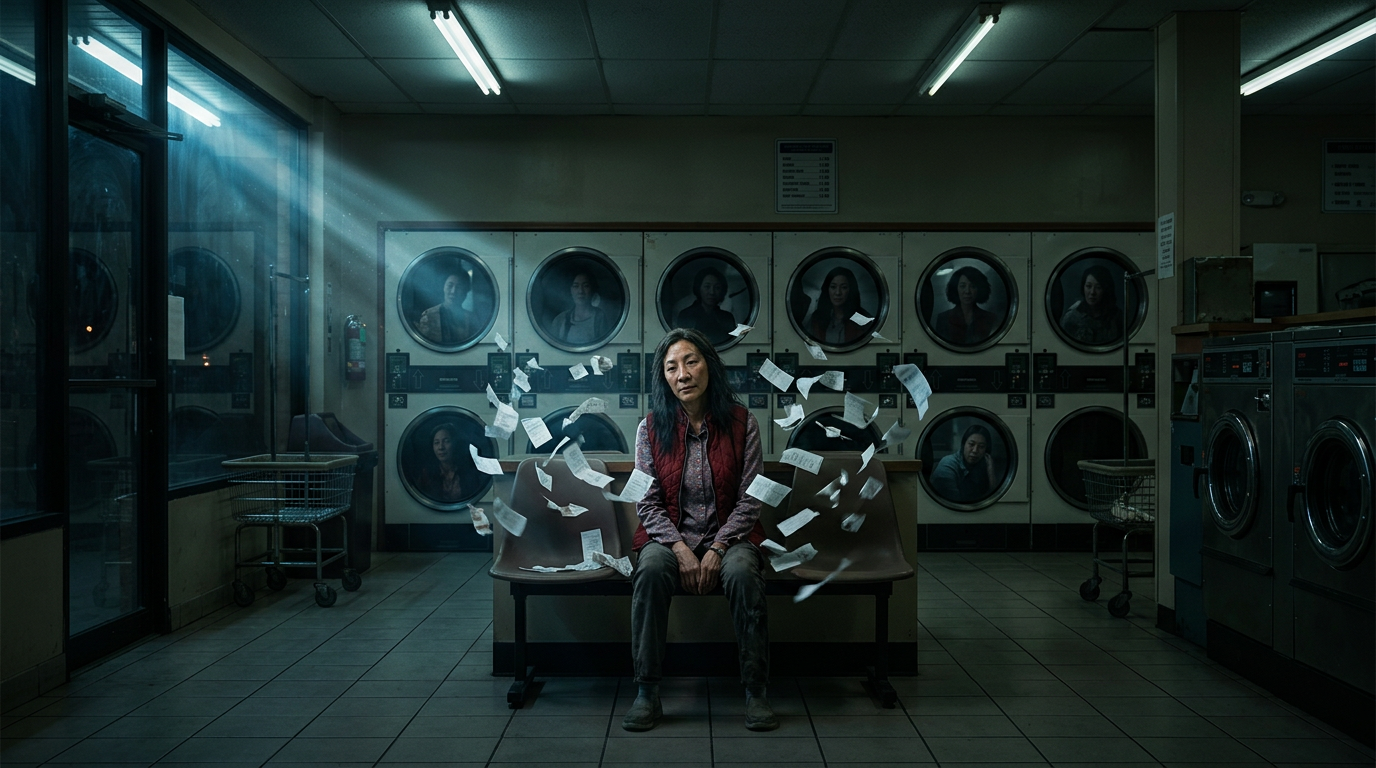
The multiverse works when it hurts
A woman sits in an IRS cubicle, surrounded by receipts, fluorescent light, and the particular despair of being asked to prove her life has been correctly itemized.
That is where Everything Everywhere All at Once becomes a great multiverse movie: not in the portals, not in the martial-arts mayhem, not in the gleeful genre pileup, but in the decision to make infinity feel like paperwork. The Daniels — Daniel Kwan and Daniel Scheinert — understood something that too many franchise architects still miss. A multiverse is not automatically profound because it contains endless worlds. It becomes profound when every alternate life intensifies the one you are actually stuck living.
The film’s premise could have been a stunt. Evelyn Wang, played with volcanic precision by Michelle Yeoh, is a laundromat owner, wife, mother, daughter, immigrant, and tax-audit defendant. She is also, somehow, the least glamorous person in the cosmos and its most important variable. That contradiction gives the movie its charge. The cosmic scale does not inflate her life. It reveals it.
Why it matters now
By 2026, the multiverse has become less a concept than an industrial setting. It is where franchises go when death becomes inconvenient, when casting nostalgia needs an excuse, when continuity has grown too tangled to prune. Marvel’s multiverse cycle turned alternate realities into a form of brand management. Doctor Strange in the Multiverse of Madness has Sam Raimi’s fingerprints, but it still spends too much time servicing machinery larger than itself. Loki finds more poetry in bureaucracy, but even there, the metaphysics can feel like corporate filing cabinets with better production design.
That is why Everything Everywhere All at Once has aged so well. It arrived from A24 with the energy of a film made outside the franchise bloodstream, then somehow walked into the center of American movie culture. Its Oscar sweep was not merely a victory lap for an eccentric indie. It was a public admission that audiences were hungry for original sci-fi that did not require homework, a wiki, or fealty to a release calendar.
The 2026 viewing landscape is crowded with ambitious speculative work: Apple TV+ keeps betting on glossy intellectual sci-fi with Severance, Silo, and Foundation; Netflix turns global hard sci-fi into event television with 3 Body Problem; Max and Amazon MGM keep mining genre for prestige; theaters are rediscovering the value of large-format spectacle after Dune: Part Two and the continuing cult of IMAX 70mm. In that context, the Daniels’ film remains a useful corrective. It proves that scale is not the same thing as size.
The multiverse as choreography, not lore
!A fluorescent office cubicle fractured by impossible parallel reflections
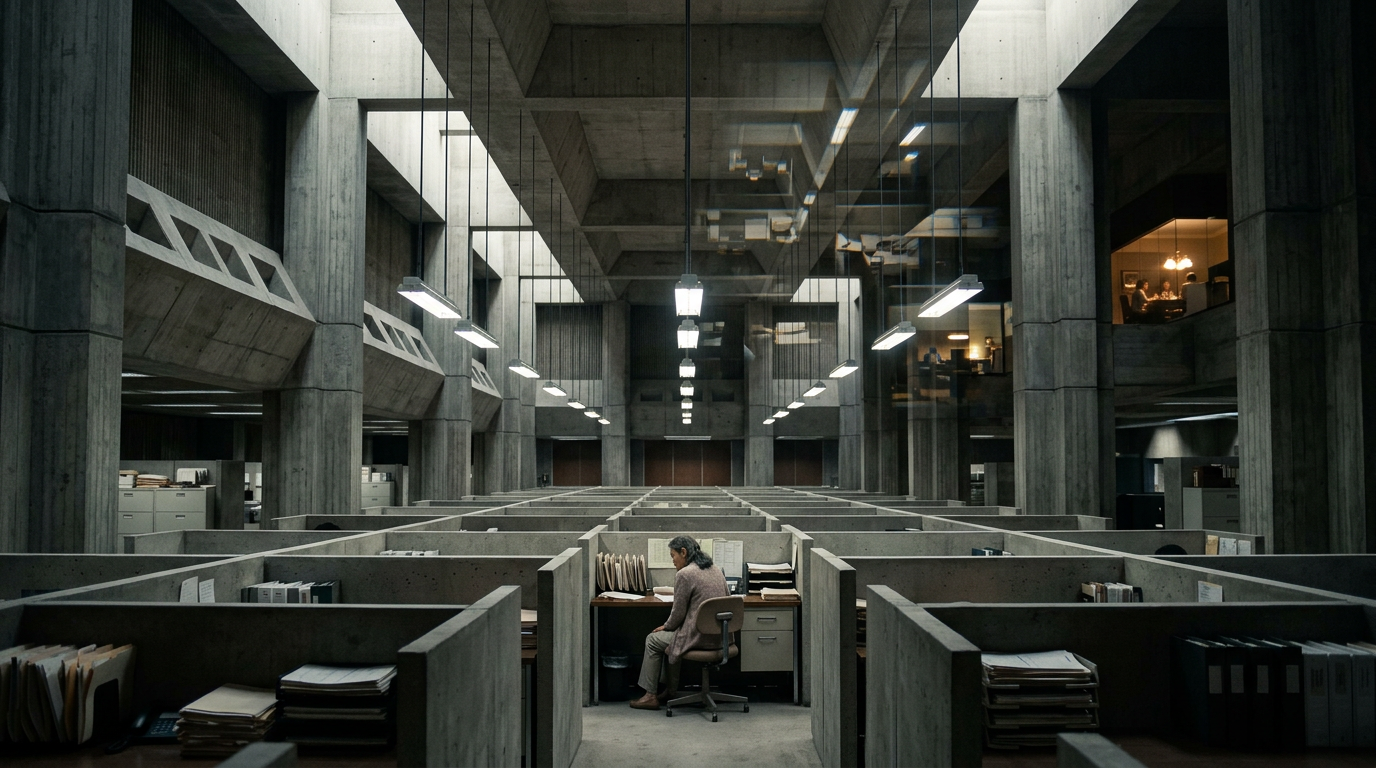
The movie’s smartest formal choice is that it treats the multiverse as editing, performance, and blocking before it treats it as world-building. The rules matter, but only enough to create momentum. This is soft sci-fi with excellent instincts. It is not asking you to admire a technical diagram. It is asking you to feel how quickly a life can splinter under pressure.
Verse-jumping is staged like slapstick, kung fu, panic attack, and channel surfing all at once. The cutting is aggressive but legible. The mise-en-scène keeps returning to drab spaces — the laundromat, the tax office, the family apartment — so that absurdity has something solid to collide with. The film’s best gags work because the frame is often so plain. A trophy, a fanny pack, a desk, a receipt: ordinary objects become weapons, jokes, metaphors, sometimes all three before the cut lands.
This is where the Daniels separate themselves from weaker multiverse storytelling. They do not build worlds so viewers can catalog them. They build pressure. Every alternate Evelyn functions as a cinematic memory of a path not taken: action star, chef, opera-adjacent glamour figure, improbable evolutionary joke. The variants are not collectible figurines. They are accusations.
What it gets right
Michelle Yeoh’s performance is the film’s anchor and its secret structure. The movie uses her star text brilliantly. Her body carries decades of screen history — martial-arts discipline, romantic restraint, regal composure, comic timing — and then places all of that inside a woman who feels she has failed at nearly everything. When Evelyn fights, the choreography is thrilling. When she hesitates, it is better. Yeoh makes regret physical: the slumped shoulders, the suspicious stare, the quick defensive snap before vulnerability can get a word in.
Ke Huy Quan gives the film its moral rhythm as Waymond. His performance could have been reduced to sweetness, but it is sharper than that. He plays kindness as a practiced form of intelligence, not as innocence. Stephanie Hsu, as Joy, gives the movie its rawest current: fury, theatricality, exhaustion, and the terrifying clarity of someone who has already decided the universe has no stable meaning. James Hong makes generational authority feel both ridiculous and immovable. Jamie Lee Curtis turns an IRS auditor into a comic obstacle with surprising reserves of loneliness.
The film also understands tonal whiplash as a legitimate grammar. It can move from gross-out comedy to family melodrama to wuxia-inflected action because Evelyn’s life already feels like incompatible genres stacked on top of one another. The film is maximalist, but not random. Its chaos has emotional bookkeeping.
[SPOILERS AHEAD]
The bigger idea
!Two small rock-like figures sit on a barren ridge beneath a vast sky

The great joke of Everything Everywhere All at Once is that its cosmic void looks like an everything bagel. It is a gag worthy of a dorm-room dare, and somehow it works because the film commits to the emotional logic underneath it. Jobu Tupaki’s bagel is not just a meme object. It is nihilism made edible, circular, and stupid. The film knows despair can look ridiculous from the outside and still be deadly serious to the person trapped inside it.
Opposite the bagel is the googly eye: cheap, silly, asymmetrical, stuck onto the world by hand. The movie’s central visual argument is almost embarrassingly simple. One symbol collapses meaning into a black center. The other adds attention, play, and a tiny wobble of personality to whatever it touches. That is not subtle. It does not need to be.
The film’s best philosophical move is to reject the idea that infinite possibility makes the present meaningless. If anything, it makes attention more urgent. Evelyn sees the lives she did not live, the versions of herself who became more elegant, more powerful, more fulfilled. The temptation is obvious: if every path exists somewhere, why honor this one? The answer is not that this life is objectively superior. It is that this life contains the people who are still asking something of her.
There is a faint Ship of Theseus problem humming underneath the movie. If Evelyn can access the skills, memories, and emotional residues of countless alternate selves, where does one Evelyn end and another begin? The film answers not with metaphysics but with ethics. A self is not a sealed container. It is a pattern of choices made in relation to others. Evelyn becomes more herself by encountering all the selves she might have been and then returning, battered and clearer-eyed, to the daughter in front of her.
That is why the parking-lot confrontation lands. The multiverse does not climax as a puzzle solved. It climaxes as a mother deciding to stop using cosmic scale as an excuse to avoid a specific wound.
What it gets wrong / where it stumbles
The film’s excess is both its engine and its liability. The Daniels have a gift for finding pathos inside absurdity, but they also love a bit so much that they occasionally squeeze it past the point of comic oxygen. A few gags announce their cleverness before they earn their emotional keep. The movie’s meme fluency, so electric on first release, now has a slightly time-stamped texture in places. Not fatal. Noticeable.
There is also a case to be made that the final act overstates what the film has already made clear. The repeated declarations of kindness, attention, and chosen connection are moving, but the movie sometimes trusts dialogue less than it trusts its own images. The rocks in the silent landscape say more, with less strain, than several later speeches.
Jamie Lee Curtis’s Deirdre is another tricky element. The performance is committed and funny, and the film eventually grants her loneliness real shape. Still, the early grotesquerie flirts with caricature. The movie is generous in the long run, but not always in the first glance.
None of this breaks the film. If anything, the flaws are tied to its virtues. Everything Everywhere All at Once is messy because it believes mess is not a problem to be airbrushed away. It is the condition of being alive with other people.
Why it beats the franchise multiverse
The franchise multiverse usually promises consequence while quietly eroding it. A dead character can return as a variant. A beloved actor can step through a portal to applause. A timeline can be pruned, restored, rebooted, monetized. The result is often less wonder than insulation. Nothing fully ends, so nothing fully hurts.
The Daniels avoid that trap by refusing to make the alternate worlds more important than the emotional line running through them. There are no cameos functioning as applause buttons. No sacred canon. No sense that the film is pausing so the audience can recognize a corporate asset. Even when the movie is at its most frantic, the question remains painfully domestic: Can this family look at one another honestly before it is too late?
That puts it closer to The Matrix than to most comic-book multiverse stories. The Wachowskis used simulation, kung fu, cyberpunk design, and religious iconography to ask what reality demands once you know it can be manipulated. The Daniels ask a smaller, meaner question: if you could see every better version of your life, would you still come home for dinner?
It also shares DNA with Spider-Man: Into the Spider-Verse, still the other great modern proof that multiverse storytelling works when style and identity are fused. Miles Morales is not meaningful because he is one Spider-Man among many. He is meaningful because the existence of many Spider-people makes his own leap of faith more personal, not less.
What to watch next if you liked this
- Double-bill it with _Spider-Man: Into the Spider-Verse_ for the cleanest modern contrast in animated and live-action multiverse grammar. Both films use visual style as character psychology, not decoration.
- Pair it with _The Matrix_ if you want the philosophical-action lineage: reality as a system, bodies as arguments, and genre filmmaking with actual intellectual voltage.
- Watch _Arrival_ afterward for a quieter study of time, grief, and choice. Denis Villeneuve and Amy Adams work in a much cooler register, but the emotional question rhymes: what does knowledge cost when love is finite?
- Try _Eternal Sunshine of the Spotless Mind_ for another film about identity, regret, and the temptation to edit pain out of existence. Less cosmic, just as bruising.
- Queue _Severance_ on Apple TV+ if the IRS-office dread is what grabbed you. Its corporate panopticon is cleaner, colder, and more sinister, but it shares the sense that modern life fractures the self into job-friendly pieces.
- Read Jorge Luis Borges’ “The Garden of Forking Paths” for an essential literary ancestor to branching realities.
- Read Ted Chiang’s “Story of Your Life” after watching _Arrival_; it is one of the great modern works about language, time, and acceptance.
Final verdict
Everything Everywhere All at Once remains the rare multiverse film that does not confuse abundance with meaning. Its worlds are funny, tacky, kinetic, and sometimes overstuffed, but they are never just inventory. Every universe points back to Evelyn’s original problem: she has mistaken disappointment for final knowledge.
That is the film’s lasting sting. It does not say that love fixes the multiverse. It says that attention is a discipline, kindness is a tactic, and the life you did not choose can become an alibi for neglecting the one you did. In a genre increasingly used to keep intellectual property alive forever, the Daniels made a movie about the terrifying privilege of choosing one fragile, ordinary world and staying there.
Discussion (0)
Loading comments…