Bong Joon-ho keeps finding bodies in the machine
A Bong Joon-ho machine always wants a body.
Sometimes it is a body at the tail of a train, packed into industrial darkness and fed protein bricks. Sometimes it is a body bred for consumption, cute enough to make slaughter look obscene again. Sometimes it is Robert Pattinson’s body in Mickey 17, printed, damaged, killed, and printed again, as if labor itself had finally become a file format. Bong’s science fiction is not interested in the clean chrome optimism of progress. It is interested in the invoice.
That is what makes his genre work feel unusually sharp in 2026, when big-screen sci-fi is again split between spectacle and systems: Denis Villeneuve’s monumental Dune films, Apple TV+’s chilly architectures in Severance, Silo, and Foundation, Netflix’s globalized puzzle-box approach to 3 Body Problem, and the theatrical revival of original, director-branded genre cinema. Bong sits adjacent to all of it and somehow apart. His sci-fi is messier, funnier, more bodily. He does not ask whether humanity will survive technology. He asks who gets fed into it first.
Bong’s sci-fi is class warfare with better production design
Bong’s career is often described through class satire because Parasite made the label irresistible. But his science fiction got there earlier, and with more grotesque machinery. Snowpiercer remains his most blunt metaphor: a post-climate-collapse train where geography has been replaced by hierarchy. The poor are not merely excluded from luxury. They are physically attached to it, car by car, laboring and starving so the engine’s mythology can keep running.
The brilliance of Snowpiercer is not subtlety. It is motion. Bong turns mise-en-scène into social order: cramped grays and blacks in the tail section, then increasingly deranged bursts of color as the rebels move forward. The blocking is almost video-game clear, but the moral geometry keeps curdling. Every door promises revolution and reveals another compromise. The train is a set, a world, and a diagram of capitalism with frostbite.
Okja is softer on the surface and arguably more ruthless underneath. Its creature-feature premise lets Bong weaponize tenderness against corporate branding. The film understands something many modern satires miss: evil does not always announce itself with a black cape. Sometimes it arrives as wellness language, sustainability theater, and a CEO who has focus-grouped compassion into a costume. Tilda Swinton’s performance is broad because the culture she is parodying is broad. The horror is not that the corporation lies. It is that the lie is designed to feel emotionally nutritious.
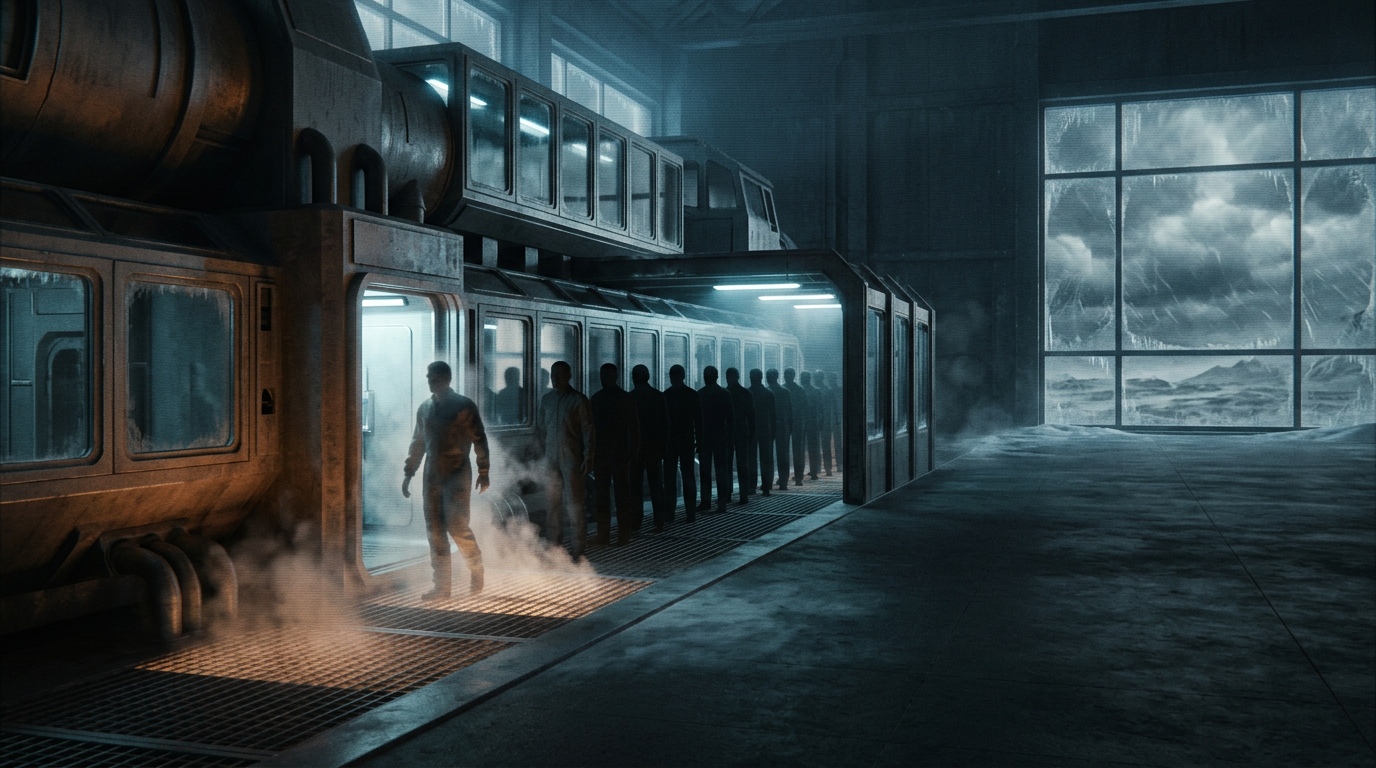
Then comes Mickey 17, Bong’s most explicit cloning film and his most literal expression of a recurring idea: under a brutal enough system, identity becomes another consumable resource. Pattinson’s Mickey is an “expendable,” a worker whose body can be regenerated after death to perform lethal tasks on a frozen colony world. Bong does not treat that premise as sleek hard sci-fi. He treats it as workplace comedy with a body count.
Why it matters now
!Frozen cloning chamber with workers queued under industrial light

The timing is almost too neat. In the 2026 viewing landscape, cloning and replacement are no longer abstract genre toys. The entertainment business itself is openly anxious about synthetic performers, digital doubles, franchise recycling, and the strange afterlife of faces as licensable assets. Meanwhile, climate fiction has stopped feeling predictive. Heat, flood, migration, food systems, resource scarcity: Bong’s films do not need to point at the future with neon arrows. The future has moved into the apartment downstairs and is arguing through the floorboards.
That is why Bong’s sci-fi lands differently than the sleek, prestige-world-building mode currently favored by streamers. Apple TV+ can make institutional dread look architectural. Netflix can make apocalypse multinational. Warner Bros. can still sell the theatrical grandeur of a filmmaker’s scale. Bong, though, keeps dragging the frame back to the body: hungry, sweating, freezing, duplicated, exploited, digesting whatever the system gives it.
His films are not anti-technology in any simple sense. The train in Snowpiercer, the bioengineering in Okja, and the cloning in Mickey 17 are not cursed objects. They are tools captured by hierarchy. Bong’s recurring argument is less “science has gone too far” than “power got there first.”
That distinction matters. Bad sci-fi blames the gadget. Better sci-fi asks who owns it, who maintains it, who is harmed by it, and who gets to call the harm necessary.
[SPOILERS AHEAD]
What it gets right
Bong’s greatest strength as a sci-fi filmmaker is tonal violence. Not violence as gore, though he is comfortable with that. Violence as collision. He can cut from slapstick to despair without asking permission because his worlds are already absurd. The absurdity is the point.
In Mickey 17, Pattinson’s performance works because it refuses heroic polish. He plays Mickey with a bruised, nasal, almost apologetic uncertainty, a man who has been treated as replaceable for so long that even his survival feels like a clerical error. The cloning premise invites the Ship of Theseus question: if the body is reprinted and the memories are restored, is this still the same person? Bong is too much of a dramatist to leave the question in seminar-room air. He makes it practical. If a duplicate can suffer, can be frightened, can be used, the ethical dodge collapses.
That is the Bong move: turn the philosophical problem into a labor dispute.
Snowpiercer does something similar with climate catastrophe. Many climate films are paralyzed by scale; Bong compresses the world into a train and makes the abstraction walkable. The climate ticking clock is not a speech about emissions. It is a social arrangement that has mistaken endurance for justice. The engine survives, therefore the engine is good. The system continues, therefore the system is natural. That is capitalist realism with icicles.
Okja, meanwhile, remains one of the great modern films about the aesthetics of ethical consumption. The creature design is crucial: Okja is not a generic monster or a plush mascot. She is ungainly, tactile, believable. Bong’s use of digital effects works because the performance around her is physical and spatial. Actors lean against her, chase her, fear for her. The film makes the animal present enough that corporate abstraction feels like an act of erasure.
Across these films, Bong’s world-building is not lore-first. He does not drown us in manuals. He builds systems through behavior: who speaks, who eats, who cleans, who waits, who gets medical care, who is allowed to be sentimental. That is why his sci-fi ages well. The specifics may be heightened, but the social choreography stays recognizable.
What it gets wrong / where it stumbles
!A child reaches toward an animal shape behind slaughterhouse plastic
Bong’s bluntness is a gift until it becomes a reflex. His English-language films sometimes push villains past satire into carnival. Snowpiercer survives its grotesques because the entire train is a feverish political cartoon. Okja mostly earns its corporate grotesquerie because the marketing world really is that close to self-parody. Mickey 17 is wobblier. Its authoritarian showmanship and colony-politics buffoonery can feel less like observation than amplification.
There is a thin line between exposing stupidity in power and making power seem too stupid to be dangerous. Bong occasionally crosses it.
The sharper material is with Mickey himself, where the comedy is smaller and more pitiless: a man negotiating with versions of his own expendability. The film is at its best when it narrows its gaze to labor, embodiment, and the horror of being treated as a renewable supply. It is less convincing when it widens into political farce and trusts volume over precision.
This is not a fatal flaw. Bong’s unruliness is part of his signature. But compared with the diamond-cut control of Parasite or the haunted procedural grip of Memories of Murder, his sci-fi can sprawl. He likes too many textures to be elegant: pulp, slapstick, body horror, melodrama, creature empathy, anti-capitalist cartooning. The mess is alive. It is also, occasionally, just mess.
The bigger idea
Bong’s sci-fi is not about the future. It is about the present wearing a bad disguise.
The train, the super-pig, the clone printer: each is a fantasy mechanism that makes an existing moral arrangement impossible to ignore. Poor bodies become infrastructure. Animal bodies become product. Worker bodies become replaceable hardware. The climate crisis intensifies the pattern because scarcity gives hierarchy a new alibi. Someone always says the cruelty is necessary. Someone always benefits from being believed.
That is what separates Bong from many contemporary genre directors. He is not especially interested in transcendence. Christopher Nolan’s Interstellar reaches for cosmic awe and familial metaphysics. Villeneuve’s Blade Runner 2049 finds melancholy in artificial personhood and ruined grandeur. Alex Garland’s Ex Machina turns the uncanny valley into a chamber piece about manipulation. Bong keeps asking who is doing the dishes after the apocalypse.
His films are also skeptical of purity. Revolution in Snowpiercer is compromised. Activism in Okja is morally urgent and media-savvy, but not untouched by vanity. Survival in Mickey 17 is tangled in self-interest, fear, sex, and bureaucracy. Bong does not give the oppressed saintly lighting. He gives them appetites, bad decisions, and punchlines. That is part of his humanism. He respects people enough to let them be ridiculous.
The climate ticking clock in his work is never only environmental. It is ethical. How long can a society keep calling sacrifice “efficiency” before the sacrificed start to look back?
Bong’s place in the sci-fi revival
The resurgence of ambitious sci-fi has produced several dominant flavors. There is the monumental: Dune: Part Two in IMAX, all sand, prophecy, and political dread. There is the puzzle-box institutional: Severance, with its fluorescent panopticon and immaculate dread. There is the literary-apocalyptic: 3 Body Problem, importing cosmic terror and Dark Forest paranoia into streamer grammar. There is the boutique surreal: A24 and Neon nurturing genre-adjacent films that smuggle metaphysics into domestic rooms.
Bong’s lane is more democratic and more vulgar, in the best sense. He remembers that sci-fi is allowed to smell. His future spaces have kitchens, toilets, slaughterhouses, dormitories, trash, and bad food. His speculative premises do not float above class. They are bolted to it.
That may be why his genre films remain accessible without becoming simple. You do not need a lore wiki to understand Snowpiercer. You need to understand a locked door. You do not need a biotechnology degree to understand Okja. You need to understand a child losing a friend to a supply chain. You do not need to solve consciousness to understand Mickey 17. You need to ask whether a copy can be abused just because the original signed a contract.
What to watch next if you liked this
If Bong’s sci-fi has you in its grip, build a smart little viewing syllabus instead of letting an algorithm flatten the mood.
- Mickey 17 and Moon: two cloning-adjacent workplace nightmares, one anarchic and social, the other lonely and lunar.
- Snowpiercer and Children of Men: climate despair, class borders, and the politics of movement, with two very different ideas of hope.
- Okja and The Host: Bong’s creature cinema as family melodrama, ecological accusation, and slapstick panic.
- Parasite and High-Rise: architecture as class structure, from Seoul’s semi-basements to J.G. Ballard’s vertical savagery.
- Mickey 17 and Severance: bodies divided for work, selves partitioned for productivity, capitalism with a clean interface and dirty hands.
For reading, start with Edward Ashton’s Mickey7, the novel that inspired Mickey 17, then go to Jacques Lob, Benjamin Legrand, and Jean-Marc Rochette’s Le Transperceneige, the graphic work behind Snowpiercer. For a sharper climate-and-capital frame, Naomi Klein’s This Changes Everything pairs well with Bong’s suspicion that the crisis is not just atmospheric but structural. If you want the bleak little theoretical key to Snowpiercer, Mark Fisher’s Capitalist Realism will do the job in one sitting and leave a bruise.
The verdict
Bong Joon-ho’s sci-fi is not tidy prophecy. It is a pressure test. Put human beings inside a machine, call the machine civilization, then watch who gets crushed first.
Mickey 17 is not his cleanest film, and it sometimes mistakes loud caricature for sharper political comedy. But it extends one of the most coherent bodies of genre work in modern cinema: Snowpiercer on class under climate collapse, Okja on biotech and consumption, Mickey 17 on cloning and labor as disposability. Together they form a nasty, funny, deeply physical trilogy of systems that eat what they claim to protect.
Bong does not hate the future. He hates the old world’s habit of smuggling itself into every new invention. That is why his sci-fi still bites. The technology changes. The bill always finds the same people.
Discussion (0)
Loading comments…